


A wave stack is any stack over a common shot
or geophone gather in which the moveout is independent of time
Schultz and Claerbout (1978).
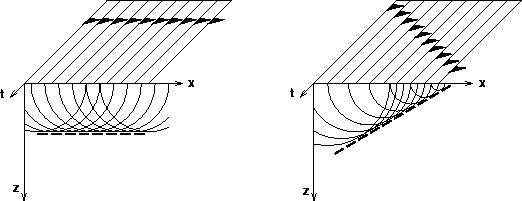
It synthesizes a particular wavefront of raw data
because Huygens' principle permits the synthesis
of arbitrarily-shaped downward propagating wavefronts
from the superposition of many spherical wavefronts.
In other words, a line-source can be simulated by firing
many smaller, closely-spaced point sources
simultaneously or sequentially (Figure ![[*]](http://sepwww.stanford.edu/latex2html/cross_ref_motif.gif) ).
Unlike the common midpoint stack,
wave stacks have the important property
of being the sampling of a wavefield and,
as such, permit the treatment of
formerly difficult or impossible problems
with the use of the wave equationSchultz and Claerbout (1978).
).
Unlike the common midpoint stack,
wave stacks have the important property
of being the sampling of a wavefield and,
as such, permit the treatment of
formerly difficult or impossible problems
with the use of the wave equationSchultz and Claerbout (1978).
 |

One of the most attractive features of the wave stack method is computational efficiency. Stacking along common geophone gathers significantly reduces the size of the data space to be migrated and produces a stacked section which has the same size as a common-offset section. Compared to shot profile migration, which requires the migration of all shot profiles to obtain a global picture of the subsurface image, the use of a wave stack reduces the size of the data space to be migrated by the order of the number of shots as common-offset migration dose.
Another advantage of the wave stack is that it provides a way to get an interpretable image in terms of angle-dependent reflection coefficients by controlling the incidence angle of the wavefront synthesized to a reflector.
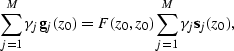
The wave stack can be formulated by means of the linear property
of the forward model operator, equation ().
Since the forward operator in equation ()
is independent of time, a linear combination of the
recorded trace can be expressed by the combination of source
functions as follows :
 |
(3) |
 is any complex value.
The
is any complex value.
The  is called a synthesis operator because it synthesizes
a wavefront by scaling the amplitude and shifting the phase
of each source function.
Therefore, we can control the wavefront
by adjusting appropriately.
Equation () can be simplified as
is called a synthesis operator because it synthesizes
a wavefront by scaling the amplitude and shifting the phase
of each source function.
Therefore, we can control the wavefront
by adjusting appropriately.
Equation () can be simplified as
 |
(4) |
 is called synthesized stack
and
is called synthesized stack
and  is the synthesis operator
because it is equal to if we assume
each shot is an impulse.
The following sections explain how to determine according to the shape of the wavefront at the surface and subsurface.
is the synthesis operator
because it is equal to if we assume
each shot is an impulse.
The following sections explain how to determine according to the shape of the wavefront at the surface and subsurface.