


In this section we examine the effect of layering on the inversion results.
Assuming that
the near seafloor sediments are underlain by a hard layer will result in
interference effects between the signals from the seafloor and the one
from the interface between the first and second layer. Using a hard layer
simulates the
extreme case of subsurface structure effects, and will thus produce upper
error bounds for the inverted ocean-bottom parameters.
We explore the effects for a layer which is
either 100 m or 50 m thick. The synthetics were generated using the same
parameters as described in the previous section.
The acoustic/elastic properties of the water and the two layers are shown in
Table 4.
| layer | vp2 (m/s) | vs2 (m/s) |  (kg/m3) (kg/m3) |
| water | 1500 | - | 1050 |
| 1 | 1693 | 437 | 1900 |
| 2 | 2141 | 781 | 2100 |
|
layer100
Figure 10 Vertical particle motion for a 100 m thick layer. | 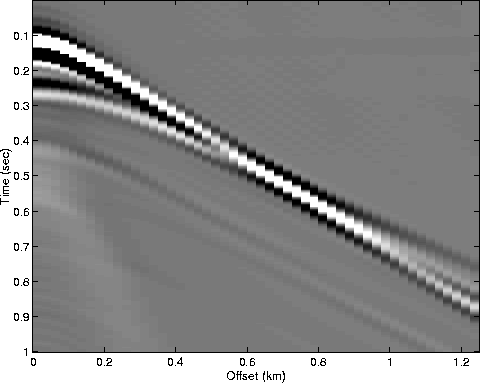 |

|
vxl100
Figure 11 Radial particle motion for a 100 m thick layer. | 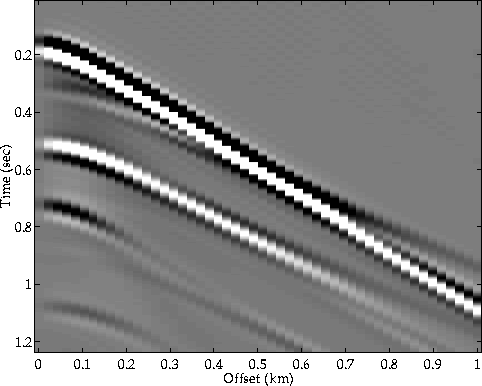 |
|
pl
Figure 12 Pressure for a 100 m thick layer. | 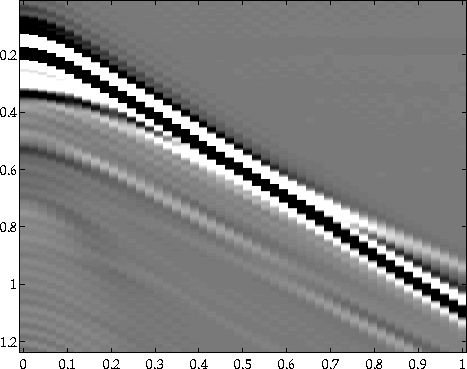 |
Figures 10, 11, and 12 show the synthetic seismograms for the vertical particle velocity, radial particle velocity and the pressure for the near sea-bottom layer being 100 m thick. In the case of a 50 m thick layer, the interference of the signals will appear at smaller offsets.
Prior to the inversion of the
data for the near seafloor parameters, the arrivals of the wave that is
being reflected off the second layer were muted out, leaving only the
signals generated by the seafloor (Figures 13, 14,
15).
Those signals were then transformed into the ( ) domain, in
which the reflection and AVO coefficients were determined.
) domain, in
which the reflection and AVO coefficients were determined.
|
vzl
Figure 13 Vertical particle motion for a 100 m thick layer after muting. | 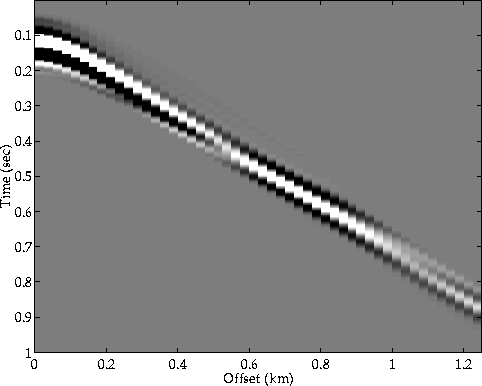 |
|
vxl100m
Figure 14 Radial particle velocity for a 100 m thick layer after muting. | 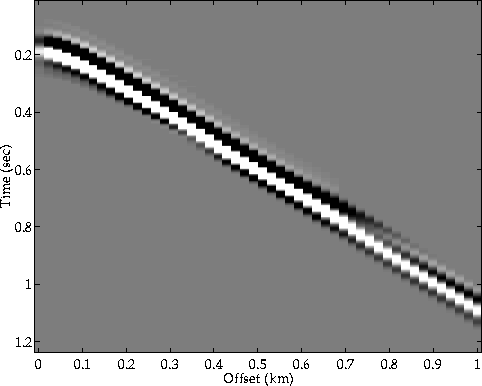 |
|
plm
Figure 15 Pressure for a 100 m thick layer after muting. | 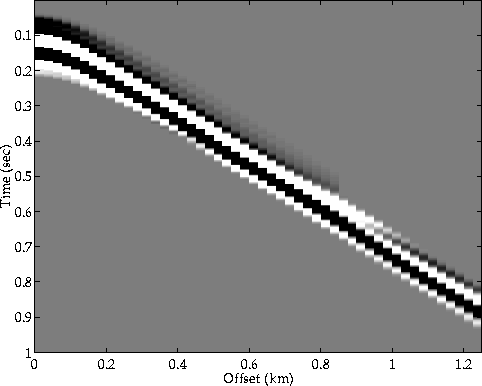 |