


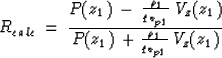
The near seafloor parameters can be determined through the reflection
coefficient at the fluid/solid interface.
Amundsen and Reitan 1995 have shown that the
reflection coefficient can be calculated by spectral division of the
pressure and vertical particle velocity of the direct wave and primary
reflection transformed to the frequency-radial wavenumber ( )domain. The data can be transformed to the () domain by
applying a Fourier transform with respect to time and a Hankel transform
of order 0 with respect to offset Amundsen (1993). The reflection
coefficient can then be expressed as:
)domain. The data can be transformed to the () domain by
applying a Fourier transform with respect to time and a Hankel transform
of order 0 with respect to offset Amundsen (1993). The reflection
coefficient can then be expressed as:
 |
(1) |
where  is the pressure component and
  is the vertical particle velocity component. Both of them are measured at the
seafloor, whose depth is given by z1.
The vertical slowness is given
by
is the vertical particle velocity component. Both of them are measured at the
seafloor, whose depth is given by z1.
The vertical slowness is given
by
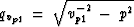 and p is the radial
slowness given as
and p is the radial
slowness given as  . The
angle of incidence is given by
. The
angle of incidence is given by  , and the horizontal wavenumber
by k.
Each combination of k and
, and the horizontal wavenumber
by k.
Each combination of k and  of the
transformed data corresponds to a specific slowness p.
of the
transformed data corresponds to a specific slowness p.
The density, P-wave, and S-wave velocity of the near seafloor can then be determined by inversion. This requires minimization of the difference between the calculated and theoretical reflection coefficient. The theoretical reflection coefficient for plane waves incident at a fluid/solid interface can be described as Berkhout (1987):
 |
(2) |
where
 and
and
 are shear coefficients,
 ,
, and
and
 are the vertical P- and S-wave slownesses in the fluid and solid, and
 is the horizontal slowness.