


Instead of using the pressure and vertical particle velocity component, the near seafloor properties can also be determined by using the vertical and radial particle velocity components. As before, this technique requires the transformation of the direct wave components into the frequency-radial wavenumber domain. The Hankel transform is used with n=0 for the vertical velocity component and n=1 for the radial component, yielding Vz and Vr.
Amundsen and Reitan Amundsen and Reitan (1994) have derived a
medium-dependent AVO
relationship between the two field components in the  domain
which can be used to estimate the P-wave and S-wave velocity of the
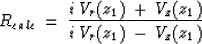
sediments. The ``AVO coefficient'' determined directly from the data
is given by:
domain
which can be used to estimate the P-wave and S-wave velocity of the
sediments. The ``AVO coefficient'' determined directly from the data
is given by:
 |
(3) |
where  is the radial particle velocity and
  is the vertical partcle velocity. As before, both of them are measured
at the seafloor. The depth of the seafloor is expressed by z1.
The theoretical ``AVO coefficient'' as derived by Amundsen and Reitan
Amundsen and Reitan (1994) satisfies the following relationship:
is the vertical partcle velocity. As before, both of them are measured
at the seafloor. The depth of the seafloor is expressed by z1.
The theoretical ``AVO coefficient'' as derived by Amundsen and Reitan
Amundsen and Reitan (1994) satisfies the following relationship:
 |
(4) |
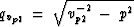
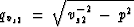
where  is again the radial slowness and qv<<99>>p2 and
qv<<100>>s2 are the P- and S-wave vertical slownesses given by
is again the radial slowness and qv<<99>>p2 and
qv<<100>>s2 are the P- and S-wave vertical slownesses given by
 and
and
 . When p=0 and
p=vp2-1 (at the critical angle), the AVO coefficient becomes
R=-1 and R=1, respectively.
. When p=0 and
p=vp2-1 (at the critical angle), the AVO coefficient becomes
R=-1 and R=1, respectively.
Given a combination of AVO coefficients for different radial slownesses, the P-wave and S-wave velocity can be estimated by minimizing the misfit between the theoretical coefficient and the calculated one. Notice that this AVO coefficient is not the same as the reflection coefficient described in the previous sections. While the pressure and vertical velocity data recorded at the seafloor yield a reflection coefficient which depends on density, P-wave, and S-wave velocity of the near seafloor sediments, the vertical and radial components measured at the seafloor yield an AVO relation which depends only on the P-wave and S-wave velocity of the sediments.