


The correct kinematics for layered models were predicted by the theory. An illustration of the raypaths for a single horizontal layer is shown in Figure 1. The cross-correlation picks out the times TQB-TPA and TPAB-TPA=TAB. These two times correspond to a `direct wave' traveling directly between the geophones with apparent slowness equal to that of the incoming wave, and the reflection received at B if there was a source at A.
The theory has not yet been extended to Earth models with lateral variations in velocity. It is important to establish if the conjecture still holds for v(x,z) models; and if it does not, then the limits of its applicability should be found and understood.
Incorporating a simple lateral velocity variation into Figure 1 gives Figure 2. Again the cross-correlation picks out two events. The velocity anomaly affects TPA and TPAB equally so the kinematics of the reflection event remain correct. However TQB is not effect by the velocity anomaly, so the kinematics of the `direct wave' are altered. Although this figure does not disprove the conjecture for a v(x,z) models, it does show that lateral variations may affect the direct wave but not the reflection event.
|
rays1
Figure 1 Ray paths for a single plane wave incident from below a horizontal layered model. Cross-correlation lag between events recorded at A and B corresponds to reflection event in conventional seismogram. | 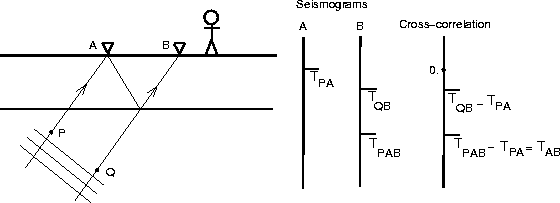 |

|
rays2
Figure 2 Ray paths for a single plane wave incident from below a model with lateral velocity anomaly. Time of reflection event is not affected by the anomaly, but the `direct wave' is. | 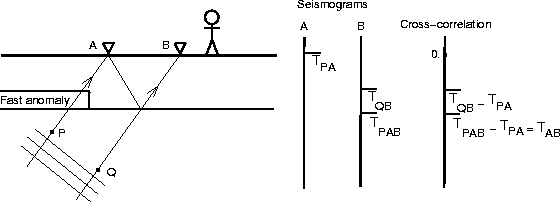 |
|
rays3
Figure 3 Ray paths for a single point source below a horizontal layered model. Time of reflection event is not affected by the location of the source, but the `direct wave' is. | 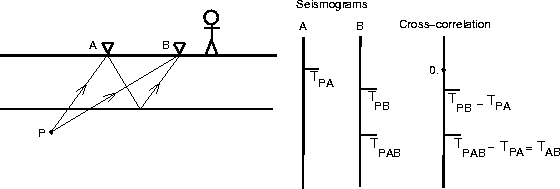 |