


Assume v is medium velocity,  is trace interval and
  is
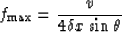
dip angle, the maximum threshold frequency that is not aliased is as follows
Yilmaz (1987):
is
dip angle, the maximum threshold frequency that is not aliased is as follows
Yilmaz (1987):
 |
(1) |
 |
(2) |
will increase.
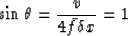
Since  , there is a critical frequency
 at which
 |
(3) |
 , the frequency slice contains information up to
 . In other words, the data is oversampled.
 , the frequency slice only contains information
 . Dip over
  will be
aliased. And is defined by
will be
aliased. And is defined by
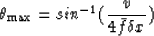
provides the feasibility of resampling the data in
the f-x domain without losing any information. Resampling means that
is no longer constant but a function of frequency, i.e.,
 . When and
  , equation
(2) can be transferred into
, equation
(2) can be transferred into
 |
(4) |
Figure 1 shows the RHS of equation (3) versus frequency.
The solid curve represents the frequency-independent grids.
The dash line represents the frequency-dependent grids.
From this figure, we can see that all the frequency lower than  have oversampled the data. Therefore, the next question is what is the
disadvantage of oversampling the data?
have oversampled the data. Therefore, the next question is what is the
disadvantage of oversampling the data?
|
sin-value
Figure 1  versus f. The solid curve represents the frequency-independent grids. The dash line represents the frequency-dependent grids. versus f. The solid curve represents the frequency-independent grids. The dash line represents the frequency-dependent grids.
|  |

Unless carefully constrained, an over-parameterized model may contain illegal components that will fit noisy data better than a better model which does not include high wavenumbers for low frequencies.
Spatial prediction filters become the same for all frequencies Nichols (1996). Since the prediction filter is independent of frequency, it will become more stable and more insensitive to the noise. Also, we do not need to estimate independent prediction filters for each frequency slice separately.
In any case, oversampling will not bring any profit to noise suppression. So
we will use , not  , when .
Figure 2 shows that when , is actually the
base of another pyramid. So we can regard the input data
, when .
Figure 2 shows that when , is actually the
base of another pyramid. So we can regard the input data  as
frequency- dependent grids directly.
as
frequency- dependent grids directly.
In other words, we can get a series of pyramids corresponding to the
frequency which is higher than . From each pyramid, we can estimate
a prediction filter. The difference between the first prediction filter (
 ) and the other () ,
is that we can apply the first prediction filter to all the frequencies which
are lower than .
Each of the remaining filters can only be applied to one frequency slice,
which is also the base of that pyramid.
) and the other () ,
is that we can apply the first prediction filter to all the frequencies which
are lower than .
Each of the remaining filters can only be applied to one frequency slice,
which is also the base of that pyramid.
 |
.
The basic and most important requirement for pyramid transform is that this transform is invertible. In other words, ``forward'' transform can turn a rectangular f-x domain to a pyramid domain and ``inverse'' transform can turn a pyramid domain back to a rectangular f-x domain, as shown in Figure 3.
 |
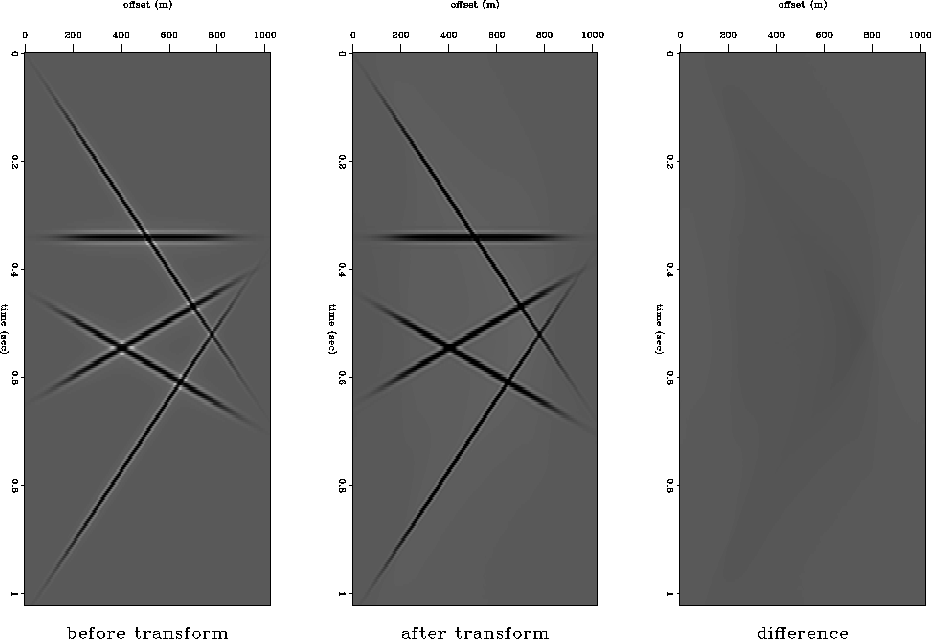
How do we guarantee this transform invertible? The key is to find a good complex-valued interpolation scheme. Here, we use Dave Hale's 8-point sinc interpolation program in SU. Some more accurate and complicated interpolation scheme can be found in Wade's paper 1988. Figure 4 is one example using 8-point sinc interpolation. The result shows that our scheme is very accurate. There is little difference between input and output.
 |


