


Dynamic ray tracing will provide us dynamic
information like amplitude and phase-shift, not only kinematic information
like raypaths and traveltimes. More specifically, we can estimate the
traveltime, amplitude, and phase-shift in the vicinity of the central ray.
In order to do this, we need to introduce another two coordinate systems, i.e.,
ray-centered coordinate system (q1, q2, q3) and ray parameter
coordinate system ( ,
,  ,
,  ).
).
The ray-centered coordinate system is a curvilinear orthogonal
coordinate system. Let us consider an arbitrarily selected ray  ,
which is specified by ray parameter , . The ray-centered
coordinates q1, q2, q3 connected with the ray are defined
in the following way: q3 corresponds to the traveltime along the ray
. q1 and q2 form a 2D orthogonal Cartesian coordinate system
in the plane perpendicular to , as shown in Figure 2.
,
which is specified by ray parameter , . The ray-centered
coordinates q1, q2, q3 connected with the ray are defined
in the following way: q3 corresponds to the traveltime along the ray
. q1 and q2 form a 2D orthogonal Cartesian coordinate system
in the plane perpendicular to , as shown in Figure 2.
|
ray-center
Figure 2 The ray-centered coordinate system. q3 is tangent to the raypath. q1 and q2 forms a plane perpendicular to q3. |  |

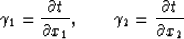
The physical meaning of the ray parameter coordinate system is very obvious.
and are two ray parameters in the x1 and x2
direction, which are constant along the whole ray and variable from one
ray to another. Their definitions are as follows
 |
(7) |
is chosen as q3. It increases monotonously along the ray.
Dynamic ray tracing system can be expressed as
 |
(8) |
where Q, P, V are  matrices.
![\begin{displaymath}
{\bf Q}=
\left[\begin{array}
{cc}
Q_{11} & Q_{12} \\ Q_{21...
...}
{cc}
V_{11} & V_{12} \\ V_{21} & V_{22} \end{array} \right]\end{displaymath}](img20.gif) |
(9) |
The definition of each component is
 |
(10) |
where  is the ray-centered coordinate.
 is the ray parameter associated with each ray.
 is the medium velocity.
Mathematically, Q and P can be interpreted as
transformation matrices:
Q is a transformation matrix from the ray parameters ,
to the ray-centered coordinate q1, q2, P is a
transformation matrix from the ray parameters , to the
slowness vector component in the ray-centered coordinate system.
Physically, matrix Q measures the derivations of paraxial rays from
ray and is also referred to as the matrix of geometrical spreading.
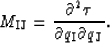
Matrix P has no obvious physical meaning. But we can define a
matrix M of second derivatives of the traveltime field
with respect to the ray-centered coordinate q1, q2 by the relationship
 |
(11) |
 |
(12) |
In order to fit the requirement of Runge-Kutta package, equation (8) is expressed as
![\begin{displaymath}
\frac{d}{d \tau}
\left[\begin{array}
{cc}
Q_{11} & P_{11} \...
...s {\partial^2 v \over \partial q_1^2}Q_{22} \end{array} \right]\end{displaymath}](img27.gif) |
(13) |
The initial condition is chosen as
![\begin{displaymath}
\left[\begin{array}
{cc}
Q_{11}^0 & P_{11}^0 \\ Q_{12}^0 &...
...}
{cc}
1 & 1 \\ 0 & 0 \\ 0 & 0 \\ 1 & 1 \end{array} \right]\end{displaymath}](img28.gif) |
(14) |
Here we set matrix  and
and  to be identity
matrix. The reason for choosing an identity matrix is to make sure that
to be identity
matrix. The reason for choosing an identity matrix is to make sure that
 is a symmetric matrix.
The paraxial ray tracing solution of the pressure field can be written as
 |
(15) |
Sub-index denotes a value taken at the source. C is a factor dependent upon the source, and is constant along the ray.