


Figures 3 and 4 contain this 2-D filter
![\begin{displaymath}
\left[
\begin{array}
{cc}
0 & -1/4 \\ 1 & -1/4 \\ -1/4 & -1/4
\end{array} \right]\end{displaymath}](img4.gif) |
(3) |
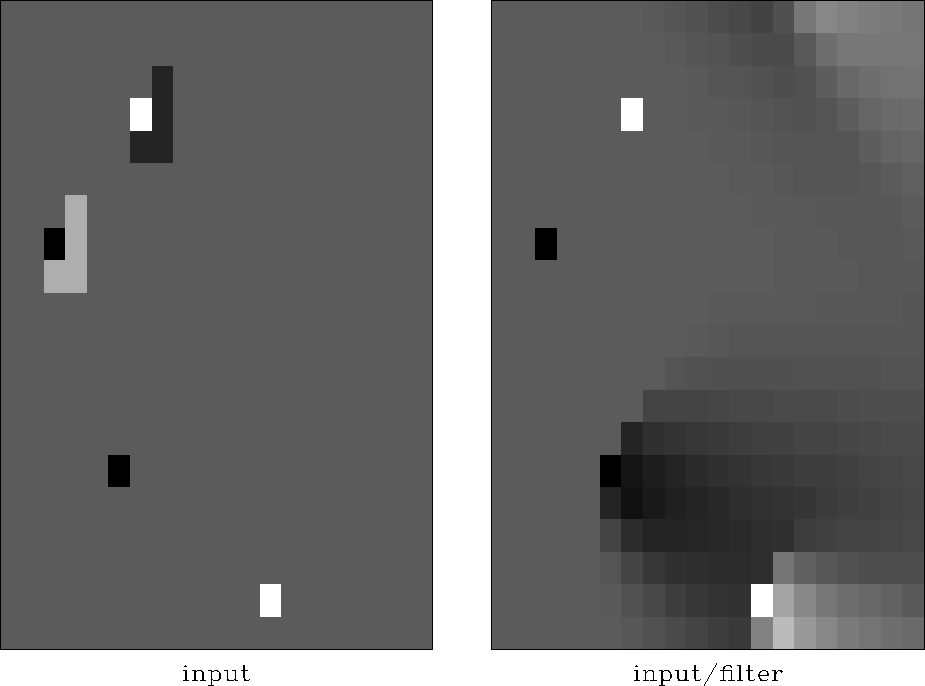 |


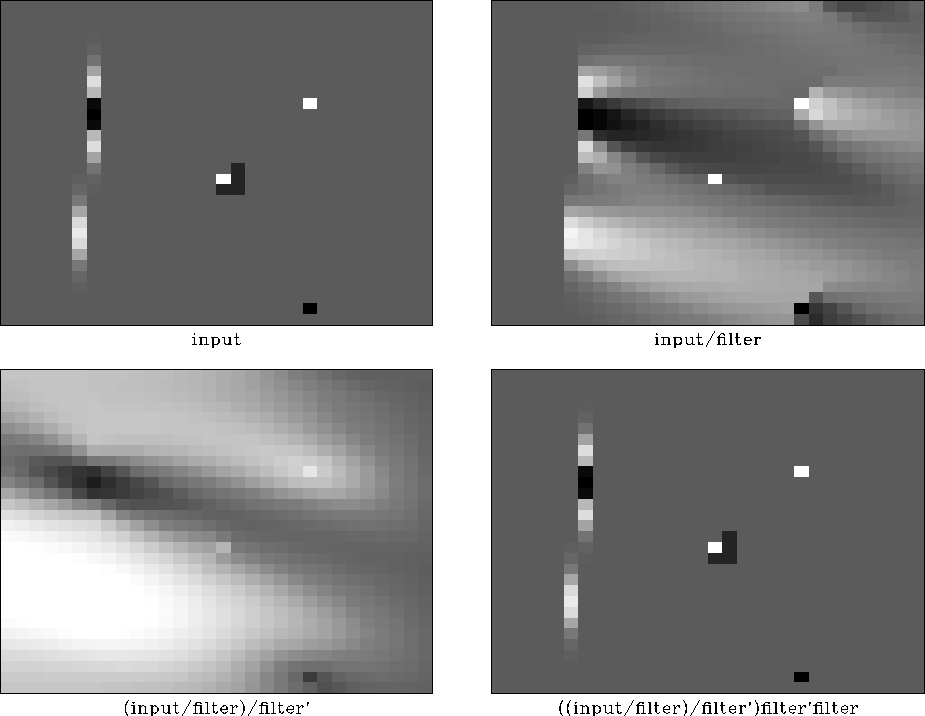
In Figure 4, many inputs are tested. Starting from the left are a low-pass blob, a Ricker wavelet, the filter (3) itself, and a couple impulses, one near the bottom boundary. The second frame shows deconvolution by the filter (3). The third frame compounds the second frame with an adjoint (reverse time) deconvolution. (Instead of blowing plumes to the right, it blows them to the left.) The fourth frame convolves the result with the original filter and its adjoint; and we see we are back where we started. No errors, no evidence remains of any of the boundaries where we have wrapped and truncated!
 |
I found myself with a powerful convolution/deconvolution program, but I did not have a bag full of 2-D filters. Further, I knew that a great number of filters are unstable for deconvolution. I recalled an ancient 1-D theorem that if the sum of the absolute values of the filter coefficients after the onset pulse is less than the pulse, then the filter is ``positive real,'' hence ``minimum phase,'' hence stable in polynomial division. Ironically, it is the ``almost unstable'' filters that hold the greatest interest, because they are the ones that move energy long distances. To make long impulse-responses of deconvolution, I chose all the adjustable filter coefficients to be negative and to sum to -1, as does (3). For damping, I took the absolute value of the sum to be a little less than 1.
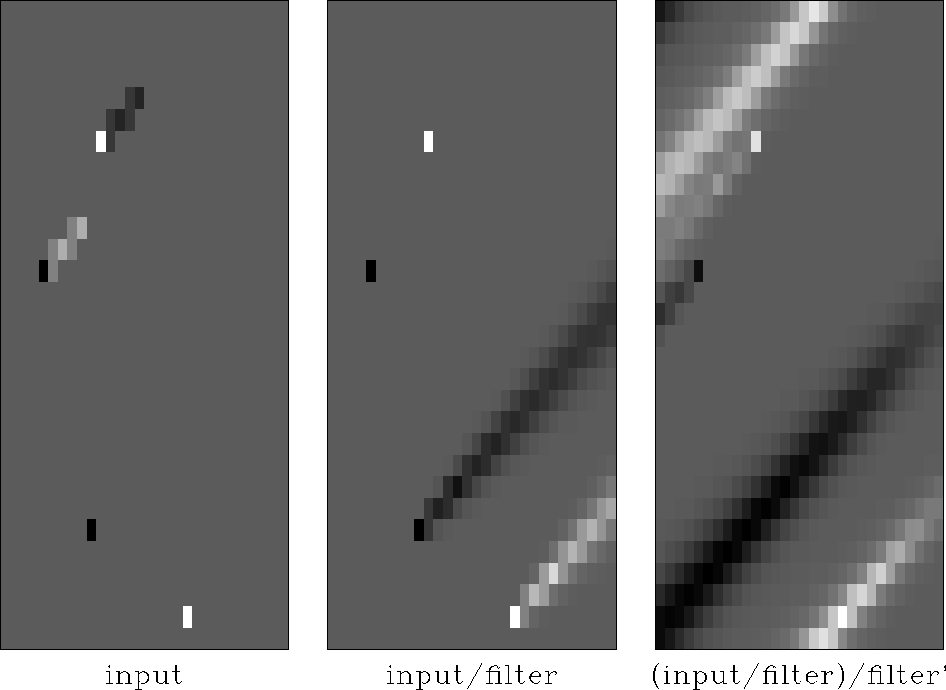
In seismology we often have occasion to steer summation along beams. Such an impulse response is shown in Figure 5.
 |
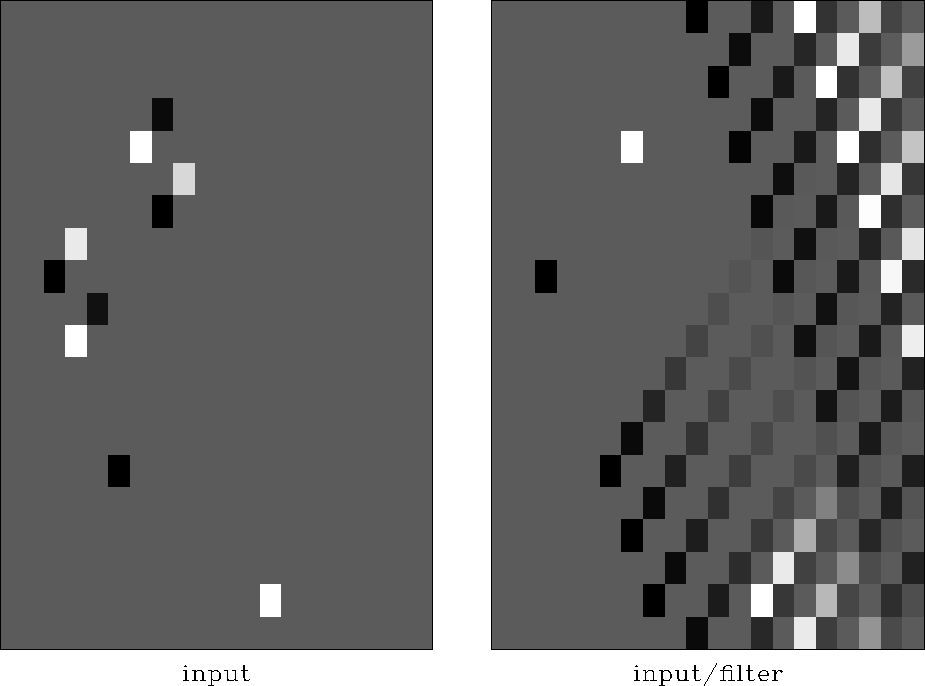
Finally, I have long had an interest in filters that would destroy plane waves. The inverse of such a filter creates plane waves. A filter that creates two plane waves is illustrated in figure 6.
 |