


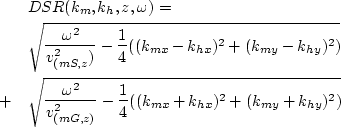
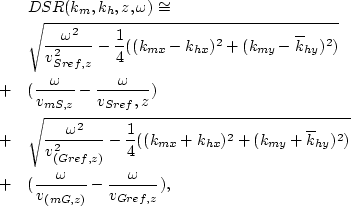
For the downward continuation of the wavefield, the DSR in the
 domain is chosen to be always real to avoid
the seismic evanescent energy. In the space the DSR operator is the following:
domain is chosen to be always real to avoid
the seismic evanescent energy. In the space the DSR operator is the following:
 |
||
| (32) |
 |
||
| (33) |
 is the
offset cross-line wavenumber, vmG,z and vmS,z are the velocity
fields for source and geophone midpoint-coordinates and vSref,z and
vGref,z are the set of the reference velocities for every depth.
is the
offset cross-line wavenumber, vmG,z and vmS,z are the velocity
fields for source and geophone midpoint-coordinates and vSref,z and
vGref,z are the set of the reference velocities for every depth.
The vertical wavenumber kz in a conventional downward continuation
is a real number (equation ![[*]](http://sepwww.stanford.edu/latex2html/cross_ref_motif.gif) ) avoiding the evanescent energy.
Therefore, in the 2-D prestack case, kz is calculated by setting
) avoiding the evanescent energy.
Therefore, in the 2-D prestack case, kz is calculated by setting
 . This condition
guarantees that kz is real, and it rejects the energy that corresponds
to imaginary kz or the evanescent energy domain. In the case of an
extended split-step migration, the evanescent energy is useful for interpolating two downward continued wavefields.
. This condition
guarantees that kz is real, and it rejects the energy that corresponds
to imaginary kz or the evanescent energy domain. In the case of an
extended split-step migration, the evanescent energy is useful for interpolating two downward continued wavefields.
Figure shows the values of kz for 10 different
reference velocities associated with receiver locations for the zeror-offset case. The outer curve corresponds to a low reference
velocity (1500m/s) and the inner curve corresponds to a high velocity (5000m/s).
The phase correction to downward continue the wavefield in one depth step is the
positive vertical wavenumbers kz multiplied
by the depth step. The negatives kz multiplied by a depth step represent
the argument of a damped exponential applied to the wavefield that is traveling with an angle sine greater than one.
Figure also shows that dips at a
higher reference velocity correspond to smaller dips at a lower reference
velocity, when kz is linear interpolated between two different reference
velocities.
In addition, Figure helps to define the evanescent energy nesccesary to image steep events. The kz values for the minimun velocity
define the the evanescent energy necessary for imaging steep events for a
depth z. Setting this new limit for the kz helps to save computer time.
In order to preserve very steep dips during the linear interpolation between
two downward continued wavefields, the
kz domain must be extended (Fig. ). Therefore, in
our extended split-step algorithm, instead of rejecting imaginary values of the 2-D DSR, we save and use those values
in the interpolation of downward continued wavefields.
Gazdag (1984) presented a different approach, where
evanescent energy is used in a phase-shift-plus-interpolation migration by
replacing the imaginary values of kz for values calculated using a
straight line tangent to a kz curve from a specific angle.
The 3-D prestack downward continuation operator in common-azimuth is based
on a stationary-phase approximation of the 3-D DSR (equation ). This approximation
reduces the dimensionality of the downward continuation operator from 5 to 4
dimensions, constraining the direction of propagation of source and receiver
rays to the same plane and azimuth, and calculating the cross-line-offset
wavenumbers () from the in-line (kmx) and cross-line CDP wavenumbers (kmy) and in-line offset wavenumbers (khx) ().