


The impulse response of the AMO operator in homegeneous media
is a skewed saddle.
The shape of the saddle depends on the offset
vector of the input data
 and on the offset vector of the desired output data
  , where the unit vectors
  and
and
 point respectively in the in-line direction and the cross-line
direction.
The time shift to be applied to the data is a function of
the difference vector
point respectively in the in-line direction and the cross-line
direction.
The time shift to be applied to the data is a function of
the difference vector  between the midpoint of the input trace and the
midpoint of the output trace.
The analytical expression of the AMO saddle,
is
between the midpoint of the input trace and the
midpoint of the output trace.
The analytical expression of the AMO saddle,
is
 |
(1) |
Figure 2 shows three AMO operators that correspond to three different azimuth correction angles in a homogeneous medium. From left to right, the azimuth corrections are 15, 30, and 45 degrees, respectively. The input and output offset were the same and equal to 2 km. Though the general shape of the AMO operator is practically the same between the three operators, the size is very much dependent on the amount of azimuth correction; the larger the azimuth correction the larger the AMO operator. Clearly, for zero azimuth correction the operator reduces to a point. The size dependence of the operator on azimuth holds regardless of the medium. The shape of the operator, however, is very much independent of azimuth correction.
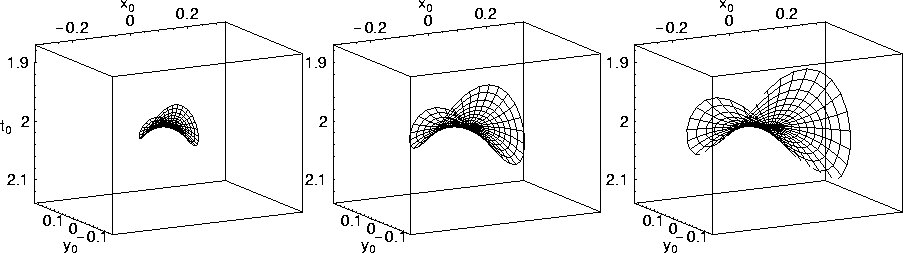 |

In Figure 2 and throughout, the contour curves plotted represent lines of equal ray parameter. It provides information on the distribution of dip angles, as well as on the distribution of energy along the operator; denser contour lines imply higher amplitude.