Next: Conclusions
Up: Alkhalifah: AMO in VTI
Previous: Residual AMO operators
Alkhalifah (1997a) extracted anisotropy parameters from field data from offshore Angola.
These parameters, when used to migrate the data, result in improved images of
the subsurface, including better fault reflection focusing. Since, the data set
corresponds to a 3-D marine survey, with some source-receiver azimuth variations in the original data,
the application of AMO might
improve the data. Using the inverted anisotropic parameters, I will generate AMO operators
applicable to this data set, and compare these operators with the conventional isotropic homogeneous-medium
operator.
veta
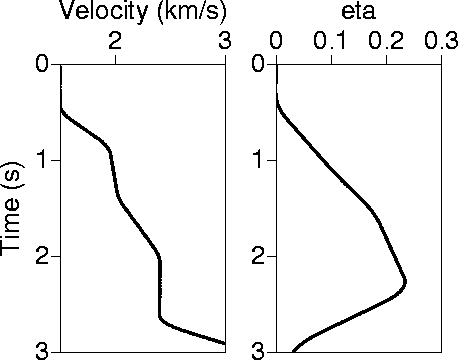
Figure 14 Curves of the interval NMO velocity and  extracted from the Angola data Alkhalifah (1997a).

Figure 14 shows the anisotropic parameters extracted from the Angola data set.
Clearly, the level of anisotropy in Angola, given by these parameters,
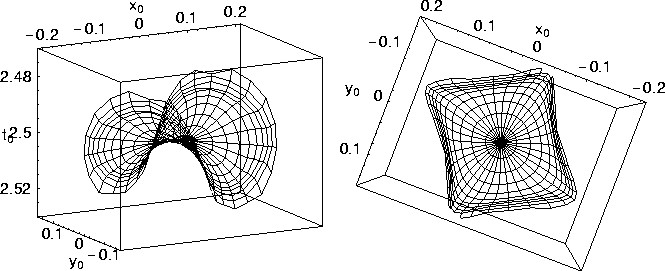
is strong. Figure 15 shows a side and a top view of the
AMO operator that resulted from the parameter in Figure 14,
corresponding to a correction only to azimuth of 30 degrees. The input NMO-corrected time for the
operator is 2.5 s. The operator, as expected from such a strong anisotropy,
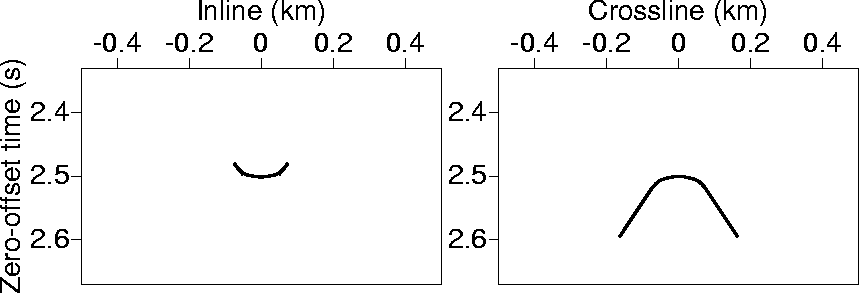
has triplications and has a somewhat complicated shape. Such triplications can be seen more clearly
in Figure 16, which shows the inline and crossline components of the operator in
Figure 15, separately. Most of the complications in the operator arise from the
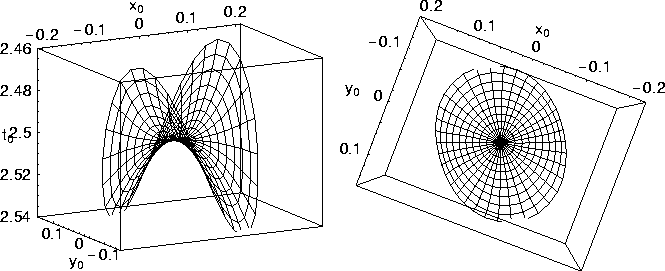
anisotropy in the medium, not the vertical inhomogeneity. As evidence, Figure 17 shows the 30-degree azimuth correction operator
corresponding to an isotropic v(z) medium, with velocity given by Figure 14 (left).
The operator, absent anisotropy,
looks very similar to the conventional operator for isotropic homogeneous media.
AMO2field
Figure 15 A side (left) and a top (right) view
of the AMO operator for a VTI vertically inhomogeneous medium for an input and output
offset of 2 km and correction to only the azimuth of 30 degrees. The medium is characterized by the velocity
and shown in Figure 14.
incrossanis30field
Figure 16 The inline and crossline components of the
AMO operator (or residual DMO) in Figure 15, but with a wider aperture which includes the
triplication. This operator, as previously stated, applies only an azimuth correction of 30 degrees.
AMO2fieldvz
Figure 17 A side (left) and a top (right) view
of the AMO operator for an isotropic vertically inhomogeneous medium for an input and output
offset of 2 km and correction to only the azimuth of 30 degrees. The medium is characterized by the velocity
curve shown in Figure 14.
Next: Conclusions
Up: Alkhalifah: AMO in VTI
Previous: Residual AMO operators
Stanford Exploration Project
8/21/1998