


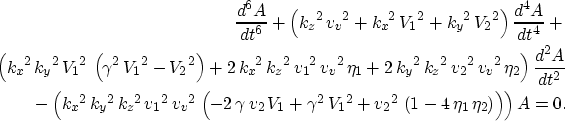
To solve equation (18), we use the plane wave,

 |
||
| (23) |
 |
(24) |
 |
||
 |
(25) |
 |
||
 |
(26) |
 |
||
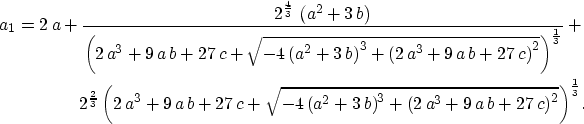
x3+a x2+b x+ c=0
with


Solution (25) reduces
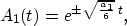
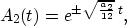
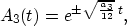
to the isotropic medium solution when  =0. Solutions (24) and (26) are additional waves
that reduces in the isotropic limit (
=0. Solutions (24) and (26) are additional waves
that reduces in the isotropic limit ( ,
,  , and
, and  )
to 1 and, with the proper initial
condition, its coefficient to zero. In other words, solutions (24) and (26) become
independent of time for
)
to 1 and, with the proper initial
condition, its coefficient to zero. In other words, solutions (24) and (26) become
independent of time for  . However, these waves will prove to be harmful in orthorhombic case.
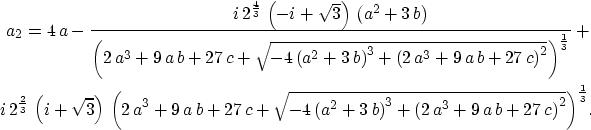
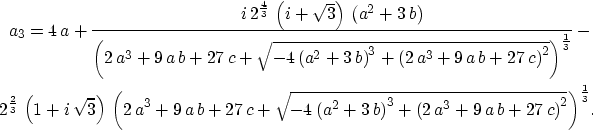
The main concern here is the sign of a1, a2 and a3. A negative sign will result in an imaginary exponential term which corresponds to wave propagation behavior. A positive sign will result in a real exponential that is either decaying or growing depending on the sign of the exponential term. Considering we have conjugate solutions, at least one the solutions will be growing exponentially and causing serious instability problems. I will leave the analysis of a1, a2, and a3 to a follow up paper.