


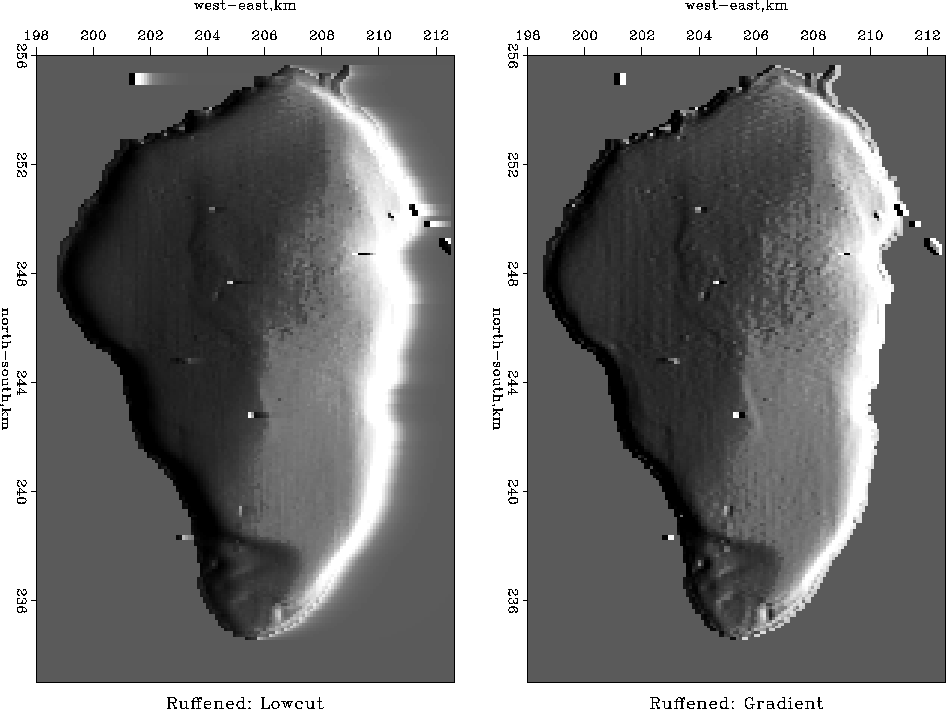
The simplest way to eliminate low frequency noise is to take a time derivative. A disadvantage is that the derivative changes the waveform from a pulse to a doublet (finite difference). Here we examine the most basic low-cut filter. It preserves the waveform at high frequencies; it has an adjustable parameter for choosing the bandwidth of the low cut; and it is causal (uses the past but not the future).
We make our causal lowcut filter (highpass filter) by two stages which can be done in either order.
 where numerically,
 is slightly less than unity.
adjusts
the cutoff frequency of the filter.
To learn the impulse response of the combined processes, we
need to convolve the finite difference (1,-1)
with the leaky integration
is slightly less than unity.
adjusts
the cutoff frequency of the filter.
To learn the impulse response of the combined processes, we
need to convolve the finite difference (1,-1)
with the leaky integration
 .The result is
minus
.The result is
minus
 .We can think of this as
 minus
minus
 .In other words the impulse response is an impulse
followed by the negative of a weak
.In other words the impulse response is an impulse
followed by the negative of a weak  decaying exponential
  .Roughly speaking, the cutoff frequency of the filter corresponds
to matching one wavelength to the exponential decay time.
.Roughly speaking, the cutoff frequency of the filter corresponds
to matching one wavelength to the exponential decay time.
Some exercise with Fourier transforms
or Z-transforms![[*]](http://sepwww.stanford.edu/latex2html/foot_motif.gif) ,
shows the
Fourier transform of this highpass filter filter
to be
,
shows the
Fourier transform of this highpass filter filter
to be
![\begin{displaymath}
H(Z) \eq {1-Z \over 1-\rho Z}
\eq
1
-(1-\rho) [
Z^1
+\rho Z^2
+\rho^2 Z^3
+\rho^3 Z^4
\cdots
]\end{displaymath}](img89.gif) |
(26) |
 and where
  is the frequency.
A symmetical (noncausal) lowcut filter would filter once forward
with H(Z) and once backwards (adjoint) with H(1/Z).
is the frequency.
A symmetical (noncausal) lowcut filter would filter once forward
with H(Z) and once backwards (adjoint) with H(1/Z).
Seismological data is more complex. A single ``measurement'' consists of an explosion and echo signals recorded at many locations. As before, a complete survey is a track (or tracks) of explosion locations. Thus, in seismology, data space is higher dimensional. Its most troublesome noise is not simply low frequency; it is low velocity. We will do more with multidimensional data in later chapters.
for which H is the most pleasing filter.
for which  is the most pleasing filter.
for which H applied to Galilee has minimum energy.
(Experiment with a range of about ten values around your favorite value.)
for which applied to Galilee has minimum energy.
is the most pleasing filter.
for which H applied to Galilee has minimum energy.
(Experiment with a range of about ten values around your favorite value.)
for which applied to Galilee has minimum energy.
 |
![[*]](http://sepwww.stanford.edu/latex2html/movie.gif)


