


For the operator approach to the fitting goal
 we rewrite it as
 where
where
![\begin{displaymath}
-\bold A_k \bold m_k
\quad \approx \quad
\left[
\begin{arra...
...
m_6
\end{array} \right]
\quad =\quad \bold A \bold J \bold m\end{displaymath}](img26.gif) |
(3) |
 ,called a masking matrix or a constraint-mask matrix
because it multiplies
constrained variables by zero
leaving freely adjustable variables untouched.
Experience shows that better name than ``mask matrix'' is
``selector matrix''
because what comes out of it,
that which is selected,
is a less-confusing name for it than which is rejected.
With a selector matrix the whole data space seems freely adjustable,
both the missing data values and known values.
We see that the CD method does not change the known (constrained) values.
In general, we derive
the fitting goal (3) by
,called a masking matrix or a constraint-mask matrix
because it multiplies
constrained variables by zero
leaving freely adjustable variables untouched.
Experience shows that better name than ``mask matrix'' is
``selector matrix''
because what comes out of it,
that which is selected,
is a less-confusing name for it than which is rejected.
With a selector matrix the whole data space seems freely adjustable,
both the missing data values and known values.
We see that the CD method does not change the known (constrained) values.
In general, we derive
the fitting goal (3) by
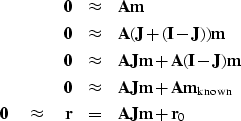 |
(4) | |
| (5) | ||
| (6) | ||
| (7) | ||
| (8) |
 by the gradient of the residual energy.
 |
(9) |
We begin the calculation with
the known data values where missing data values are replaced by zeros, namely
 .Filter this data,
getting
.Filter this data,
getting  ,and load it into the residual
  .With this initialization completed,
we begin an iteration loop.
First we pass the residual through the adjoint
.With this initialization completed,
we begin an iteration loop.
First we pass the residual through the adjoint
 |
(10) |
 applies a crosscorrelation of the filter to the residual
and then
applies a crosscorrelation of the filter to the residual
and then  sets to zero any changes proposed to known data values.
Next, compute the change in residual
sets to zero any changes proposed to known data values.
Next, compute the change in residual  from the proposed change in the data .
 |
(11) |
and ,and update  and
and  accordingly
and iterate.
accordingly
and iterate.
I could have passed a new operator  into the old solver,
but found it worthwhile to write a new,
more powerful solver having built-in constraints.
To introduce the masking operator into the solver
subroutine
into the old solver,
but found it worthwhile to write a new,
more powerful solver having built-in constraints.
To introduce the masking operator into the solver
subroutine ![[*]](http://sepwww.stanford.edu/latex2html/cross_ref_motif.gif) ,
I introduce an optional input parameter known,
which contains a logical array of the model size.
The values of known are .true. for the known data locations,
and .false. for the unknown data.
Two lines in the simple_solver module
,
I introduce an optional input parameter known,
which contains a logical array of the model size.
The values of known are .true. for the known data locations,
and .false. for the unknown data.
Two lines in the simple_solver module
stat = oper( T, F, g, rr)                          # dm = A' r
stat = oper( F, F, g, gg)                          # dr = A  dm
become three lines in the standard library module solver_mod.
(Here I changed the comment lines to
correspond to the notation of the missing-data application;
is g and
is gg.)
stat = oper( T, F, g, rr)                          # dm  = A' r
if ( present( known))  where(known)   g = 0.       # dm  = JJ' dm
stat = oper( F, F, g, gg)                          # dr =  A   dm
In Fortran77, I simply multiplied by .In Fortran90, subroutines can have optional arguments.
The expression
if( present( known)) says, ``if the argument
known, a logical array, is an argument of the call.''
The expression,
where( known) dm = 0 means that each component
of the logical array known is examined;
if the value of that component is .true. then
the corresponding component of is set to zero.
In other words, we are not going to change the given, known data values.
The subroutine to find missing data is mis1().
It assumes that zero values in the input data
correspond to missing data locations.
It uses our convolution operator
tcai1()
call tcai1_init( aa); zero = 0.
call solver (tcai1_lop,cgstep,mm, zero, niter,x0 =mm,known =(mm/=0.))
call cgstep_close ()
}
}
.
You can also check the Index for other
operators and modules.
module mis_mod {
use tcai1+cgstep_mod+solver_mod
contains
# fill in missing data on 1-axis by minimizing power out of a given filter.
subroutine mis1 ( niter, mm, aa) {
integer, intent (in) :: niter # number of iterations
real, dimension (:), pointer :: aa # roughening filter
real, dimension (:), intent (in out) :: mm # in - data with zeroes
# out - interpolated
real, dimension (size(mm) + size(aa)) :: zero # filter output
Here known is declared in solver_mod to be a logical vector.
The call argument known=(xx/=0.) sets the mask vector components
to .true. where components of  are nonzero and sets it
to .false. where the components are zero.
are nonzero and sets it
to .false. where the components are zero.
I sought reference material on conjugate gradients with constraints
and didn't find anything,
leaving me to fear that this chapter was in error
and that I had lost the magic property of convergence
in a finite number of iterations.
I tested the code and it did converge in a finite number of iterations.
The explanation is that these constraints are almost trivial.
We pretended we had extra variables, and computed a
for each of them.
Then we set the to zero,
hence making no changes to anything,
like as if we had never calculated the extra 's.
 .)
.)