


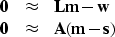
Let us consider theory to
construct a map  that fits dense seismic data
 and the well data
  .The first goal
 says that when we linearly interpolate from the map,
we should get the well data.
The second goal
says that when we linearly interpolate from the map,
we should get the well data.
The second goal
 (where
  is a roughening operator like
  or
or  )says that the map should match the seismic data at high frequencies but need not do so at low frequencies.
 |
(17) |
Although (17) is the way I originally formulated the well-fitting problem, I abandoned it for several reasons: First, the map had ample pixel resolution compared to other sources of error, so I switched from linear interpolation to binning. Once I was using binning, I had available the simpler empty-bin approaches. These have the further advantage that it is not necessary to experiment with the relative weighting between the two goals in (17). A formulation like (17) is more likely to be helpful where we need to handle rapidly changing functions; where binning is inferior to linear interpolation, perhaps in reflection seismology where high resolution is meaningful.