


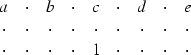
The filter below can be designed despite alternate missing traces. This filter destroys plane waves. If the plane wave should happen to pass halfway between the ``d'' and the ``e'', those two points could interpolate the halfway point, at least for well-sampled temporal frequencies, and the time axis should always be well sampled. For example, d=e=-.5 would almost destroy the plane wave and it is an aliased planewave for its higher frequencies.
 |
(1) |
![[*]](http://sepwww.stanford.edu/latex2html/cross_ref_motif.gif) to find the filter (1),
if we set up the
lag table lag
appropriately.
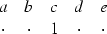
Then we could throw away alternate zeroed rows and columns (rescale the lag) to get the filter
to find the filter (1),
if we set up the
lag table lag
appropriately.
Then we could throw away alternate zeroed rows and columns (rescale the lag) to get the filter
 |
(2) |
,
to find the interleaved data
because both
the filters (1) and (2)
have the same dip characteristics.
Figure 1 shows three plane waves recorded on five channels and the interpolated data.
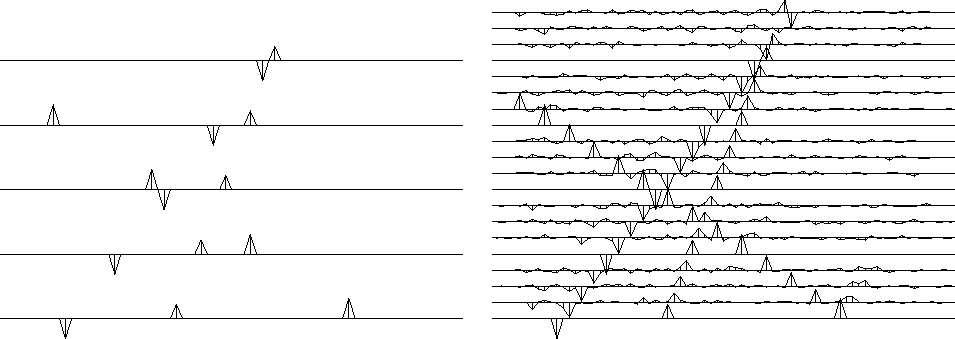 |


Both the original data and the interpolated data can be described
as ``beyond aliasing,'' because on the input data
the signal shifts exceed the signal duration.
The calculation requires only a few seconds
of a two-stage least-squares method, in which the first stage
estimates a PEF (inverse spectrum) of the known data,
and the second uses the PEF to estimate the missing traces.
Figure 1 comes from PVI
which introduces the clever method described above.
We will review how that was done and examine the F90 codes
that generalize it to N-dimensions.
Then we'll go on to more general methods
that allow missing data in any location.
Before the methods of this section
are applied to field data for migration,
data must be broken into many overlapping tiles
of size about like those shown here
and the results from each tile pieced together.
That is described later in chapter .
A PEF is like a differential equation.
The more plane-wave solutions you expect,
the more lags you need on the data.
Returning to Figure 1,
the filter must cover four traces (or more)
to enable it to predict three plane waves.
In this case,
na=(9,4).
As usual, the spike on the 2-D PEF is at
center=(5,1).
We see the filter is expanded by a factor of
jump=4.
The data size is
nd=(75,5)
and gap=0.
Before looking at the code
lace
for estimating the PEF,
it might be helpful to recall the basic utilities
line2cart and
cart2line
for conversion between a multidimensional space and
the helix filter lag.
We need to sweep across the whole filter
and ``stretch'' its lags on the 1-axis.
We do not need to stretch its lags on the 2-axis
because the data has not yet been interlaced by zero traces.
module lace {                                     # find PEF on interlaced data
  use createhelixmod
  use bound
  use pef
  use cartesian
contains
  function lace_pef( dd, jump, nd, center, gap, na)  result( aa) {
    type( filter)                      :: aa
    integer,               intent( in) :: jump
    integer, dimension(:), intent( in) :: nd, center, gap, na
    real,    dimension(:), pointer     :: dd          # input data
    integer, dimension(:), pointer     :: savelags    # holding place
    integer, dimension( size( nd))     :: ii
    integer                            :: ih, nh, lag0, lag
    aa = createhelix( nd, center, gap, na);  nh = size( aa%lag)
    savelags => aa%lag;   allocate( aa%lag( nh))      # prepare interlaced helix
    call cart2line(  na, center, lag0)
    do ih = 1, nh {				 	# Sweep thru the filter.
       call line2cart( na, ih+lag0, ii)
       ii = ii - center;            ii(1) = ii(1)*jump  # Interlace on 1-axis.
       call cart2line( nd,  ii+1, lag)
       aa%lag( ih) = lag - 1
       }
    call boundn( nd, nd, (/ na(1)*jump, na(2:) /), aa)  # Define  aa.mis
    call find_pef( dd, aa, nh*2)                        # Estimate aa coefs
    deallocate( aa%lag);   aa%lag => savelags		# Restore filter lags
  }
}
The line ii(1)=ii(1)*jump means we interlace the 1-axis but not the 2-axis because the data has not yet been interlaced with zero traces. For a 3-D filter aa(na1,na2,na3), the somewhat obtuse expression (/na(1)*jump, na(2:)/) is a three component vector containing (na1*jump, na2, na3).
After the PEF has been found, we can get missing data in
the usual way with with module
mis2 .