


We can use the same technique to throw out fitting equations
from defective data that we use for missing data.
Recall the theory and discussion leading up to
Figure 4.
There we identified defective data by its lack
of continuity. We used the fitting equations
 where the weights wi were chosen
to be approximately the inverse
to the residual (yi+1 -2yi + yi-1) itself.
where the weights wi were chosen
to be approximately the inverse
to the residual (yi+1 -2yi + yi-1) itself.
Here we will first use the second derivative (Laplacian in 1-D) to throw out bad points, while we determine the PEF. Having the PEF, we use it to fill in the missing data.
module pefest { # Estimate a PEF avoiding zeros and bursty noise on input.
use quantile_mod
use helicon
use misinput
use pef
contains
subroutine pefest1( niter, yy, aa) {
integer, intent( in) :: niter
real, dimension( :), pointer :: yy
type( filter) :: aa
real, dimension( size( yy)) :: rr
real :: rbar
integer :: stat
call helicon_init( aa) # starting guess
stat = helicon_lop( .false., .false., yy, rr)
rbar = quantile( size( yy)/3, abs( rr)) # rbar=(r safe below rbar)
where( aa%mis) yy = 0.
call find_mask(( yy /= 0. .and. abs( rr) < 5 * rbar), aa)
call find_pef( yy, aa, niter)
}
}
#$=head1 NAME
#$
#$pefest - find prediction error filter, avoid bursty noise
#$
#$=head1 SYNOPSIS
#$
#$C<call pefest1(dd,aa,niter)>
#$
#$=head1 INPUT PARAMETERS
#$
#$=over 4
#$
#$=item dd - C<real(:)>
#$
#$ Input data
#$
#$=item niter - integer
#$
#$ Number of itterations
#$
#$=back
#$
#$=head1 OUTPUT PARAMETERS
#$
#$=over 4
#$
#$=item aa - type(filter)
#$
#$ output filter
#$
#$=back
#$
#$=head1 DESCRIPTION
#$
#$ Find prediction-error filter (helix magic) avoid bursts
#$
#$=head1 SEE ALSO
#$
#$L<npef>,L<hconest>,L<solver>,L<cgstep>,L<pef>
#$
#$=head1 LIBRARY
#$
#$B<geef90>
#$
#$=cut
#$
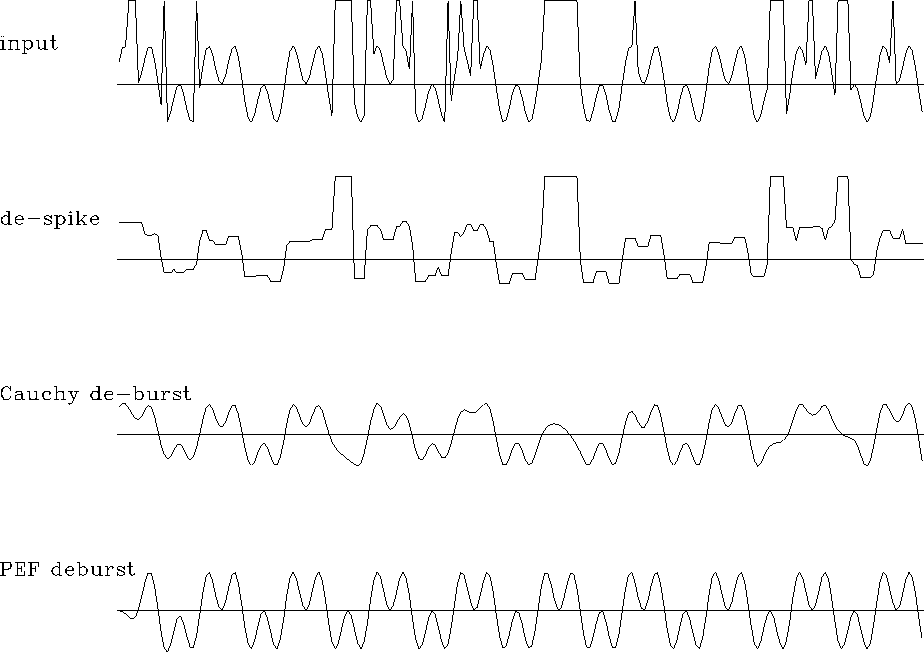
The result of this ``PEF-deburst'' processing is shown in Figure 6.
 |


Given the PEF that comes out of pefest1()![[*]](http://sepwww.stanford.edu/latex2html/foot_motif.gif) , subroutine
fixbad1() below convolves it with the data and looks for
anomalous large outputs. For each that is found, the input data is
declared defective and set to zero. Then subroutine mis1()
, subroutine
fixbad1() below convolves it with the data and looks for
anomalous large outputs. For each that is found, the input data is
declared defective and set to zero. Then subroutine mis1()
![[*]](http://sepwww.stanford.edu/latex2html/cross_ref_motif.gif) is invoked to replace the zeroed values by
reasonable ones.
is invoked to replace the zeroed values by
reasonable ones.
module fixbad { # Given a PEF, find bad data and restore it.
  use mis2
  use helicon
  use quantile_mod
contains
  subroutine fixbad1 (niter, aa, yy) {
    integer,       intent (in)	    :: niter
    type( filter), intent (in)      :: aa
    real,    dimension (:)	    :: yy
    real,    dimension (size (yy))  :: rr
    logical, dimension (size (yy))  :: known
    integer                         :: stat
    call helicon_init( aa)
    stat = helicon_lop (.false., .false., yy, rr); rr = abs (rr)
    known = ( yy > 0.) .and. ( rr < 4. * quantile( size(rr)/2, rr))
    call mis1 (niter, yy, aa, known, .true.)
 }
}