


Figure 7 shows a day's worth of data![[*]](http://sepwww.stanford.edu/latex2html/foot_motif.gif) collected at sea by SeaBeam,
an apparatus for measuring water depth both
directly under a ship, and somewhat off to the sides of the ship's track.
The data is measurements of depth h(x,y) at miscellaneous locations
in the (x,y)-plane.
collected at sea by SeaBeam,
an apparatus for measuring water depth both
directly under a ship, and somewhat off to the sides of the ship's track.
The data is measurements of depth h(x,y) at miscellaneous locations
in the (x,y)-plane.
|
seabin90
Figure 7 Depth of the ocean under ship tracks. | 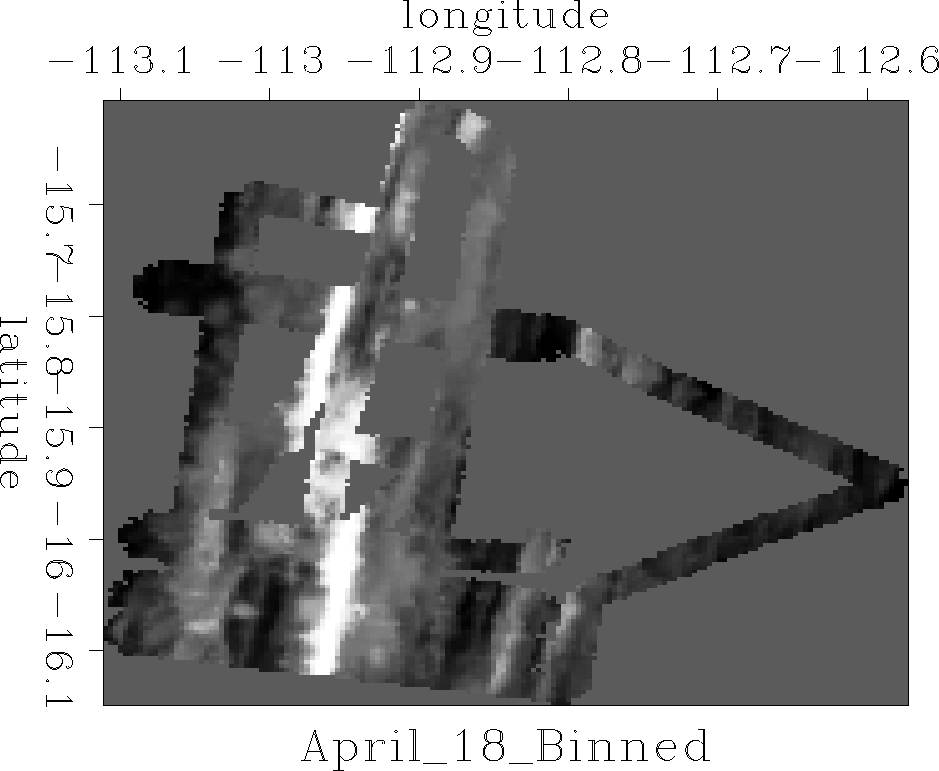 |


The locations are scattered about,
according to various aspects
of the ship's navigation and the geometry of the SeaBeam sonic antenna.
Figure 7 was made by
binning with bin2() ![[*]](http://sepwww.stanford.edu/latex2html/cross_ref_motif.gif) and equation ().
The spatial spectra of the noise in the data
could be estimated where tracks cross over themselves.
More interesting are the empty mesh locations where no data is recorded.
Here I left empty locations
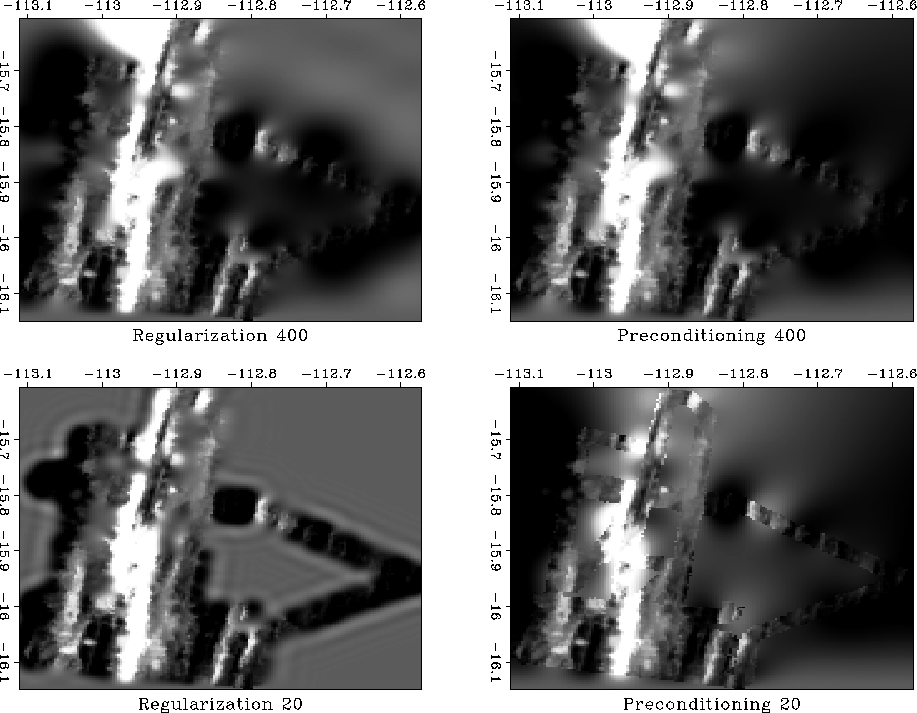
with a background value equal to the mean depth .Supposing the roughening operator to be the Laplacian operator and using module mis2
led to the result in Figure 8.
After many iterations, both regularization and preconditioning
lead us to the same result.
After a small number of iterations, we see that
regularization has filled the small holes
but it has not reached out far away from the known data.
With preconditioning, it is the opposite.
and equation ().
The spatial spectra of the noise in the data
could be estimated where tracks cross over themselves.
More interesting are the empty mesh locations where no data is recorded.
Here I left empty locations
with a background value equal to the mean depth .Supposing the roughening operator to be the Laplacian operator and using module mis2
led to the result in Figure 8.
After many iterations, both regularization and preconditioning
lead us to the same result.
After a small number of iterations, we see that
regularization has filled the small holes
but it has not reached out far away from the known data.
With preconditioning, it is the opposite.
 |
![[*]](http://sepwww.stanford.edu/latex2html/movie.gif)