


A seismic trace represents a signal d(t) recorded
at a constant location x. The normal moveout operator
transforms a trace into a ``vertical propagation'' signal,
 , by stretching t into
  Claerbout (1999).
For conventional PP seismic processing
the NMO transformation is generally described as a hyperbola.
For PS waves the traveltime moveout does not approximate a
hyperbola for large values of offset-to-depth ratio even for
an Earth's model consisting on horizontal layers embedded in a
constant P and S velocities.
Claerbout (1999).
For conventional PP seismic processing
the NMO transformation is generally described as a hyperbola.
For PS waves the traveltime moveout does not approximate a
hyperbola for large values of offset-to-depth ratio even for
an Earth's model consisting on horizontal layers embedded in a
constant P and S velocities.
One of the main characteristic of converted-wave data is their non-hyperbolic moveout in CMP gathers. However, for certain values of offset-to-depth ratio, it is possible to approximate the non-hyperbolic moveout in a CMP gather to a hyperbola Tessmer and Behle (1988).
Castle (1988) developed a non-hyperbolic moveout equation
for converted-wave data. This equation consists on three
coefficients instead of the two coefficients for the hyperbolic
equation. Castle's 1988 non-hyperbolic moveout equation
is a function of both the P-velocity and the S-velocity.
Next, I present an expression for the
non-hyperbolic moveout equation in terms of  .
.
Equation ![[*]](http://sepwww.stanford.edu/latex2html/cross_ref_motif.gif) is the third-order approximation for the
total traveltime function
of reflected PP or SS data presented by Taner and Koehler (1969):
is the third-order approximation for the
total traveltime function
of reflected PP or SS data presented by Taner and Koehler (1969):
| t2 = c1 + c2 x2 + c3 x4, | (1) |
 , and the third coefficient
 , where
 |
(2) |
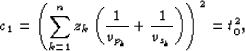
For the second order approximation of the total traveltime function, Tessmer and Behle (1988) show that the first coefficient, c1, is simplified as
 |
(3) |
 |
(4) |
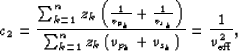
 . This simplification for the
second coefficient (c2) is
valid only for constant values of .
. This simplification for the
second coefficient (c2) is
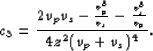
valid only for constant values of .The third coefficient, as presented by Castle (1988), is
 |
(5) |
simplifies to
![\begin{displaymath}
c_3 = \frac{z^2 \left [ (v_p+v_s)^2 - (\frac{1}{v_p} + \frac{1}{v_s})(v_p^3 + v_s^3) \right ]}{4 z^4 (v_p+v_s)^4},\end{displaymath}](img14.gif) |
(6) |
 |
(7) |
represents the simplification for the third coefficient (c3)
as a function of both the P-velocity and the S-velocity.
However, equation can be rewritten using the results of
equation and , that is,
 and
and
 .Remember, the velocity ratio is approximately constant in all layers.
With these assumptions, the new expression for the third coefficient (c3) in the total
traveltime function is
.Remember, the velocity ratio is approximately constant in all layers.
With these assumptions, the new expression for the third coefficient (c3) in the total
traveltime function is
 |
(8) |
|
nhterm
Figure 1 Non-hyperbolic term as a function of the offset-to-depth ratio. | 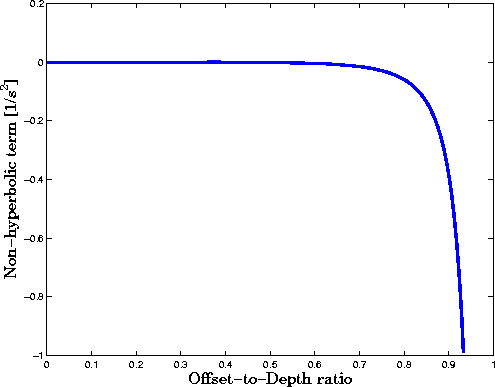 |


The coefficient c3 is the term in the total traveltime function that
controls the non-hyperbolicity characteristic for PS reflections.
Figure plots equation ,
as a function of the offset-to-depth ratio.
Notice that the non-hyperbolicity is primarily observed for
large values of the offset-to-depth ratio, this conclusion validates the assumption
of Tessmer and Behle (1988), that is the non-hyperbolic moveout can be approximated with
a hyperbola for small values of the offset-to-depth ratio. Also, note that the correction
is always negative and ignoring it will result in overestimates values for the velocities.
Substituting equations , and into
the total traveltime equation , I obtain the non-hyperbolic
moveout equation for PS data
![\begin{displaymath}
t^2 = t_0^2 + \frac{x^2}{v_{\rm eff}^2} + \frac{x^4}{t_0^2 v...
...)}{4 \left( \gamma^{1/2} + \gamma^{-1/2} \right ) ^4} \right ].\end{displaymath}](img19.gif) |
(9) |
depends only on two parameters: 1) the effective velocity ( ),
and 2) the P-to-S velocity ratio (). It is also important to note that this equation assumes a
constant value of in all layers.
For the non-physical case of vp=vs,
i.e. no converted waves,
equals 1, and equation () reduces to the conventional hyperbolic normal moveout
equation. This equation also assumes a single layer model.
),
and 2) the P-to-S velocity ratio (). It is also important to note that this equation assumes a
constant value of in all layers.
For the non-physical case of vp=vs,
i.e. no converted waves,
equals 1, and equation () reduces to the conventional hyperbolic normal moveout
equation. This equation also assumes a single layer model.
Figure shows the traveltime computed with
equation , with a constant P-velocity of 2 km/s, and S-velocity
of 0.6 km/s, a maximum absolute offset of 7 km, and four horizontal reflectors
at depths of 0.8, 1.5, 2.2, 2.9 km. The dotted curve represents non-hyperbolic
moveout, equation (), and the solid curve represents the hyperbolic
moveout equation, that is omitting the third term in equation ().
Observe that for deeper reflectors and small offset both curves match
reasonably well.
|
nhnmo
Figure 2 Non-hyperbolic traveltime comparison with the hyperbolic approximation. | 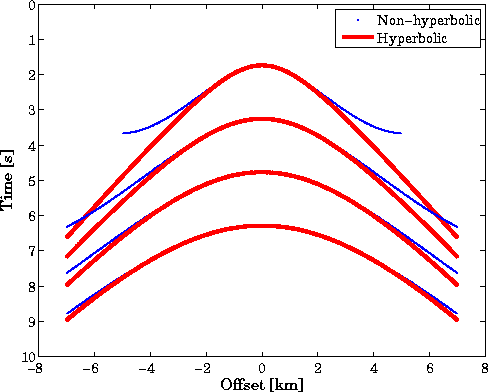 |