


The transformation to the angle domain of PS-SODCIGs follows an approach similar
to the 2-D isotropic single-mode (PP) method Sava and Fomel (2003).
Figure ![[*]](http://sepwww.stanford.edu/latex2html/cross_ref_motif.gif) describes the angles I use in this section.
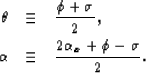
For the converted-mode case, I define
the following angles:
describes the angles I use in this section.
For the converted-mode case, I define
the following angles:
 |
||
| (31) |
In definition the angles  ,
,  , and
, and
 represent the incident, reflected, and geological dip angles, respectively.
This definition is consistent with the single-mode case;
notice that for the single-mode case
the angles and are the same. Therefore,
the angle
represent the incident, reflected, and geological dip angles, respectively.
This definition is consistent with the single-mode case;
notice that for the single-mode case
the angles and are the same. Therefore,
the angle  represents the reflection angle, and the
angle
represents the reflection angle, and the
angle  represents the geological dip Biondi and Symes (2004); Sava and Fomel (2003).
For the converted-mode case, the angles and are not the same.
Hence, the angle is the
half-aperture angle, and the angle is the pseudo-geological dip.
represents the geological dip Biondi and Symes (2004); Sava and Fomel (2003).
For the converted-mode case, the angles and are not the same.
Hence, the angle is the
half-aperture angle, and the angle is the pseudo-geological dip.
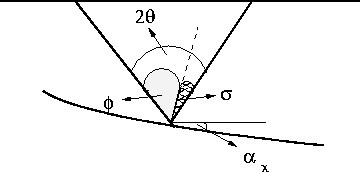 |
, , , represent
the half-aperture, the incident, the reflection,
and the geological dip angles, respectively.

Throughout this chapter, I present a relationship between the known quantities from
our image,  , and the half-aperture angle ().
Appendix A presents the full derivation of this relationship. Here, I present only
the final result, its explanation and its implications.
The final relationship to obtain converted-mode angle-domain common-image
gathers is the following (Appendix A):
, and the half-aperture angle ().
Appendix A presents the full derivation of this relationship. Here, I present only
the final result, its explanation and its implications.
The final relationship to obtain converted-mode angle-domain common-image
gathers is the following (Appendix A):
 |
(32) |
 |
||
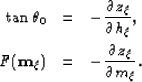
Equation consists of three main components. First  is the
P-to-S velocity ratio. Next,
is the
P-to-S velocity ratio. Next,  is the pseudo-opening angle.
This pseudo-opening angle is the
angle obtained throughout the conventional method to transform
SODCIGs into isotropic ADCIGs as described by Sava and Fomel (2003). Finally,
is the pseudo-opening angle.
This pseudo-opening angle is the
angle obtained throughout the conventional method to transform
SODCIGs into isotropic ADCIGs as described by Sava and Fomel (2003). Finally,
 is the field of local image-dips.
Equation describes the transformation from
the subsurface-offset domain
into the angle-domain for converted-wave data.
This equation is valid under the assumption of constant velocity. However, it
remains valid in a differential sense in an arbitrary velocity medium, by
considering that
is the field of local image-dips.
Equation describes the transformation from
the subsurface-offset domain
into the angle-domain for converted-wave data.
This equation is valid under the assumption of constant velocity. However, it
remains valid in a differential sense in an arbitrary velocity medium, by
considering that  is the subsurface half-offset. Therefore, the limitation of
constant velocity applies in the neighborhood of the image. For ,
it is important to consider that every point of the image
is related to a point on the velocity model with the same image coordinates.
Notice that for the non-physical case of vp = vs, i.e. no converted waves,
is the subsurface half-offset. Therefore, the limitation of
constant velocity applies in the neighborhood of the image. For ,
it is important to consider that every point of the image
is related to a point on the velocity model with the same image coordinates.
Notice that for the non-physical case of vp = vs, i.e. no converted waves,  ,and the angles and are the same.