


![[*]](http://sepwww.stanford.edu/latex2html/cross_ref_motif.gif) .
First, the adjoint solution with equation .
Second, the weighted adjoint solution with equations
and . I compare these two solutions with the
conventional method, that is NMO and stacking along the
crossline offset direction.
.
First, the adjoint solution with equation .
Second, the weighted adjoint solution with equations
and . I compare these two solutions with the
conventional method, that is NMO and stacking along the
crossline offset direction.
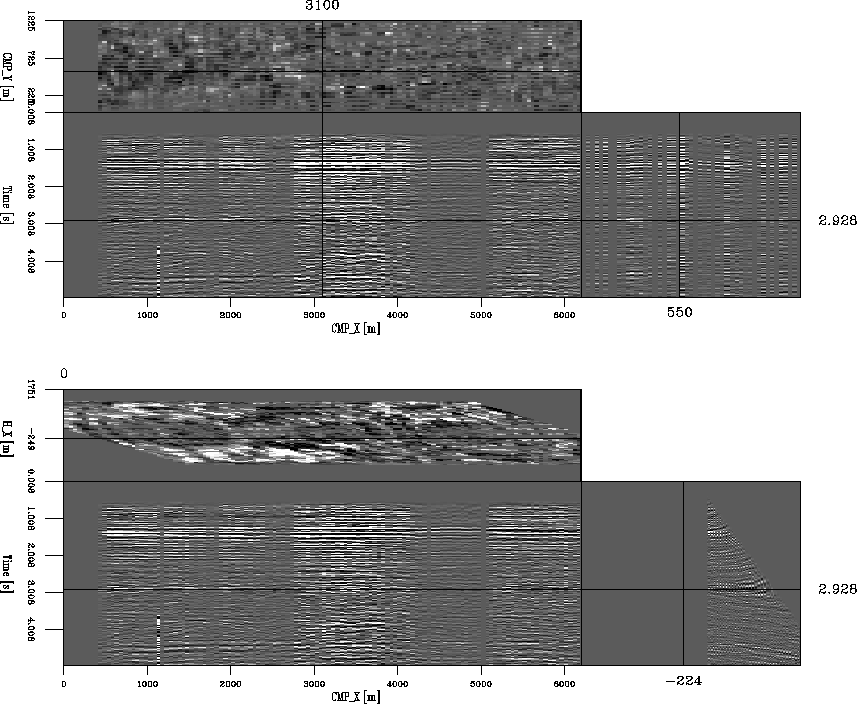
Figure presents the conventional
method result.
The top panel shows the inline-CMP and crossline-CMP sections
for a constant inline-offset=-224 m. The bottom panel
shows the result along the inline-CMP and the inline-offset
for a constant croosline-CMP=550 m.
 |
 and
and  sections for a
hx=-224 m. Bottom panel, and hx sections for =550 m. Traditional method result.
sections for a
hx=-224 m. Bottom panel, and hx sections for =550 m. Traditional method result.


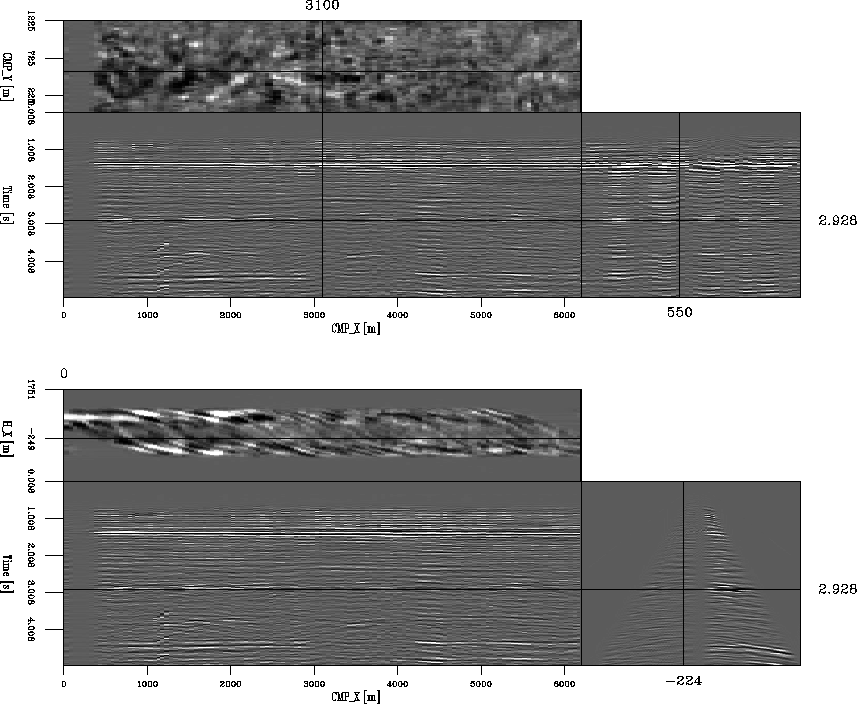
Figure presents the adjoint solution (equation ).
The panels displayed are the same as in Figure .
Notice that even after simple NMO plus stacking there are remaining holes in the
regularized 4-D cube. However, the adjoint solution gives improved results
really good results, since all the major acquisition gaps in the data are
filled up with the information from surrounding traces thanks to
the PS-AMO operator.
The sections at the top and
bottom panels on Figure
shows a successful interpolation. The crossline section
on the top panel (Figure ) shows not only
all the acquisition gaps filled up after the
data regularization but also a horizontal displacement
on the traces, this displacement corresponds to the
CMP to CCP spatial shift correction.
Also, note that the amplitudes of the adjoint
solution are uneven along the entire 4-D cube.
 |
and sections for a
hx=-224 m. Bottom panel, and hx sections for =550 m. Adjoint solution.
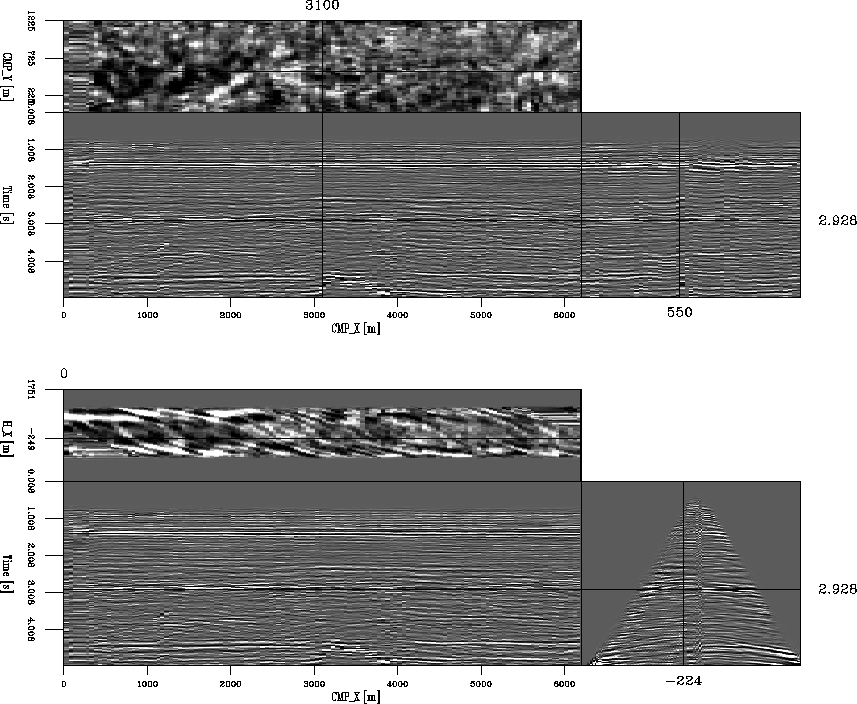
Figure displays the final result
for this chapter, that is the weighted adjoint result, where
I approximate the Hessian with a diagonal model-space
weighting function.
The figure shows the results as in the traditional method
result and the adjoint result. The energy is balanced along
the entire 4-D cube due to this approximation.
The normalized result on Figure
uses a reference model consisting on
a diagonal matrix of one's, and the epsilon value is
0.1. This epsilon value is an order magnitude smaller than
the corresponding data values. Therefore, I guarantee
that the normalized result is not contaminated with
artificial amplitude values. The weighted adjoint result
is twice more computer expensive than the adjoint result. This
raise in the cost makes the geometry regularization process approximately
half of the cost of the final migration.
 |
and sections for a
hx=-224 m. Bottom panel, and hx sections for =550 m.
Weighted adjoint solution.
The next chapter presents the final migration results for
this dataset. I compare two migration results, the first
image is using the a common-azimuth cube from the conventional
method result, Figure . The second
migration is using the common-azimuth cube of the
weighted adjoint solution, Figure .