


The 2-D PS-DMO operator in equations ![[*]](http://sepwww.stanford.edu/latex2html/cross_ref_motif.gif) and , from
Chapter 2, extend to 3-D
by replacing the offset and midpoint coordinates for the offset and
midpoint vectors respectively. This extension gives the 3-D expression for the
PS-DMO operator:
and , from
Chapter 2, extend to 3-D
by replacing the offset and midpoint coordinates for the offset and
midpoint vectors respectively. This extension gives the 3-D expression for the
PS-DMO operator:
 |
(87) |
where
 |
(88) |
 |
(89) |
and
![\begin{displaymath}
{\bf D}=\left[ 1 + \frac{4\gamma \Vert {\bf h}\Vert ^2}{v_p^...
...Vert {\bf h} \Vert^2}\right] \frac{1-\gamma}{1+\gamma} {\bf h}.\end{displaymath}](img180.gif) |
(90) |
Here,  is the midpoint position vector,
  is the offset
vector,
is the offset
vector,
 is the transformation vector responsible for the CMP to
CRP correction,
and
is the transformation vector responsible for the CMP to
CRP correction,
and  is the vp/vs ratio.
I use the 3-D PS-DMO operator to derive the PS-AMO operator.
Since the vectors and are collinear, and from substituing
equation into equation , we obtain the first of two time shifts
corresponding to the PS-AMO transformation:
 |
(91) |
where  corresponds to the intermediate
transformation to zero-offset.
The vector,
corresponds to the intermediate
transformation to zero-offset.
The vector,  , relates to the transformation
from CMP to CRP, which is an
intrinsic property of PS-DMO operator.
, relates to the transformation
from CMP to CRP, which is an
intrinsic property of PS-DMO operator.
The second time shift for the PS-AMO operator corresponds to the transformation from the intermediate zero-offset
position, , to the final trace position, is
 |
(92) |
where the vector ( ) corresponds to the transformation
from zero-offset to the final CMP position.
The transformation vectors, (
) corresponds to the transformation
from zero-offset to the final CMP position.
The transformation vectors, ( and
and  , both comes from equation
with the offset vector, , equals to the input offset and the output offset, respectively.
, both comes from equation
with the offset vector, , equals to the input offset and the output offset, respectively.
Finally, combining equations and I obtain
the expression for the PS-AMO operator:
 |
(93) |
Figure shows that and are parallel, as well as
 and . Therefore, we can rewrite equation as
 |
(94) |
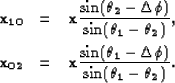
Both and can be expressed in terms of the
final midpoint position,
, by using the rule of sines in the triangle
(,,),
in Figure , as
 |
(95) | |
| (96) |
By introducing equations and into equation
and by replacing  and
and  for their definition on equation ,
I obtain the final expression for the PS-AMO operator, that is equation in
Chapter 4.
for their definition on equation ,
I obtain the final expression for the PS-AMO operator, that is equation in
Chapter 4.