


![[*]](http://sepwww.stanford.edu/latex2html/cross_ref_motif.gif) ,
allows us to predict what seismic reflection data would be recorded in an
experiment.
This allows us to solve the forward problem of seismic imaging: given
a reflectivity model,
,
allows us to predict what seismic reflection data would be recorded in an
experiment.
This allows us to solve the forward problem of seismic imaging: given
a reflectivity model,  , we can construct a forward
modeling operator,
, we can construct a forward
modeling operator,  , such that the predicted data,
 .
.
Unfortunately, in a geophysical experiment we record  , and
would like to find . This is the so-called inverse problem,
and is much more difficult to solve.
As discussed in the previous section, rather than actually trying to
invert the operator, , seismic migration amounts simply to
applying its adjoint,
, and
would like to find . This is the so-called inverse problem,
and is much more difficult to solve.
As discussed in the previous section, rather than actually trying to
invert the operator, , seismic migration amounts simply to
applying its adjoint,
 |
(79) |
Due to the symmetry of wave-propagation with respect to time-reversal,
it turns out that migrating with the adjoint operator treats event
kinematics correctly, and produces structurally correct images of the
subsurface. Adjoint processing is also robust to the presence of
noise, and missing or inconsistent data. However, the major
shortcoming of migrating with the adjoint is that it does not treat
seismic amplitudes correctly.
Also, because processing places the emphasis on kinematics not
amplitudes, amplitude terms are often completely ignored, or
artificially constructed so that  .
.
Interpreters, however, often try to extract more from seismic
reflection images than kinematics: for example, rock physics studies
show how important rock parameters such as porosity, lithology and
fluid saturations may influence seismic amplitudes.
The failure of migrating with the adjoint to correctly handle
amplitudes has lead to the search for ``true-amplitude'', or
``amplitude-preserving'' migration operators. Rather applying the
adjoint of a loosely-defined forward-modeling operator,
true-amplitude schemes rigorously formulate the forward-modeling
operator  , and then approximate
  with a pseudo-inverse
  .
For example, Bleistein (1987) describes a Kirchhoff operator
that becomes the inverse of the modeling operator in the
high-frequency asymptotic limit.
.
For example, Bleistein (1987) describes a Kirchhoff operator
that becomes the inverse of the modeling operator in the
high-frequency asymptotic limit.
If true-amplitude migration is the pseudo-inverse of the physically
correct forward-modeling operator, then its adjoint,  , is known as ``demigration''.
Demigration is receiving increasing attention as part
of amplitude-preserving processing flows Hubral et al. (1996).
Figure illustrates the relationships between forward
modeling, migration, true-amplitude migration and demigration.
Figure also shows the relationship these operators
have with what I refer to as ``industrial-strength'' migration - that
is the pseudo-unitary operator, which is kinematically correct, but
ignores the amplitude effects of wave-propagation in depth.
, is known as ``demigration''.
Demigration is receiving increasing attention as part
of amplitude-preserving processing flows Hubral et al. (1996).
Figure illustrates the relationships between forward
modeling, migration, true-amplitude migration and demigration.
Figure also shows the relationship these operators
have with what I refer to as ``industrial-strength'' migration - that
is the pseudo-unitary operator, which is kinematically correct, but
ignores the amplitude effects of wave-propagation in depth.
|
miginv4
Figure 2 Relationship between migration, modeling, their pseudo-inverses, and their (pseudo-unitary) industrial-strength counterparts. | 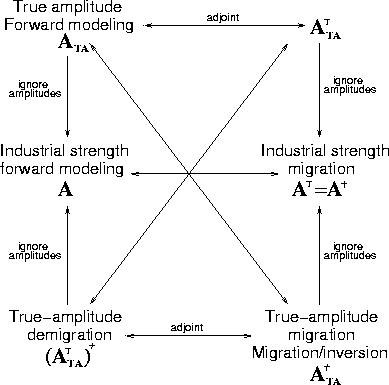 |

 |
![[*]](http://sepwww.stanford.edu/latex2html/movie.gif)


