


![[*]](http://sepwww.stanford.edu/latex2html/cross_ref_motif.gif) confirms this by displaying the
frequency-domain response of cascaded modeling and migration
(
confirms this by displaying the
frequency-domain response of cascaded modeling and migration
( ). Panel (a) shows the input
spectrum that has been band-passed and dip-limited to remove
evanescent energy. Panel (b)
shows the spectrum after exploding-reflector modeling and migration.
Although high-spatial wavenumbers are attenuated slightly, the
low-spatial wavenumbers associated with flat events remain
essentially unchanged.
Therefore, if a model consists of mostly flat-events,
exploding-reflector modeling acts as a pseudo-unitary operator:
). Panel (a) shows the input
spectrum that has been band-passed and dip-limited to remove
evanescent energy. Panel (b)
shows the spectrum after exploding-reflector modeling and migration.
Although high-spatial wavenumbers are attenuated slightly, the
low-spatial wavenumbers associated with flat events remain
essentially unchanged.
Therefore, if a model consists of mostly flat-events,
exploding-reflector modeling acts as a pseudo-unitary operator:
 .
.
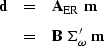
Equation () decomposes exploding-reflector modeling by
wavefield extrapolation into a spraying operator,
 , followed by an
extrapolation/recording operator,
, followed by an
extrapolation/recording operator,  , so that
 |
(80) | |
| (81) |
,
 .
For a model consisting of mostly flat-events, this implies
.
For a model consisting of mostly flat-events, this implies
 subject to a multiplicative
constant.
subject to a multiplicative
constant.
If the approximation that is
indeed valid, then amplitude problems on
zero-offset migrations must be associated with the two-way wave
propagation rather than the exploding-reflector migration.
To test the validity of this conjecture, I can generate
exploding-reflector and genuine zero-offset seismograms and compare
the results of exploding-reflector migration on the two datasets.
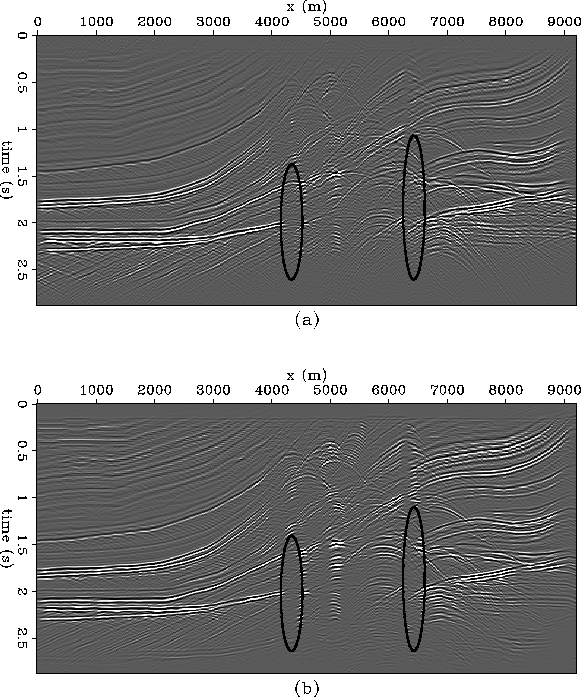
Figure compares exploding-reflector data with
true zero-offset data. I generated the two datasets by running the
adjoint of exploding-reflector and shot-profile downward continuation
migration algorithms respectively.
Kinematically they are similar; however, vertical amplitude streaking
is much more apparent in the true zero-offset section.
Field datasets, such as the stacked section shown in
Figure , often contain vertical amplitude
streaks. Such streaks often pose a dilemma for a processing
geophysicist as to how they should be correctly treated.
 |
![[*]](http://sepwww.stanford.edu/latex2html/movie.gif)


|
illumexamples
Figure 5 Stacked section from the Mobil AVO dataset Clapp (1999). Vertical streaking is visible throughout the section. | 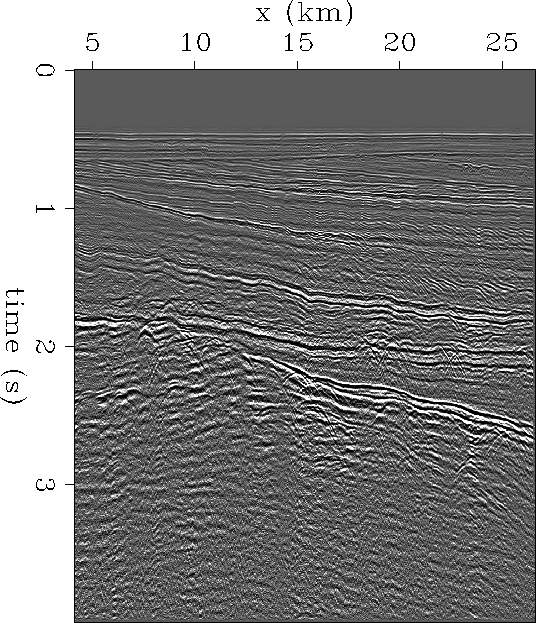 |
An even more interesting picture emerges when the two modeled datasets
are migrated (Figure ) with an exploding-reflector
migration algorithm. The exploding-reflector data migrates nearly
perfectly. Whereas the high amplitude streaks in the true zero-offset
dataset migrate into the commonly seen ``migration-smile'' artifacts.
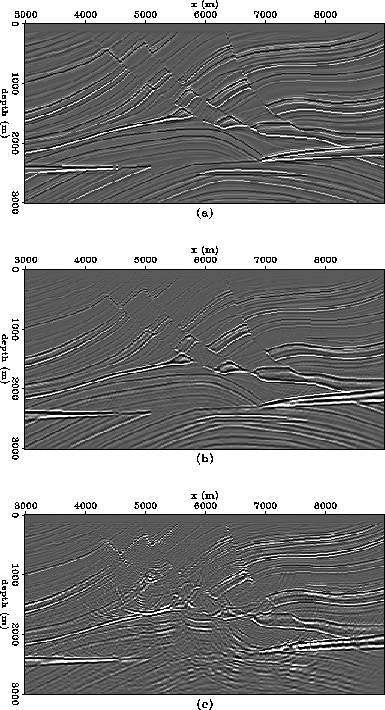 |
(a), and panel (c) shows the
reflectivity estimate obtained by migrating the zero-offset data from
Figure (b).