


![[*]](http://sepwww.stanford.edu/latex2html/foot_motif.gif)
This value can be chosen by inspection of a SNA histogram. We can hope for clean separation of roughly Gaussian distributions of shale-wet sand reflections and shale-oil sand (and/or shale-gas sand) resulting in a bi- or tri-modal distribution of reflections. As discussed above, the less dense the pore-filling fluid, the higher the SNA value. Therefore, assuming only that most intervals are water-bearing, we can confidently pick the first mode as indicative of water reflections. Figure 4 shows an ideal distribution of SNA, while Figure 5 shows the histogram for the synthetic data.
|
ideal
Figure 4 Ideal distributions of SNA attribute. Threshold values for color tables or clipping can be set with these in mind for fast and furious prospecting or horizon mapping and volumetrics. | 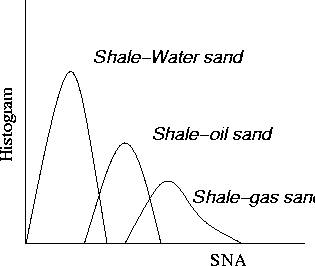 |

|
histo
Figure 5 Histogram of SNA from modeled then migrated from the density/velocity grid shown in 6. The extreme preponderance of zero values in the model makes the plot ugly, but the tri-modal nature of the histogram is evident. | 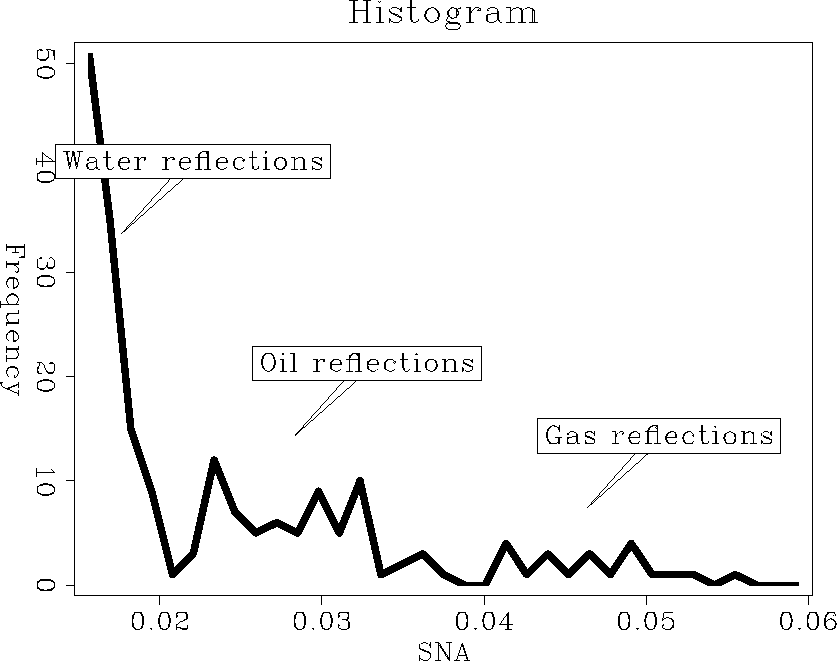 |


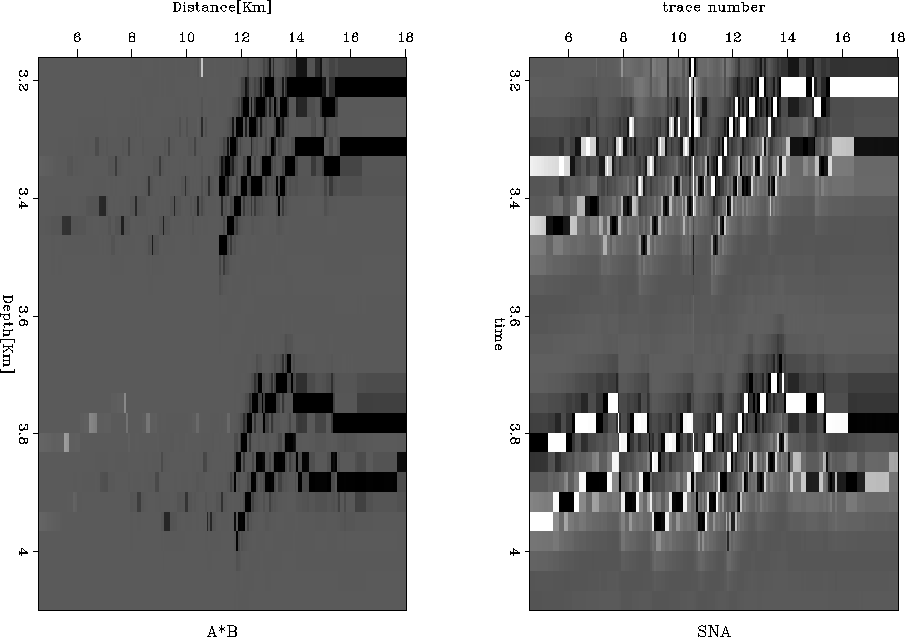 |
 models. Gratwick (2001b) shows the entire
model and details the processing steps. White denotes high A*B value
(down-dip water reflections have already been muted).
Notice the accuracy of the SNA model showing prospective
AVA character on the top reservoir reflection, but not the bottom
reflection.
Figure 5 shows picks along the upper-most reflector.
models. Gratwick (2001b) shows the entire
model and details the processing steps. White denotes high A*B value
(down-dip water reflections have already been muted).
Notice the accuracy of the SNA model showing prospective
AVA character on the top reservoir reflection, but not the bottom
reflection.
Figure 5 shows picks along the upper-most reflector.
![[*]](http://sepwww.stanford.edu/latex2html/movie.gif)
An even more powerful approach is to extract the SNA attribute along an event and
plot it as a function of depth or time. As the event crosses fluid
levels, we will see nice step-changes in the SNA value.
|
event
Figure 7 While fault blocks complicate the plot somewhat, fluid level remains obvious, and a prospecting threshold of 12-14 is comfortably assigned. Values were not normalized by  . . | 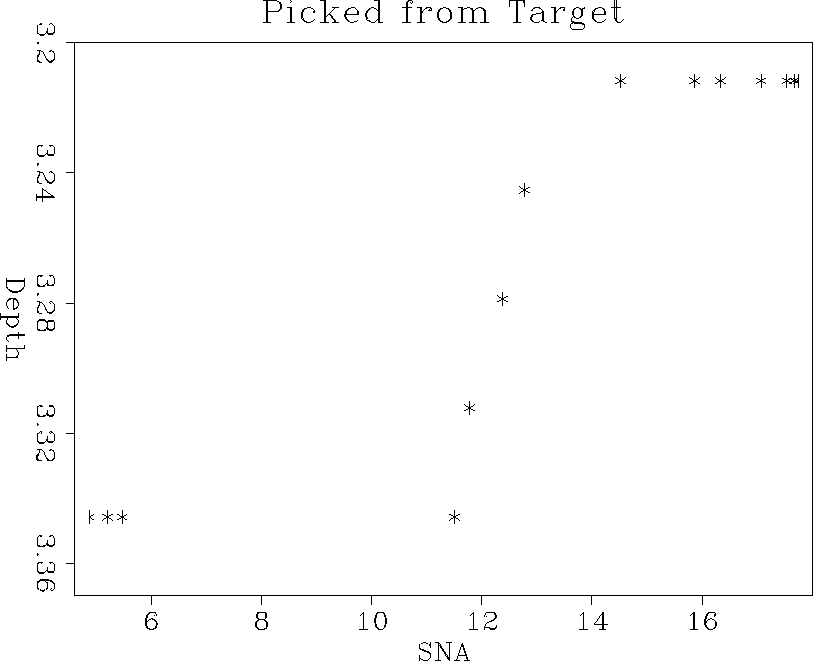 |
To use this type of analysis on well or seismic data (integration!),
one is only required to perform the trivial calculations of equations
(1) and/or (3) to generate the  plane.
Further, after estimating the Shale trend angle on the
plot,
the SNA attribute can be calculated and used as a prospecting or reservoir
characterization tool.
plane.
Further, after estimating the Shale trend angle on the
plot,
the SNA attribute can be calculated and used as a prospecting or reservoir
characterization tool.
The next step in proving the value of this concept will be to apply these simple transformations to single events known to have fluid contacts. Such a data set is thought to exist in-house, and a thorough description of our success/failure with this analysis will be included in the next report.