


We introduced the extension of Stolt prestack residual migration for converted waves. Our new operator involves the selection of three parameters in order to update the image.
To help in the memory and
disk space necessary for the implementation of our
operator,
we also derived
approximations that reduce the number of free parameters to
a two.
The most appropriate way of reducing the
number of parameters is by freezing one of them.
Our experience suggests freezing  at the RMS value of the ratio between the
P and the S migration velocities.
at the RMS value of the ratio between the
P and the S migration velocities.
In constant velocity, we proved that we can recover the image obtained with an initial migration that uses an inaccurate velocity model. Therefore, we can update a migration with constant two-velocities model using our new operator. We can also update an image obtained with a depth variant velocity. However, the refocusing performed by residual migration is only approximate.
The advantages of having an operator to update converted waves images allow us to extrapolate our ability to handle multiple mode data. We hope that it will lead to more accurate methods for performing velocity analysis for converted waves.
A
Solving the first equation of:
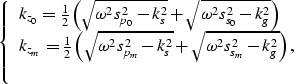 |
for  we have:


Squaring the previous equation and isolating the remaining square root we obtain:

Squaring the previous equations, grouping common terms, and setting equal to zero, we get:
![\begin{displaymath}
\omega^4 \left( s_{p_0}^2 -s_{s_0}^2 \right)^2 + \omega^2 \l...
...ht] + \left(4k_z^2 +k_g^2 -k_s^2 \right)^2 + 16k_z^2 k_s^2 = 0.\end{displaymath}](img43.gif)
Solving for we obtain
 |
(6) |
We select the negative sign of the
radical as the
final solution for ,as discussed in Appendix B.
Substituting the result of in the second equation of relation (7),
we obtain the relationship for residual prestack migration for converted waves.
In order to demonstrate this fact,
we need to simplify the dispersion relation for in
terms of  , sp0 and ss0
depending on
the source or receiver SSR equation.
, sp0 and ss0
depending on
the source or receiver SSR equation.

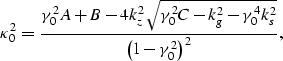
therefore,

since

calling
 |
(7) |
we finally note that  .
.
We then have equation (3), which is:
 |
B
We want to evaluate
equations (3), (5) and (6)
when vp = vs, or equivalently, when  .
.
It is possible to see from equation (9) that for the particular
case of  we have a division by zero.
Since we have a division by zero, we need to analyze the equation when we
approach to
we have a division by zero.
Since we have a division by zero, we need to analyze the equation when we
approach to  .For this purpose,
we are going to use L'Hôpital.
Therefore, we need to have a zero also in the numerator, which
is possible for any value of kz if, and only if, we choose the
negative sign as a solution
in equation (8).
.For this purpose,
we are going to use L'Hôpital.
Therefore, we need to have a zero also in the numerator, which
is possible for any value of kz if, and only if, we choose the
negative sign as a solution
in equation (8).
Referring to equation (9)
as  , and
applying the L'Hôpital, we calculate the derivative with
respect to to
, and
applying the L'Hôpital, we calculate the derivative with
respect to to  and
and  .
.
We derive

On the other hand, the derivative of the denominator is:

Analyzing the limit for of the  ,we still have a
  relation, which means we must
re-apply L'Hôpital,
relation, which means we must
re-apply L'Hôpital,

On the other hand, the second derivative of the denominator is:
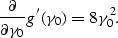
We finally have
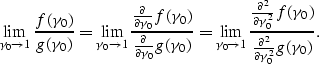
Therefore, we have  for reduces to:
![\begin{displaymath}
\left [ 4k_z^2 + \left ( k_g - k_s \right )^2 \right ] \left[ 4k_z^2 + \left ( k_g + k_s \right )^2 \right ]\end{displaymath}](img66.gif)
which is the expression for the conventional case of PP waves.