


Next: Examples
Up: Sava and Biondi: Image
Previous: Image perturbation by WEMVA
Residual migration can also be used to create an image perturbation.
In its simplest form, we can build it as a difference between an
improved image ( ) and the reference image (
 )
)
|  |
(9) |
where is derived from as a function of the parameter  ,which is the ratio of the original and improved velocities
Sava (2000).
Of course, the improved velocity map is unknown explicitly, but it
is described indirectly by the ratio map of the two velocities.
,which is the ratio of the original and improved velocities
Sava (2000).
Of course, the improved velocity map is unknown explicitly, but it
is described indirectly by the ratio map of the two velocities.
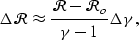
If we define  , we can also write the discrete version
of the image perturbation as
, we can also write the discrete version
of the image perturbation as
|  |
(10) |
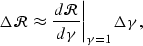
equation which can be written in differential form as
|  |
(11) |
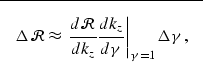
or, equivalently, using the chain rule, as
|  |
(12) |
where  is the depth wavenumber defined for PSRM.
The Equations (7) and (12) are very similar,
which comes at no surprise since they effectively represent the same thing:
the perturbation of the image given a perturbation of the slowness field,
or equivalently, a perturbation of the (ratio) field. We will use
Equation (12) to create the image perturbation, which we will then
backproject in the slowness space using the adjoint of the WEMVA equation
(7).
Equation (12) offers the possibility to build the image
perturbation directly. We achieve this by computing three elements:
the derivative of the image with respect to the depth wavenumber,
and two weighting functions, one for the derivative
of the depth wavenumber with respect to the velocity ratio parameter (),
and the other one for the magnitude of the  perturbation from the
reference to the improved image.
perturbation from the
reference to the improved image.
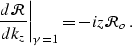
Firstly, the image derivative in the Fourier domain,
 ,
is straightforward to compute in the space domain as
,
is straightforward to compute in the space domain as
|  |
(13) |
The derivative image is nothing but the imaginary part of the migrated
image, scaled by depth.
Secondly, we can obtain the weighting representing the derivative of
the depth wavenumber with respect to the velocity ratio parameter,
 , starting from
the double square root (DSR)
equation written for prestack Stolt residual migration
Sava (2000):
, starting from
the double square root (DSR)
equation written for prestack Stolt residual migration
Sava (2000):
where  is given by the expression:
| ![\begin{displaymath}
\mu^2 = \frac{ \left[4 \left({{\k_z}^o}\right)^2 + \left(\le...
...s \right\vert\right)^2 \right]}
{16\left({{\k_z}^o}\right)^2}.\end{displaymath}](img34.gif) |
(14) |
The derivative of with respect to is
| 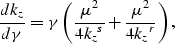 |
(15) |
therefore
|  |
(16) |
Finally, can be picked from the set of residually migrated images at
various values of the parameter Sava (2000).
The main criterion that should be used is the flatness of the angle-domain
image gathers, although in principle other derived parameters, such as stack
power or semblance, can be used as well.
Next: Examples
Up: Sava and Biondi: Image
Previous: Image perturbation by WEMVA
Stanford Exploration Project
9/18/2001
