


Next: Conclusion
Up: Shan and Zhang: Migration
Previous: Source-Receiver Migration
Although shot-profile migration and source-receiver migration look totally different, they obtain
both the same image and CIG.
In this section,
we prove that the mono-frequency image  and CIG
  in the shot-profile migration
are exactly the same mono-frequency image
in the shot-profile migration
are exactly the same mono-frequency image  and CIG
  in the source-receiver migration, respectively.
We define a new wavefield  , which is the cross-correlation between the source
wavefield
, which is the cross-correlation between the source
wavefield  and the receiver wavefield
 in the shot-profile migration for shot s, that is
|  |
(8) |
and the wavefield  is the stack of along all the shots,
|  |
(9) |
Obviously, from equation (7),  is the surface data in
source-receiver migration. We will demonstrate that the wavefield
satisfies the DSR equation,
is the surface data in
source-receiver migration. We will demonstrate that the wavefield
satisfies the DSR equation,
|  |
(10) |
where  . By extension, also satisfies the DSR equation.
Thus shot-profile migration and source-receiver migration are
two different ways to obtain wavefield Q at the subsurface.
In shot-profile migration, source and receiver wavefields are downward continued into the subsurface
with the one-way wave equation, and the wavefield is formed by
cross-correlating the source wavefields and receiver wavefields and stacking over all shots at all depths.
But in source-receiver migration, the wavefield at the surface
. By extension, also satisfies the DSR equation.
Thus shot-profile migration and source-receiver migration are
two different ways to obtain wavefield Q at the subsurface.
In shot-profile migration, source and receiver wavefields are downward continued into the subsurface
with the one-way wave equation, and the wavefield is formed by
cross-correlating the source wavefields and receiver wavefields and stacking over all shots at all depths.
But in source-receiver migration, the wavefield at the surface
 is obtained by cross-correlating the source wavefield
and the receiver wavefield at the surface, and is formed
by extrapolating to all depths with the DSR equation.
is obtained by cross-correlating the source wavefield
and the receiver wavefield at the surface, and is formed
by extrapolating to all depths with the DSR equation.
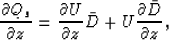
From the Leibniz rule, we have
|  |
(11) |
where  and
and  .Since is an up-going wavefield, it satisfies the up-going
wave equation(1), so we have
.Since is an up-going wavefield, it satisfies the up-going
wave equation(1), so we have
|  |
(12) |
 is not dependent on xU, so it is constant with respect to the
operator
is not dependent on xU, so it is constant with respect to the
operator 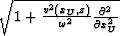 , and we have
|  |
(13) |
Summarizing equation (12) and (13), we have
|  |
(14) |
It is easy to prove that
|  |
(15) |
So the second term of equation (11) changes to
| 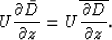 |
(16) |
Since is a down-going wavefield, it satisfies the down-going wave equation (2), and we have
| 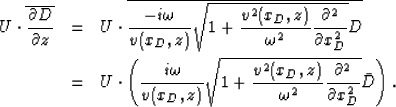 |
(17) |
| (18) |
Again, does not depend on xD, so we have
|  |
(19) |
| (20) |
Summarizing equations (15-20), we have
|  |
(21) |
Finally, from equation (11), equation (14) and equation (21), we know
Qs satisfies the DSR equation (10). Q is the stack of Qs over all shots,
so by extension Q satisfies the DSR equation also.
It is obvious that the image of shot-profile migration in equation (3) is
|  |
(22) |
and the corresponding CIG in equation (5) is
|  |
(23) |
In traditional source-receiver migration,  is the stack of the cross-correlation
between the impulse source and the recorded data along shots,
which is the CMP gather
is the stack of the cross-correlation
between the impulse source and the recorded data along shots,
which is the CMP gather  of the recorded data at the surface. Since
both
of the recorded data at the surface. Since
both  and are obtained by propagating
to the subsurface with the DSR equation (10),
they are equivalent.
If the source in source-receiver migration is not an impulse function,
is the stack of
the cross-correlation between the source wavefield and the receiver wavefield,
and the same conclusion is reached.
Thus we have
and are obtained by propagating
to the subsurface with the DSR equation (10),
they are equivalent.
If the source in source-receiver migration is not an impulse function,
is the stack of
the cross-correlation between the source wavefield and the receiver wavefield,
and the same conclusion is reached.
Thus we have
|  |
(24) |
and
|  |
(25) |
Next: Conclusion
Up: Shan and Zhang: Migration
Previous: Source-Receiver Migration
Stanford Exploration Project
7/8/2003