


 norm
norm
![[*]](http://sepwww.stanford.edu/latex2html/cross_ref_motif.gif) )
the Huber norm defined in Chapter and minimize
)
the Huber norm defined in Chapter and minimize
 |
(39) |
)], I selected  cm, which
corresponds to the measurement error of the sounder.
Figure a shows
cm, which
corresponds to the measurement error of the sounder.
Figure a shows  estimated with the
 norm [equation ()] after 50 iterations, which
simulates a least-squares solution with damping. Note that
the scale bar is not displayed whenever
is plotted because its values are of little interest for this analysis.
Although appears to be a variable of
mathematical interest only, in fact, the solution
norm [equation ()] after 50 iterations, which
simulates a least-squares solution with damping. Note that
the scale bar is not displayed whenever
is plotted because its values are of little interest for this analysis.
Although appears to be a variable of
mathematical interest only, in fact, the solution  is so
smooth that we have difficulty viewing it. We could view the two
components of
is so
smooth that we have difficulty viewing it. We could view the two
components of  but it happens that is
a roughened version of . In addition, it is more convenient
to view than the two images
but it happens that is
a roughened version of . In addition, it is more convenient
to view than the two images  and
and  because it is only a single
component vector.
We can see considerable spurious noise in the map of
Figure a. In addition, we can see the vessel
tracks in the north part of the map.
because it is only a single
component vector.
We can see considerable spurious noise in the map of
Figure a. In addition, we can see the vessel
tracks in the north part of the map.
Figure b displays estimated with the
norm [equation (]. Most of
the glitches are attenuated showing vessel tracks only.
Some ancient shorelines in the west part and south part of the Sea of
Galilee are now easy to identify (shown as ``AS'' in Figure
b). In addition, we also start to see
a ``valley'' in the middle of the lake (shown as ``R'' in Figure
b). This feature is also present in Figure
a where no attempts were made to remove the
spikes. Therefore, this can be either a geological feature that represents the
on-going rifting in this area or a track. The next section will prove
that this valley is not a processing artifact or some noise not
accounted for in our inversion scheme. The data outside the sea have been
also partially removed. The tracks (shown as ``T'' in Figure
) are still clearly visible after the attenuation
of the outliers because they do not fit the model of the noise we are
trying to remove.
Figures a,b
show the bottom of the Sea of Galilee ( )after inversion. Each line represents one east-west line of the
interpolated data every 500 meters.
The result is a great improvement over the
maps. The glitches inside and outside the sea
have disappeared. It is also pleasing to see that the norm
gives us positive depths everywhere. Although not everywhere
visible in Figure , it is interesting to notice
that we produce topography outside the lake.
Indeed, the effect of regularization is to produce synthetic
topography which is a natural continuation of the lake floor surface.
)after inversion. Each line represents one east-west line of the
interpolated data every 500 meters.
The result is a great improvement over the
maps. The glitches inside and outside the sea
have disappeared. It is also pleasing to see that the norm
gives us positive depths everywhere. Although not everywhere
visible in Figure , it is interesting to notice
that we produce topography outside the lake.
Indeed, the effect of regularization is to produce synthetic
topography which is a natural continuation of the lake floor surface.
I have shown that the combined utilization of preconditioning and
the Huber norm removes the spikes in the depth map of the Sea of Galilee.
In the next section, I propose removing the ship tracks by
introducing an operator in equation () that will model
the coherent noise created by different weather and human conditions during
the acquisition of the data.
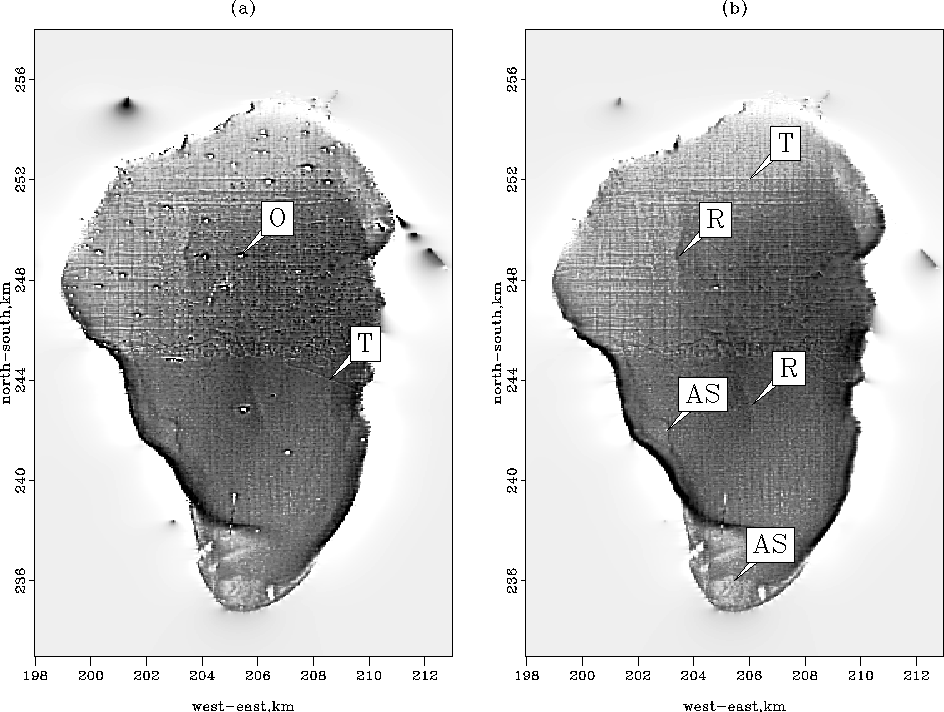 |
 estimated
with equation () in a least-squares sense after 50
iterations, which simulates a least-squares solution with
damping. (b) estimated with equation () in a sense. The spikes have been
correctly attenuated. Some interesting features are shown by the
arrows: AS points to few ancient shores, O points to some outliers,
T points to a few tracks and R points to a ridge.
estimated
with equation () in a least-squares sense after 50
iterations, which simulates a least-squares solution with
damping. (b) estimated with equation () in a sense. The spikes have been
correctly attenuated. Some interesting features are shown by the
arrows: AS points to few ancient shores, O points to some outliers,
T points to a few tracks and R points to a ridge.


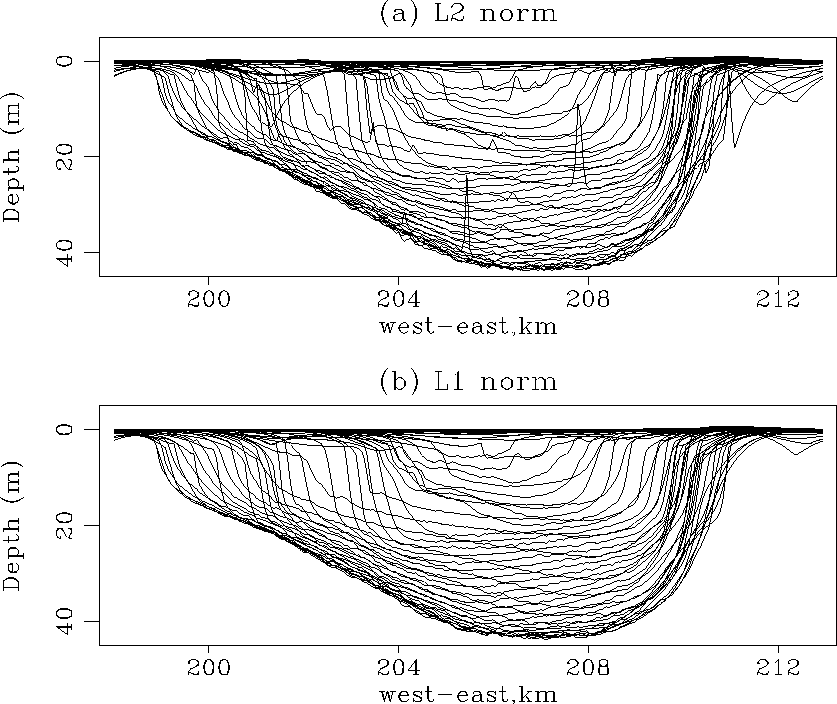 |
) with the norm after 50 iterations, which simulates a least-squares solution
with damping. (b) View of the bottom of the lake with the norm.
Note that with the norm, the spikes have been attenuated.
Each line represents one east-west track every 500 meters.