


Computing considerations aside, the two methods can perform very differently according to the geological setting. Here, both are tested in a salt environment with a synthetic dataset. This dataset was primarily designed to conduct blind tests for velocity estimation methods. Consequently, no structural information is known. The adaptive subtraction technique used in this section is based on the estimation of 2-D, time/space varying matching filters Rickett et al. (2001). The filters are computed for one shot gather at a time. With the pattern-based approach, 3-D filters are used for the multiple attenuation. Ideally, 3-D filters should be also used with adaptive subtraction. However, matching filters are generally not estimated that way.
The multiple model is computed with SRMP. Therefore, only multiples
bouncing at least once at the water surface will be modeled and subtracted.
The synthetic model has an offset spacing of 12.5 m
and a shot separation of 50 m. To make the multiple prediction work,
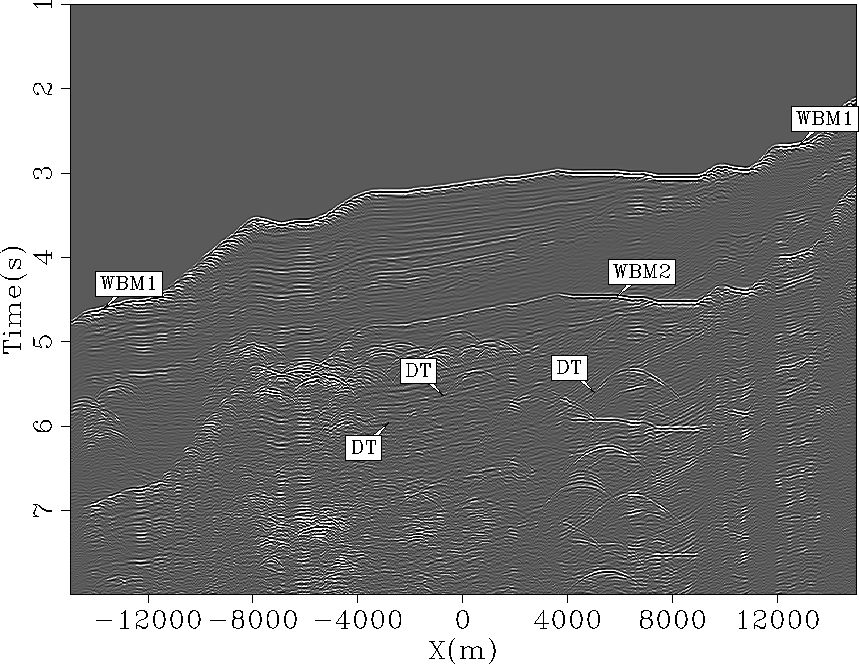
the offset axis is sampled down to 50 m. Figure ![[*]](http://sepwww.stanford.edu/latex2html/cross_ref_motif.gif) shows
one constant offset section from -15,000 m to +15,000 m with primaries
and multiples. This section of the dataset is particularly interesting because
of the diffractions visible throughout. A possible interpretation of
these diffractions is the presence of salt bodies with a rugose top
(similar to what we see with the Sigsbee2B dataset).
The multiple model is shown in Figure for
the same offset. DT points to diffraction tails
where the model is not properly rendering the multiples in the data.
Figure illustrates on a zero-offset example why
diffractions are difficult to predict. The main reasons are that
far offset data are not recorded and/or the scatter points are out of plane.
Besides these few imperfections, the model looks very
faithful to the actual multiples.
shows
one constant offset section from -15,000 m to +15,000 m with primaries
and multiples. This section of the dataset is particularly interesting because
of the diffractions visible throughout. A possible interpretation of
these diffractions is the presence of salt bodies with a rugose top
(similar to what we see with the Sigsbee2B dataset).
The multiple model is shown in Figure for
the same offset. DT points to diffraction tails
where the model is not properly rendering the multiples in the data.
Figure illustrates on a zero-offset example why
diffractions are difficult to predict. The main reasons are that
far offset data are not recorded and/or the scatter points are out of plane.
Besides these few imperfections, the model looks very
faithful to the actual multiples.
|
scatter
Figure 10 Illustration of a pegleg multiple with a bounce on a scatter point recorded at zero-offset. These events are difficult to model because of the lack of far and/or crossline offsets. | 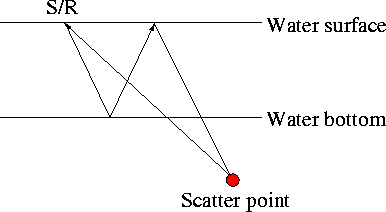 |

The result of adaptive subtraction is shown for one offset section in
Figure and the result of pattern-based subtraction is
shown in Figure . The adaptive subtraction is doing a
decent job everywhere. However, some multiples are still visible.
For example, '1' in Figure points to a location where
multiples overlap with primaries and are not attenuated. In contrast,
the pattern-based subtraction (i.e., Figure )
seems to do a better job attenuating these events.
The same is true for arrows '2' and '5'. The diffracted multiples
(arrows '3' and '4') are also
attenuated more effectively with the pattern-based approach.
Because no velocity analysis was conducted with this dataset, no stacks
are presented. Alternatively, close-ups of constant offset sections
are shown to illustrate strengths and weaknesses of the two different
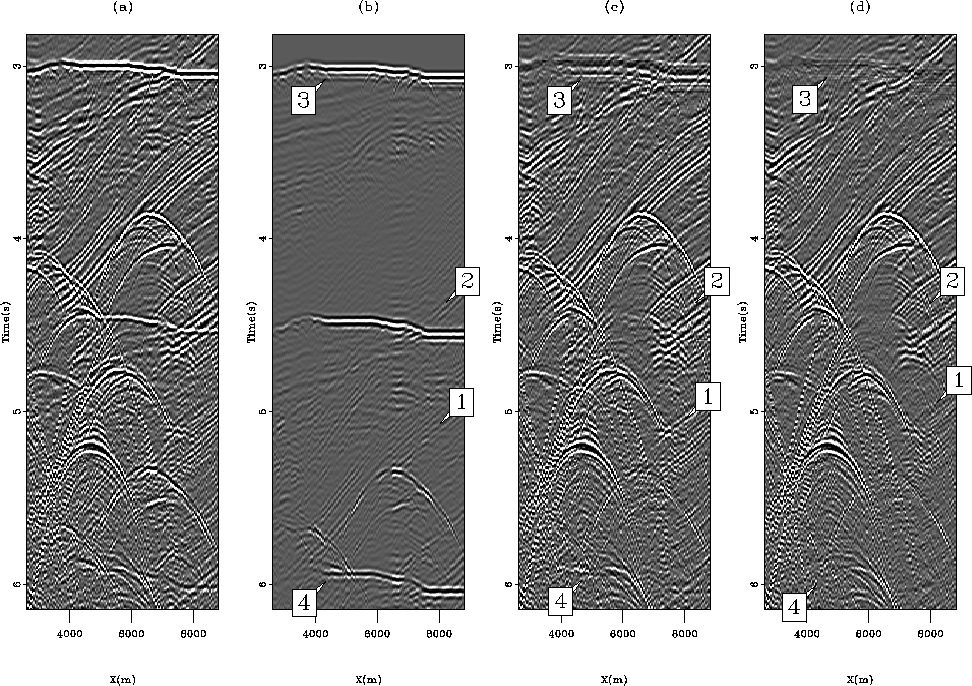
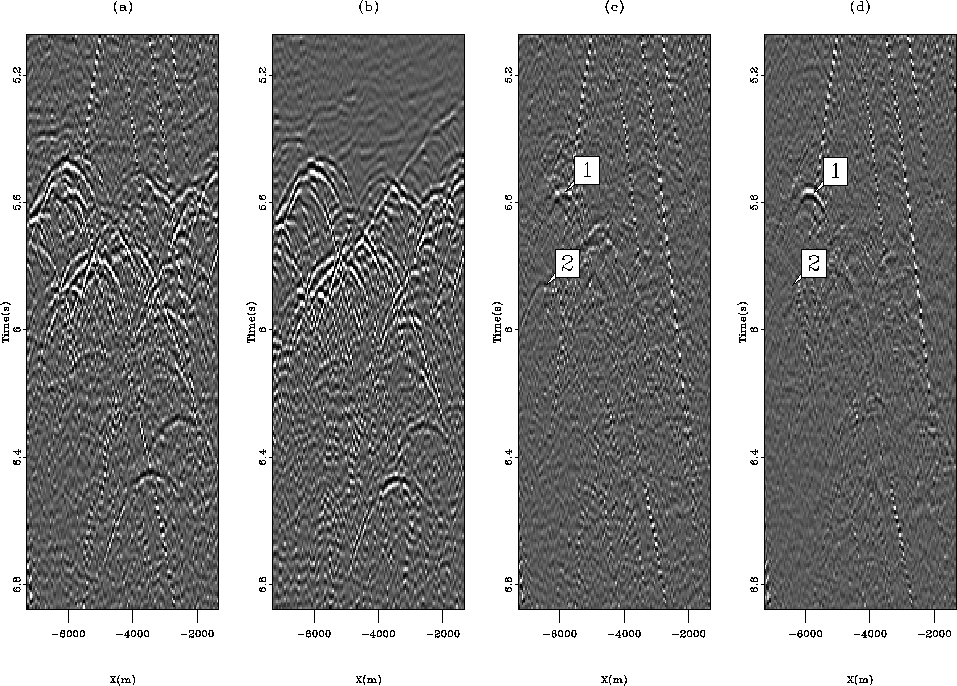
approaches. Figure shows a comparison between the
input data, the multiple model, the estimated primaries with the
adaptive subtraction and the estimated primaries with the
pattern-based technique. The offset is 700 m. As shown by the arrows,
the pattern-based method performs generally better. The same
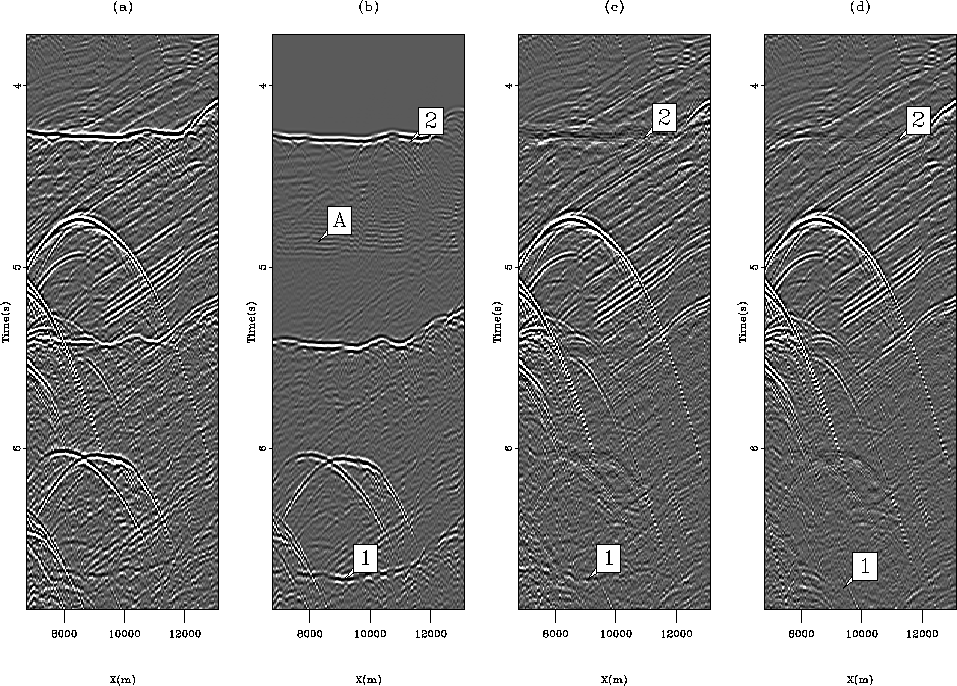
conclusions hold in Figure . Note in Figure
b aliasing artifacts due to the coarse sampling of
the offset axis for the multiple prediction van Dedem (2002).
Sometimes, it can be rather difficult to see if multiples are removed
or not by simply looking at 2-D planes. Figure c shows
one event at '2' that seems to be a primary. However, by looking at the
shot gathers (not shown here),
it appears that this event is a multiple that the pattern-based
approach was able to attenuate.
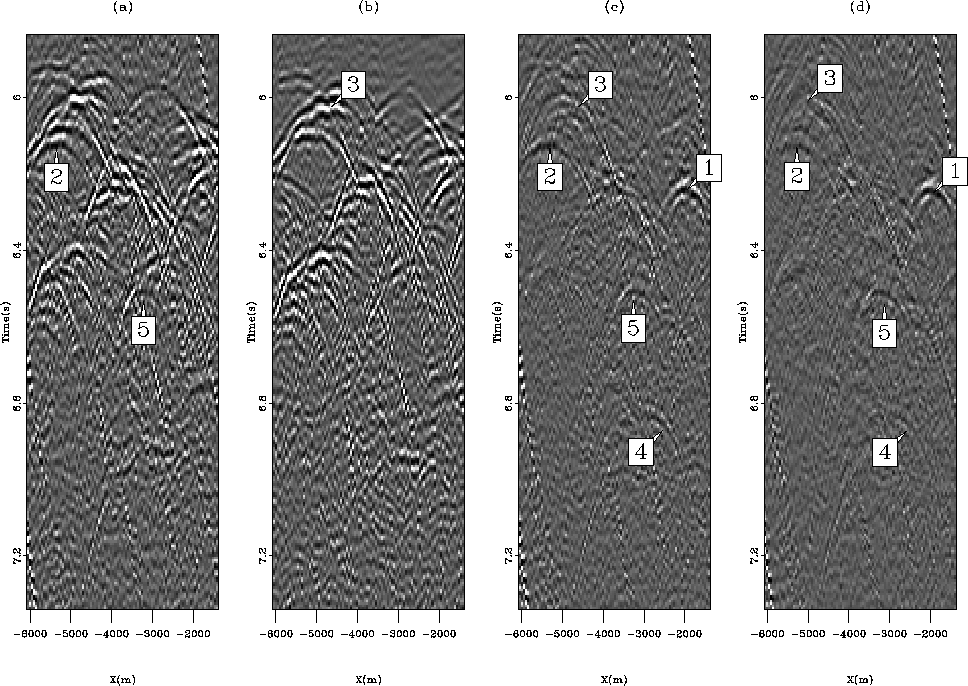
One shortcoming of the pattern-recognition technique is that it relies on the Spitz approximation to provide a signal model if nothing else is available. By construction, the signal and noise filters will span different components of the data space. Therefore, the estimated primaries and multiples are uncorrelated. This simple fact suggests that with the Spitz approximation, higher dimension filters are preferred because primaries and multiples have fewer chances to look similar.
Figure shows an example where primaries are
damaged by the pattern-based method. For instance in Figure
a, we see at '2' a primary that is attenuated by the
PEFs (Figure d) but well preserved by the adaptive
subtraction (Figure c). Here the primaries and
multiples (Figure b) exhibit similar
patterns and the signal may have minimum energy.
Using the Spitz approximation, event '2' is identified as
noise and removed as such. For event '3', it is quite difficult to say
if multiples are removed in Figure d or if primaries are
preserved in Figure c. Looking at the
corresponding shot gathers did not help to make a decision because the
multiples are very strong. Event '4' is preserved with the
adaptive subtraction and '1' and '5' are well recovered with the
pattern-based approach.
This synthetic example indicates that the pattern-based approach tend to attenuate the multiples more accurately than adaptive subtraction when the multiples are not correlated with the primaries. This illustrates that higher dimensions filters should be preferred to discriminate the noise and signal more effectively. The next section shows how the pattern-based approach performs on a field dataset from the Gulf of Mexico.
 |


 |
 |
 |
. Arrow WBM1 shows the
remaining energy for the first order surface-related multiple.
 |
 |
 |
 |