


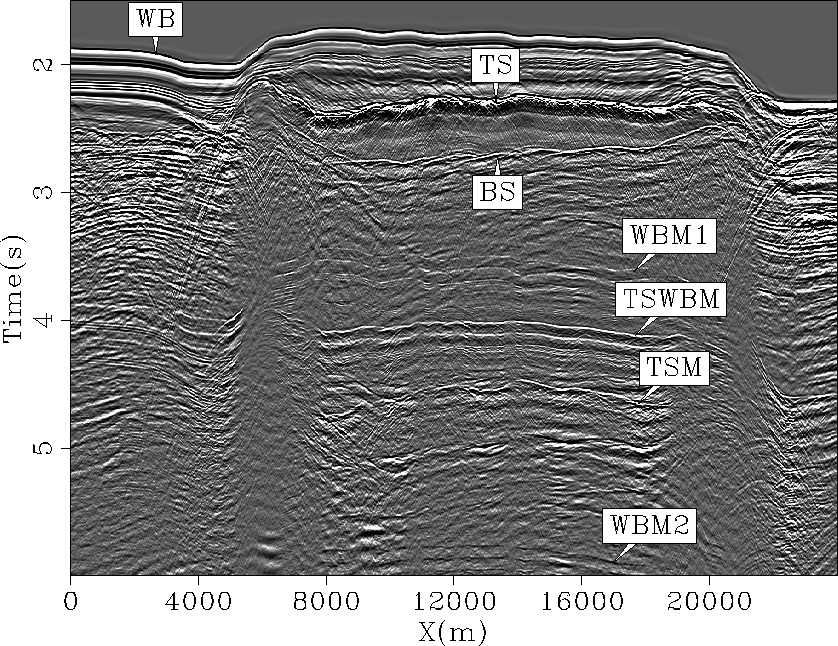
![[*]](http://sepwww.stanford.edu/latex2html/cross_ref_motif.gif) . Strong surface-related
multiples are visible below 3 s. The tabular salt near the water
bottom generates peg-legs in the data. The shot and receiver spacing is
26.6 m. and the first hydrophone is 100 m. away from the source.
Ideally, before using SRMP, the missing short offset traces should be
interpolated for improved separation Kabir and Verschuur (1995).
No interpolation was performed here, thus creating wrong
amplitudes in the multiple model, especially
at short offset where amplitudes are zero. Note that SRMP creates
a model for all multiples with at least one bounce at the sea surface.
For this dataset both adaptive subtraction and pattern-based techniques
are compared after migration.
. Strong surface-related
multiples are visible below 3 s. The tabular salt near the water
bottom generates peg-legs in the data. The shot and receiver spacing is
26.6 m. and the first hydrophone is 100 m. away from the source.
Ideally, before using SRMP, the missing short offset traces should be
interpolated for improved separation Kabir and Verschuur (1995).
No interpolation was performed here, thus creating wrong
amplitudes in the multiple model, especially
at short offset where amplitudes are zero. Note that SRMP creates
a model for all multiples with at least one bounce at the sea surface.
For this dataset both adaptive subtraction and pattern-based techniques
are compared after migration.
The multiple attenuation starts with the estimation of 3-D PEFs from
SRMP and the Spitz approximation. Then multiples and primaries are
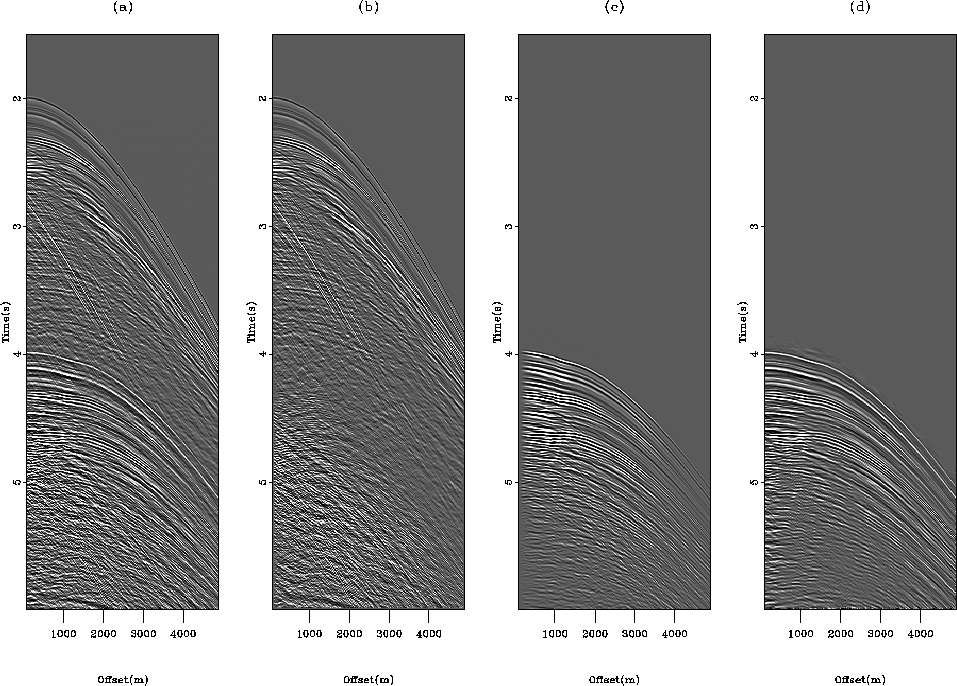
separated according to their multidimensional spectra. Figure
displays the multiple attenuation result for
one shot gather outside the salt boundaries (X=4500 m).
The multiple model in Figure c
demonstrates that the short offset traces are not accurately modeled.
However, the estimated primaries (Figure b)
and multiples (Figure d) show that the
subtraction is working at short and far offsets. This robustness
to modeling errors is increased by the smoothing of the filter coefficients
during the PEFs estimation.
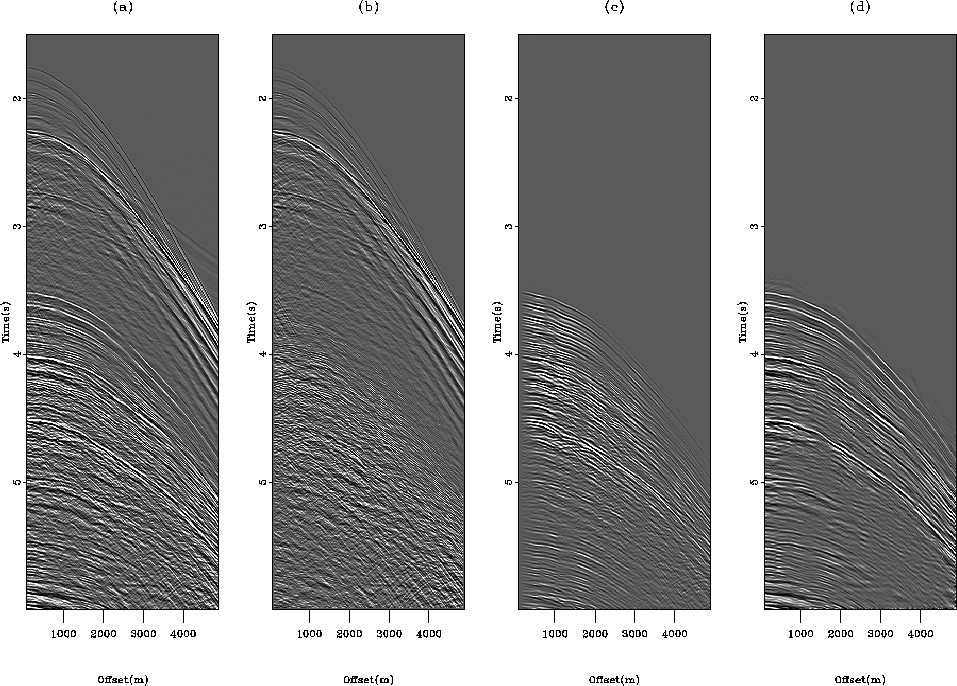
A second shot gather is shown in Figure from
inside the salt boundaries (X=12000 m). The estimated primaries
(Figure b) and multiples (Figure
d) are again separated well.
However, looking closely at the primaries in Figure
b, some diffracted multiples seem to have
leaked in. These diffractions (Figure ) can be either out of plane events or in
plane events that SRMP cannot model due to limitations imposed by
the acquisition geometry Kabir (2003).
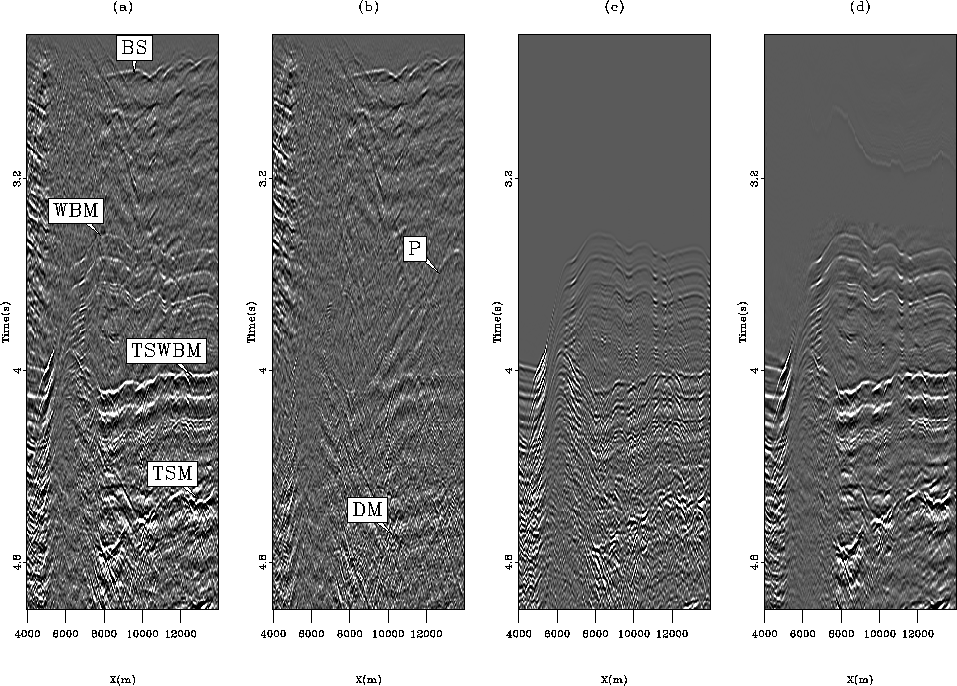
Stacked sections of the input data, estimated multiples and
primaries are displayed in Figure . These stacks
are located below the salt, as shown in Figure a.
The estimated primaries in Figure b are still
contaminated with diffracted multiples (shown as M). The multiples are
attenuated very well otherwise. Comparing the stack of the multiple
model (Figure c) with the stack of the extracted
multiples (Figure d) indicates that no prominent
primaries have been attenuated.
 |


 |
 |
 |