


Having interpolated the shots to a 25 m grid makes the multiple
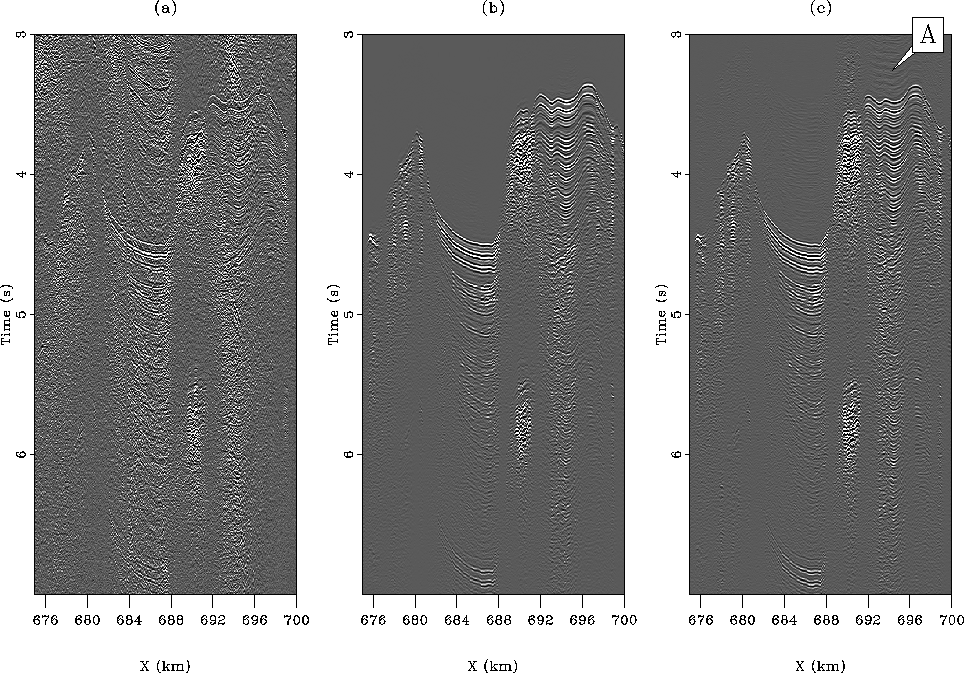
prediction more accurate. Figure ![[*]](http://sepwww.stanford.edu/latex2html/cross_ref_motif.gif) shows a
comparison for one offset of the input data and the predicted multiples
with and without sparse interpolation. The predicted multiples in
Figures b and c look
almost identical to the true multiples in Figure
a. Some artifacts, shown as A in Figure
c, are nevertheless present
in the multiple model obtained from the interpolated data without
regularization. These artifacts come from the convolution
of the noise visible in Figure b before the
water-bottom reflection with coherent
energy. Some of them could be attenuated by applying a mute on the
interpolated shot gathers.
shows a
comparison for one offset of the input data and the predicted multiples
with and without sparse interpolation. The predicted multiples in
Figures b and c look
almost identical to the true multiples in Figure
a. Some artifacts, shown as A in Figure
c, are nevertheless present
in the multiple model obtained from the interpolated data without
regularization. These artifacts come from the convolution
of the noise visible in Figure b before the
water-bottom reflection with coherent
energy. Some of them could be attenuated by applying a mute on the
interpolated shot gathers.
 |


The multiple model looks relatively accurate for the whole
section. However, some important discrepancies exist between the true and
modeled multiples in some places. For instance, Figure
displays the multiple prediction results in
an area where the model does not match the observed multiples very
well. In Figure b, the water-bottom multiple
(shown as 1) is clearly modeled better with the interpolated data
with sparseness constraint than in Figure c
without regularization.
The two circles in Figure b and
c highlight aliasing artifacts that are also
visible in Figures b and
c. These artifacts would disappear by having
a smaller sampling of both shot and offset axes. Therefore, these
aliasing artifacts are stronger when no Cauchy regularization
is applied for the interpolation.
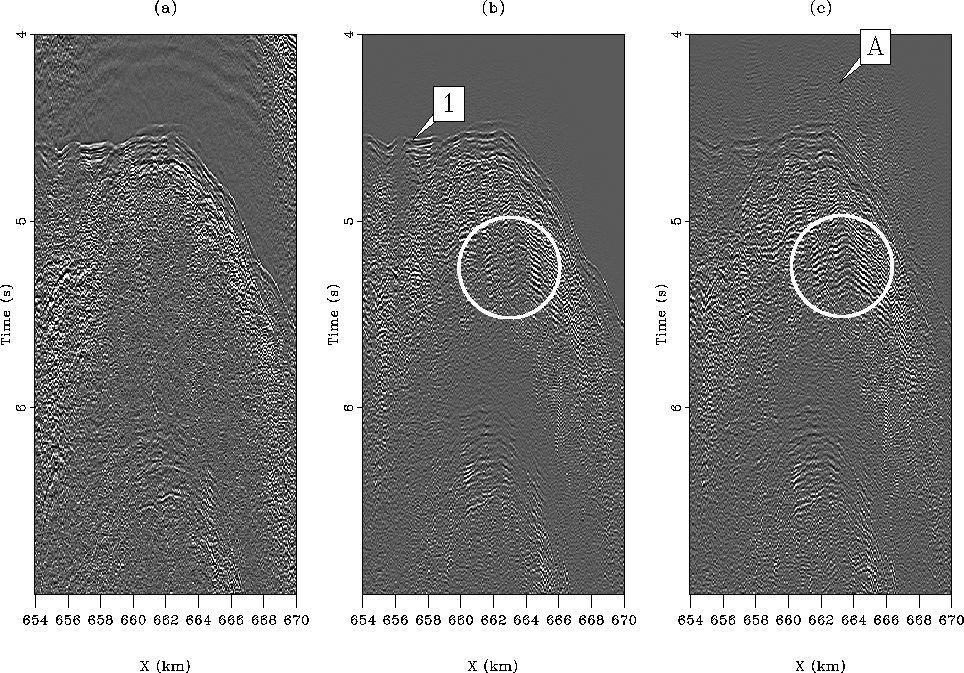 |
c. The two circles point to aliasing
artifacts created during the multiple prediction.
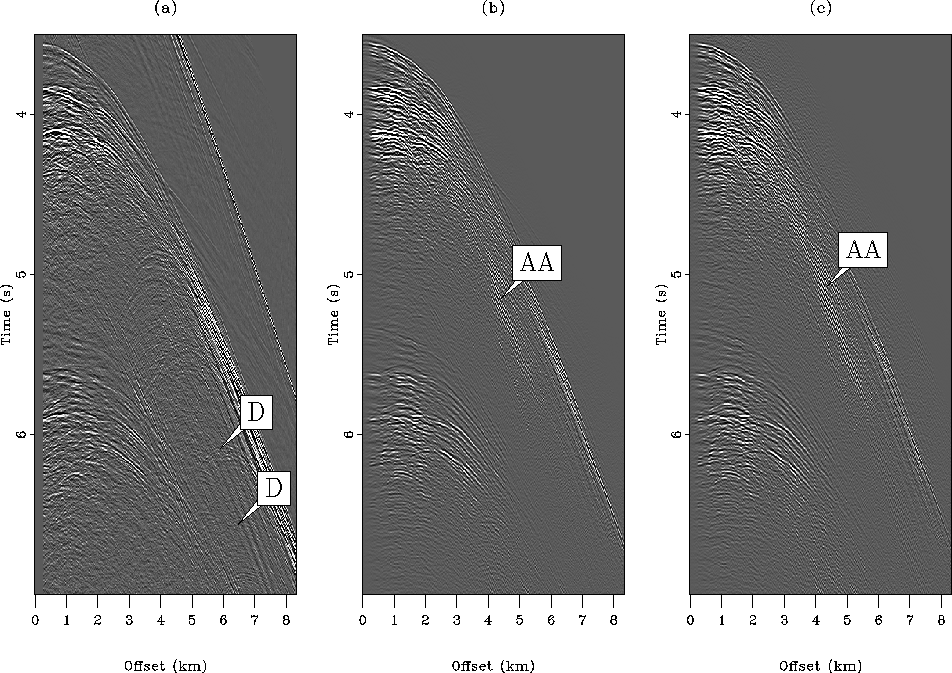
Looking now at shot gathers in Figure , it
appears that the modeling of multiples worked well for the main
reflection events. Energetic diffracted multiples are almost totally absent in the
predictions of Figures b and
c, however. Diffracted multiples are generally
more difficult to model because they require a very dense surface
coverage of sources and receivers in order to recover all the dips
(Figure ). This effect is amplified in 3-D.
Approximating the sail line as a
continuous 2-D survey and ignoring 3-D effects lead to large errors
in the model of diffracted multiples.
 |
.
The estimation of a multiple model with a 2-D prediction scheme for 3-D field data, although being accurate in most places, suffers from kinematic and amplitude errors. For some events, e.g., diffracted multiples, the modeling fails completely. In addition, the shot interpolation technique needs to be chosen carefully to minimize its impact on the final multiple model. Here, the radon-based approach with a sparseness constraint yields the best multiple model. Given this imperfect model, it is now the goal of the subtraction to come up with the best estimated primaries. In the next section, multiple attenuation results are presented with a pattern-based and adaptive subtraction technique.