


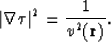
 |
(80) |
 .The classical wave-equation
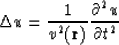
1. Absence of wave dispersion. Let the coefficient of the equation (80) be constant. After substitution

 and
and  . The equation is
reduced to
. The equation is
reduced to
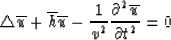
 .
.Looking for the solution in the form
![\begin{displaymath}
\exp[i (\omega t - \sum_{i=1}^{3}k_i x_i)],\end{displaymath}](img466.gif)
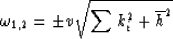
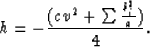
 ,only in the case when
  or
or
2. Amplitude equivalence. This term means that while discontinuities propagate, amplitudes A change along rays s following the transport equation (see Chapter 4)
![\begin{displaymath}
2 {dA\over{ds}} + A\left[ v \Delta \tau + {d\over{ds}} \ln(\rho v^2) \right] = 0\end{displaymath}](img471.gif)
c=0
and
3. Nonscattering vertical propagation. If in the amplitude-equivalent equation
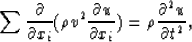 |
(81) |
 and
and  , then plane waves
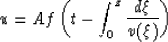
propagate in z-direction without scattering.
This is easy to show if one inserts
, then plane waves
propagate in z-direction without scattering.
This is easy to show if one inserts
II. Boundary conditions. There are few types of conditions that can be used for the wave-field continuation with the help of equation (80).
1. Mixed problem with boundary and initial conditions
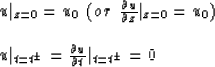
This problem has a unique and stable solution (in a restricted domain). It is
restricted at  (for direct continuation) and
  (for inverse continuation) if h>0 and
  (or
(or  ).
).
Representations of the solution:
 Finite-difference technique which can be applied
for any inhomogeneous media.
Finite-difference technique which can be applied
for any inhomogeneous media.
Kirchhoff's type integral:
 |
(82) |
where  , I+ =(0, t), I(-) =(T-t, T),
 -Green's function which is the solution
of the equation
-Green's function which is the solution
of the equation
 |
(83) |
 and
and
 .
.
For inhomogeneous media Green's function usually is unknown
(although one can calculate ray zero-approximation of
). In the case of wave equation
Green's function for homogeneous medium is
 |
(84) |
 .It gives
![\begin{displaymath}
\begin{array}
{cl}
u^{(\pm)}({\bf r}, t) =
& {1\over 2\pi}\...
...bf D} u({\bf r}_0, t\mp{R\over v}) \Big ] d{\bf
r}_0\end{array}\end{displaymath}](img491.gif) |
(85) |
 .
.At big values of R the first term in square brackets can be neglected:
 |
(86) |
These expressions are valid only in 3D case. In 2D case Green's function is
![\begin{displaymath}
g^+({\bf r}, {\bf r}_0, t) = {1\over 2\pi}\left[{H(t-{R_+\ov...
... {H(t-{R_-\over v})\over\sqrt{t^2 - ({R_-\over v})^2}}
\right]\end{displaymath}](img494.gif) |
(87) |
Inserting this into the equation (82) we obtain for the reverse continuation
![\begin{displaymath}
\begin{array}
{cl}
U^{(-)}({\bf r}, t) =
& {1\over \pi v}
...
...r v})\over
\sqrt{\tau-t+{2R\over v}}
}
\Big ]dx_0\end{array}\end{displaymath}](img495.gif) |
(88) |
 .
. 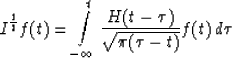 |
(89) |
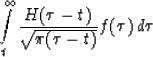
 . Now we may
also introduce
. Now we may
also introduce 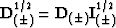 where signs + and - show what time
(usual or reverse) is used.
where signs + and - show what time
(usual or reverse) is used.
Let the field u0 (x0, t) contain a wave at t=t0.
The field u(-) will contain the wave at t = t0 -
R/v. Then the main contribution in the integral (88) is
made by the values of the field u0 at  , that is,
  .
.
Taking into account all these considerations and neglecting
the term with fast attenuating at  , we
derive from equation (88):
, we
derive from equation (88):
 |
(90) |
Spectral representation in ( )-domain
(the wave equation, homogeneous media):
)-domain
(the wave equation, homogeneous media):
 |
(91) |
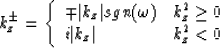
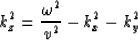
2. The Cauchy problem with respect to z in the  domain
for the equation
domain
for the equation
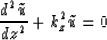 |
(92) |
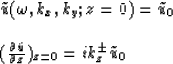
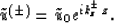
 and unstable at
  .We have the same problem with respect to the Cauchy problem for the wave equation
with the conditions:
.We have the same problem with respect to the Cauchy problem for the wave equation
with the conditions:
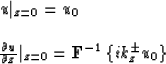
The natural way to stabilize Cauchy's problem is to cut off all frequencies at k2z < 0.
3. Reconstruction-type wave-field extrapolation. In this case we pose the conditions

 |
(93) |
) in both the (r,t)
and the domain. The simplest regularization is the same as above.
There is only one reverse type regular continuation into homogeneous medium which satisfies the condition:
| u|z=0 =u0 | (94) |
![\begin{displaymath}
\left[ \alpha u + (1- \alpha ) {\partial u \over \partial z} \right] _{z=0} = u_{0}\end{displaymath}](img516.gif)
 .
.
In inhomogeneous media different conditions produce different solutions.
Figure ![[*]](http://sepwww.stanford.edu/latex2html/cross_ref_motif.gif) shows an example of different solutions:
(a) is the reversed continuation of a single event at
shows an example of different solutions:
(a) is the reversed continuation of a single event at  for
mixed conditions, and (b) for the Cauchy problem.
for
mixed conditions, and (b) for the Cauchy problem.
In Figure a we use reverse time -t instead of t (we can do it with
accordance with relation (51) in Chapter 5) because it promotes better understanding of
reflection-refraction pattern at the interface z=d. In reverse time we have the
usual process of wave propagation. Dashed lines show some ghost waves.