


Now suppose I know a set of n Green's function traveltime fields
 for n source positions
  .
Estimating the traveltime field
.
Estimating the traveltime field  ,
due to a single intermediate
surface source position
,
due to a single intermediate
surface source position  , from the n given fields
  ,
is defined as traveltime interpolation.
,
is defined as traveltime interpolation.
For the set of , (7) can be generalized to a linear matrix
equation of the form:
 |
(12) |
or into a general weighted least-squares system  :
:
 |
(13) |
System (13) can be solved by standard damped least-squares,
 |
(14) |
or by the optimal (but slow) Singular Value Decomposition (SVD)
method, for the components of the unknown vector  .I refer the reader to Strang (1980) for an excellent review of damped
least squares and SVD linear algebra techniques.
The diagonal weighting matrix
.I refer the reader to Strang (1980) for an excellent review of damped
least squares and SVD linear algebra techniques.
The diagonal weighting matrix  is of
dimensions (nxn), and the weights wi could be inverse-distance:
is of
dimensions (nxn), and the weights wi could be inverse-distance:
 ,
for example. The
,
for example. The  matrix is (nx3) in 3-D and (nx2) in 2-D (ignoring
the
matrix is (nx3) in 3-D and (nx2) in 2-D (ignoring
the  terms), and contains the vector components of the known traveltime
gradient fields. The data vector
terms), and contains the vector components of the known traveltime
gradient fields. The data vector  is (nx1) and contains the
 values. For a 2-D geometry, at least two traveltime
gradient fields must be known, and for a 3-D interpolation at least three
traveltime gradient fields must be available.
values. For a 2-D geometry, at least two traveltime
gradient fields must be known, and for a 3-D interpolation at least three
traveltime gradient fields must be available.
In the case of interpolation, a refinement to the estimate of the
values is possible. In this paper, I use the Law of
Cosines given by (8) as an initial estimate of, say,
 and
and  , where the traveltime field
at
, where the traveltime field
at  is to be interpolated from two bounding source locations
 and
and  . Please refer to Figure
 ![[*]](http://sepwww.stanford.edu/latex2html/cross_ref_motif.gif) to consider the
appropriate interpolation geometry.
However, the angle
to consider the
appropriate interpolation geometry.
However, the angle  is known precisely from
the given traveltime (gradient) fields at and :
is known precisely from
the given traveltime (gradient) fields at and :
 |
(15) |
Therefore, given the angle estimates  ,
,  and
and
 , and the true angle , I can refine my
initial (primed) estimates such that the total angle is
conserved as a sum of
, and the true angle , I can refine my
initial (primed) estimates such that the total angle is
conserved as a sum of  ,
,  :
:
 |
(16) |
Then, the correction factor f is given as

 |
(17) |
As an example,
for a 2-D interpolation of  given
given  and
and  , I first
set up a 2x2 matrix system per (13). I evaluate the required
data vector values
, I first
set up a 2x2 matrix system per (13). I evaluate the required
data vector values  and
and  using (8),
and refine the cosine estimates using (17). I then invert system
(13) by Cramer's Rule if the determinant is not too small, or by
SVD if otherwise. The entire procedure is repeated in a point-by-point
independent manner, making it an obvious candidate for massively parallel
implementation, for all subsurface grid locations
using (8),
and refine the cosine estimates using (17). I then invert system
(13) by Cramer's Rule if the determinant is not too small, or by
SVD if otherwise. The entire procedure is repeated in a point-by-point
independent manner, making it an obvious candidate for massively parallel
implementation, for all subsurface grid locations  .
.
Finally, the traveltime gradients are spatially integrated to traveltime such that, for a source at (x2,z2) on a flat surface z = z2,
 |
(18) |
 |
(19) |
where H is the Heaviside function. This process completes
the traveltime interpolation of from and .
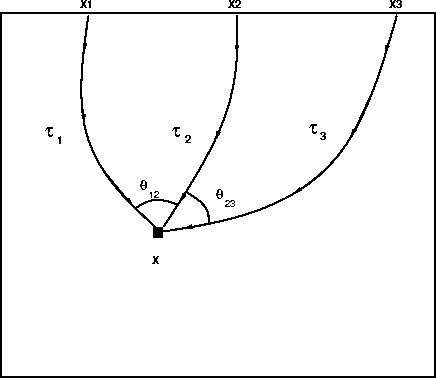 |
 due to
a source position at can be interpolated from two known traveltime
fields
due to
a source position at can be interpolated from two known traveltime
fields  and
and  due to sources at positions
and respectively.
due to sources at positions
and respectively.
