


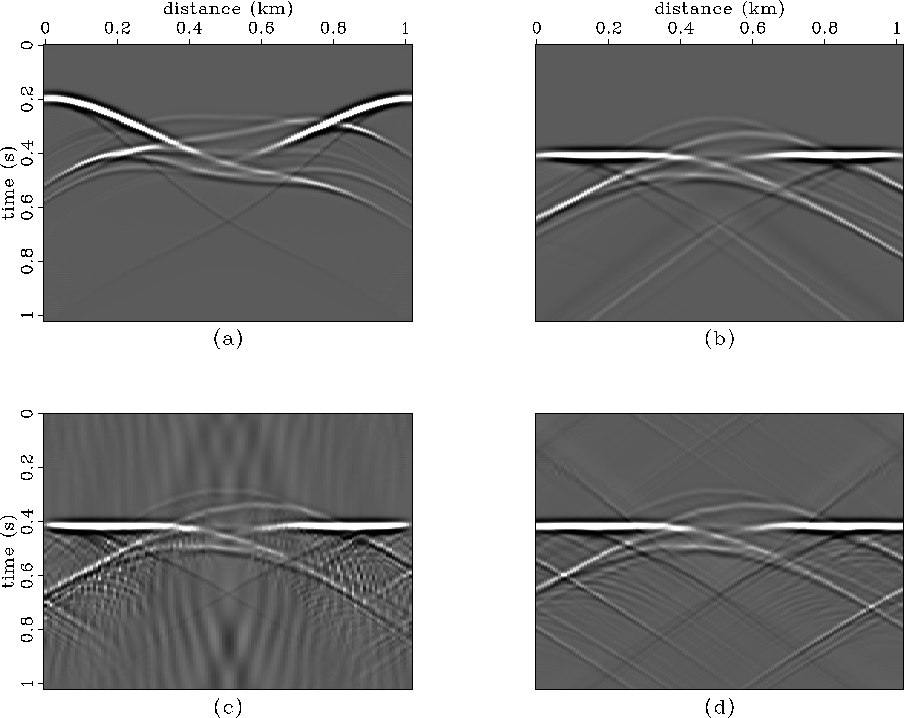
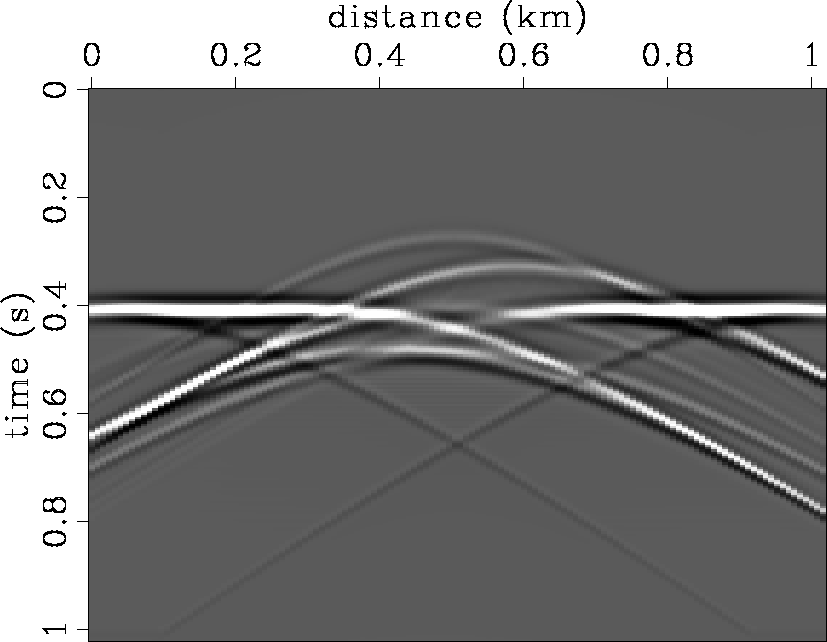
Upward continuing the synthetic data removes the distortions.
Figures ![[*]](http://sepwww.stanford.edu/latex2html/cross_ref_motif.gif) b through d are the result of
upward continuing the synthetic of Figure a
with the Kirchhoff, finite-difference, and phase-shift operators.
The output datum for all these upward continuations is just above
the highest topography at a datum elevation of 210 m.
The results exhibit different types of artifacts, but they are all
kinematically correct. The Kirchhoff result is the most pleasing, with
the fewest artifacts.
b through d are the result of
upward continuing the synthetic of Figure a
with the Kirchhoff, finite-difference, and phase-shift operators.
The output datum for all these upward continuations is just above
the highest topography at a datum elevation of 210 m.
The results exhibit different types of artifacts, but they are all
kinematically correct. The Kirchhoff result is the most pleasing, with
the fewest artifacts.
The Kirchhoff result is generated using the one-step time domain
formulation of equation ().
In this instance, the near-field term
has been retained and the  operator has been replaced
by a convolutional operator which depends on the delay
operator has been replaced
by a convolutional operator which depends on the delay  .The corresponding matrix formulation is the time domain equivalent of
equation () with H operator submatrices replaced
by -dependant convolutional operators.
.The corresponding matrix formulation is the time domain equivalent of
equation () with H operator submatrices replaced
by -dependant convolutional operators.
The finite-difference result is generated using the  equation and corresponds to the matrix formulation of equation ().
This result exhibits boundary artifacts and finite-difference
dispersion. The phase-shift result is generated using an implementation
corresponding to the
matrix formulation of equation (). It is kinematicly
equivalent to the other two upward continuations, but exhibits
Fourier wrap-around artifacts. The result is more aesthetically pleasing
than the finite-difference result, but has more artifacts than the
output of the Kirchhoff method.
equation and corresponds to the matrix formulation of equation ().
This result exhibits boundary artifacts and finite-difference
dispersion. The phase-shift result is generated using an implementation
corresponding to the
matrix formulation of equation (). It is kinematicly
equivalent to the other two upward continuations, but exhibits
Fourier wrap-around artifacts. The result is more aesthetically pleasing
than the finite-difference result, but has more artifacts than the
output of the Kirchhoff method.
The results of upward continuation can be
compared with Figure , which is the result of calculating
the synthetic result directly at the datum elevation of 210 m. This
Figure represents the desired output of the datuming algorithms, and
it is best matched by the Kirchhoff datuming result. There are
minor differences between Figure and Figure b.
There is an imperceptible phase shift between the two figures,
and there are a few added artifacts in the datuming result.
For the most part, the Kirchhoff datuming result matches
Figure very well.
 |


|
syn21
Figure 8 Synthetic data generated at the flat output datum, at an elevation of 210 m. Compare to Figures b through d.
|  |
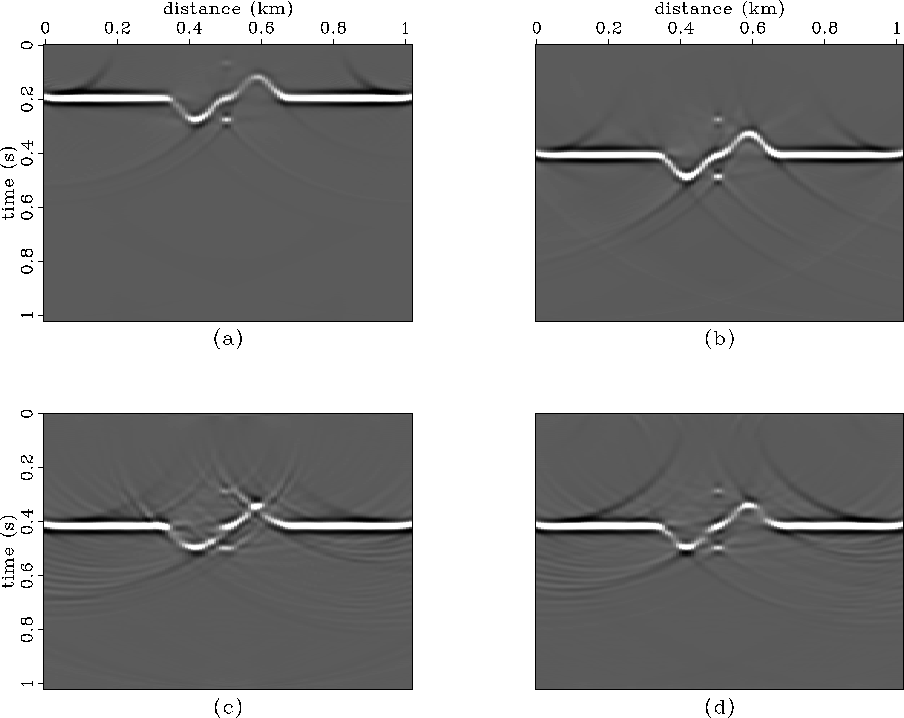
In Figure a, the synthetic data are migrated using the
adjoint of the program which generated
the synthetic. This migration requires
knowledge of the subsurface velocity.
In Figures b through c the upward continued
synthetics of Figures b through c
are migrated from the flat datum.
These three migrations were performed with the same Kirchhoff imaging algorithm.
In these migrations it is evident how the different dip components of the
wavefield are transformed by the different datuming operators.
The migration after finite-difference datuming results in the poorest
image because of the dip limitations of the approximation
to the one-way wave equation. The flanks of the anticline/syncline are
not imaged and the point diffractors are poorly imaged.
The migration after Kirchhoff datuming (Figure b)
images all the features of the
subsurface model.
This is because in the Kirchhoff datuming step,
much of the high dip energy has been captured during the upward
continuation by padding traces on either side of the section.
The migration after phase-shift datuming (Figure d)
results in a satisfactory image that compares favorably with the result of
imaging from the topography (Figure a).
The phase-shift method preserves the steep dips,
and performs much better than the finite-difference method.
In the phase-shift method, some of the steep dip energy is wrapped rather
than propagated off the grid. So, if a phase-shift migration had been
used, the high dip resolution would be similar to the Kirchhoff method.
In Chapter I will demonstrate the utility of upward continuing
data acquired along a rugged topography to a flat processing datum
in order to facilitate wave-based processing and to better determine
subsurface velocity.
 |