


For transformation of a wavefield from one datum to another,
as depicted in Figure ![[*]](http://sepwww.stanford.edu/latex2html/cross_ref_motif.gif) ,
a discrete form of equation () is
,
a discrete form of equation () is
 |
(6) |
 is the traveltime between input location i and output
location j.
The equivalent time domain equation is
is the traveltime between input location i and output
location j.
The equivalent time domain equation is
 |
(7) |
 operator would be replaced
by an i,j-variable convolution operator.
The 3-D equations are algorithmically identical, except that the
half-order derivative is replaced by a full derivative, and the
amplitude terms
operator would be replaced
by an i,j-variable convolution operator.
The 3-D equations are algorithmically identical, except that the
half-order derivative is replaced by a full derivative, and the
amplitude terms
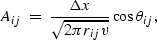
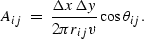
 is the angle between the normal to the input surface and the
traveltime path connecting input location i and output location j.
The
is the angle between the normal to the input surface and the
traveltime path connecting input location i and output location j.
The  factor arises from the identity

|
kwed
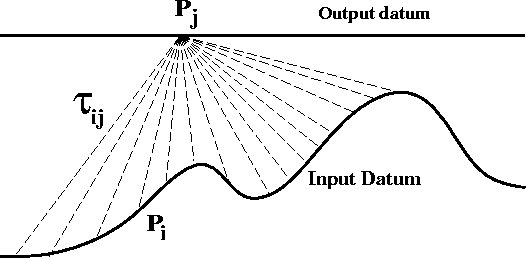
Figure 2 Schematic representation of Kirchhoff upward continuation corresponding to implementation of equation ( ) or
equation (). Each input trace Pi is filtered,
time shifted according to , scaled, and summed into
output trace Pj.
|  |

For the special illustrative case of three input traces,
equation () can be expressed in matrix form as
![\begin{displaymath}
\left[
P(x_j,z_j,\omega)
\right]
\;=\;
\left[
\begin{array}...
...,\omega) \\ P(x_{i=3},z_{i=3},\omega) \\ \end{array}\right] ,\end{displaymath}](img32.gif)
 is the Fourier-transformed input wavefield recorded
at datum zi and
is the Fourier-transformed input wavefield recorded
at datum zi and  is an output trace at
location (xj,zj).
A half-order derivative is applied to the input data by the block matrices
is an output trace at
location (xj,zj).
A half-order derivative is applied to the input data by the block matrices
![\begin{displaymath}
H \; = \;
\left[
\begin{array}
{cccccc}
\sqrt{-i\omega_1}& &...
... & & &.& \\ & & & & &\sqrt{-i\omega_n} \\ \end{array}\right] .\end{displaymath}](img35.gif)
, the time-shift matrix is given by
![\begin{displaymath}
Z_{ij} \; = \;
\left[
\begin{array}
{cccccc}
A_{ij}e^{i\omeg...
... & & & & &A_{ij}e^{i\omega_n \tau_{ij}} \\ \end{array}\right] .\end{displaymath}](img36.gif) |
(8) |
![\begin{displaymath}
\left[
P(x_j,z_j,\omega)
\right]
\;=\;
\left[
\begin{array}...
...,\omega) \\ P(x_{i=3},z_{i=3},\omega) \\ \end{array}\right] .\end{displaymath}](img37.gif) |
(9) |
Equation () can be generalized to multiple output traces. For
illustrative purposes, I write down the matrix equation for three input traces
and three output traces. The wavefield at the upper datum is
![\begin{displaymath}
\left[
\begin{array}
{c}
P(x_{j=1},z_{j=1},\omega) \\ P(x...
...,\omega) \\ P(x_{i=3},z_{i=3},\omega) \\ \end{array}\right] .\end{displaymath}](img38.gif) |
(10) |
) with ij corresponding to the time shift between input and output locations i and j. In actual implementation,
more than three traces are required for summation to represent integration
adequately. Three traces are used here merely for ease of exposition,
and to establish a pattern which is trivial to extend to more traces.
Equation () represents the upward continuation of a wavefield
between two arbitrarily-shaped surfaces.
The downward continuation operator is derived by taking the complex
conjugate transpose of the operator in equation (). This yields
the adjoint operator:
![\begin{displaymath}
\left[
\begin{array}
{ccc}
H^*& & \\ &H^*& \\ & &H^* \\...
...2}^* \\ Z_{13}^* & Z_{23}^* & Z_{33}^* \\ \end{array}\right] .\end{displaymath}](img39.gif) |
(11) |
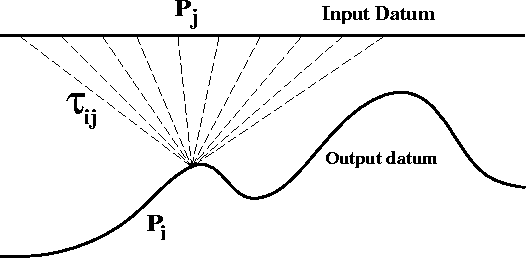
) is the downward continuation operator
which is depicted in Figure for one output trace.
|
kweddown
Figure 3 Schematic representation of Kirchhoff downward continuation corresponding to the operator of equation ( ). Each input trace Pj
is filtered, time shifted according to , scaled, and summed into
output trace Pi.
|  |
These matrix representations result in huge, albeit sparse, operator matrices. In the actual computer implementation of Kirchhoff datuming these huge matrix operators are not actually stored. The numerical algorithms apply these linear operators indirectly and much more efficiently.
In order to understand why Kirchhoff datuming is much more efficient than Kirchhoff time migration, it is instructive to look at the kinematics of the two processes. Kirchhoff datuming is performed by summing along a trajectory given by
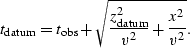
 is the vertical datuming distance, which remains
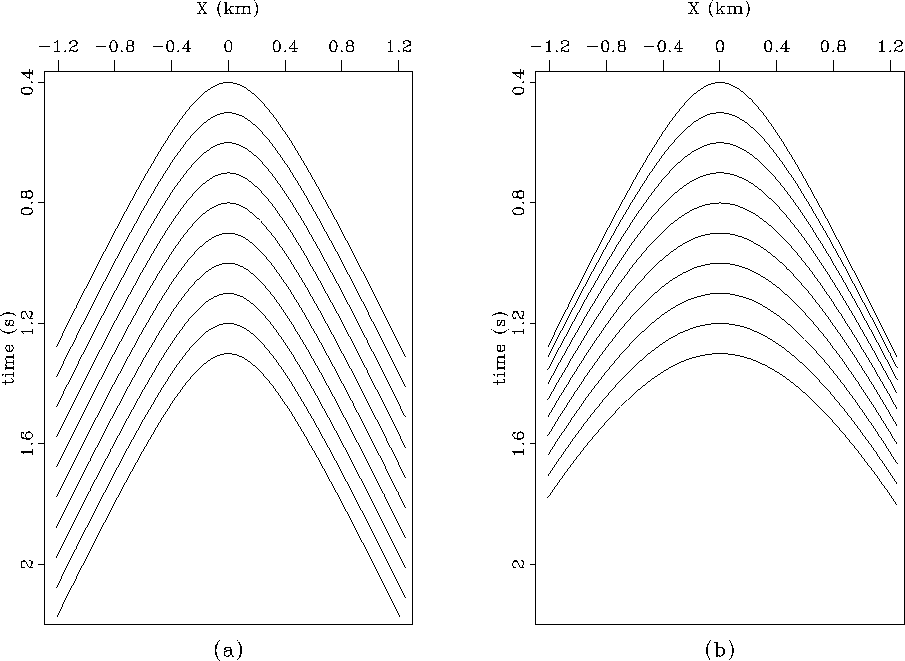
fixed, so each input trace is shifted by a time-invariant amount.
This is illustrated in Figure a for the simple case of
extrapolation between two level datums.
Time migration is performed by invoking the imaging condition
(setting
is the vertical datuming distance, which remains
fixed, so each input trace is shifted by a time-invariant amount.
This is illustrated in Figure a for the simple case of
extrapolation between two level datums.
Time migration is performed by invoking the imaging condition
(setting  ) and performing the summation for each image point
 .The resulting summation trajectory is given by
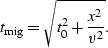
b.
Most of the Kirchhoff datuming results in this dissertation are generated
by implementing equation () on Thinking Machine's
massively parallel CM5 (Bevc, 1993). The frequency domain
is computationally attractive because the static time shift
and the convolutional filtering are both efficiently
applied by complex multiplication. This frequency domain implementation
makes Kirchhoff datuming much more efficient than time domain
Kirchhoff migration.
 |


Prestack datuming is performed by using reciprocity to extrapolate shot and receiver gathers (Berryhill, 1984). This can be represented mathematically by the double summation
 |
(12) |
 . The summations
over
. The summations
over  and
and  represent integration over the shot
and receiver coordinates.
represent integration over the shot
and receiver coordinates.  and
and
 represent amplitude and
traveltime delay in either shot (* = s) or receiver
(* = g) gathers. Because both shot and group gathers are
datumed, for 2-D the convolutional operator
represent amplitude and
traveltime delay in either shot (* = s) or receiver
(* = g) gathers. Because both shot and group gathers are
datumed, for 2-D the convolutional operator
 corresponds to filtering
with a full derivative operator, and for 3-D data D corresponds to
filtering with a second-order derivative operator.
This sum is performed for all output shot
corresponds to filtering
with a full derivative operator, and for 3-D data D corresponds to
filtering with a second-order derivative operator.
This sum is performed for all output shot  and receiver
 coordinates.
So far, this development has been for constant velocity media. In
variable velocity media, the calculation of the Green's functions
becomes more complicated. The most common way of handling complex
velocity structure with Kirchhoff methods is by
calculating the traveltime shift  using ray tracing or
finite-difference solutions to the eikonal equation.
I choose to use eikonal traveltimes calculated with van Trier and Symes'
(1991) upwind finite-difference algorithm. In Chapter I demonstrate
that this gives excellent results, even for complex velocity models
such as the Marmousi synthetic.
using ray tracing or
finite-difference solutions to the eikonal equation.
I choose to use eikonal traveltimes calculated with van Trier and Symes'
(1991) upwind finite-difference algorithm. In Chapter I demonstrate
that this gives excellent results, even for complex velocity models
such as the Marmousi synthetic.