


The distortion of the raw shot gathers (Figure ![[*]](http://sepwww.stanford.edu/latex2html/cross_ref_motif.gif) ) due to
topography and near-surface effects can be broken down into two
components: a high-frequency jitter, and a low-frequency
component associated with the topography. The high-frequency
component can be due to local velocity variations, surveying errors,
or any other effects that often plague land data.
Wave-equation datuming is only intended to remove the long
wavelength effects of the topography. The high-frequency statics
degrade the datuming result if they are not removed.
) due to
topography and near-surface effects can be broken down into two
components: a high-frequency jitter, and a low-frequency
component associated with the topography. The high-frequency
component can be due to local velocity variations, surveying errors,
or any other effects that often plague land data.
Wave-equation datuming is only intended to remove the long
wavelength effects of the topography. The high-frequency statics
degrade the datuming result if they are not removed.
To take care of the high-frequency component, I shift the data
statically using the result of a commercial
maximum power residual statics program![[*]](http://sepwww.stanford.edu/latex2html/foot_motif.gif) . The residual
statics solution is then applied to the data. In general, this
process may have to be iterated, depending on the data and the
statics solution.
. The residual
statics solution is then applied to the data. In general, this
process may have to be iterated, depending on the data and the
statics solution.
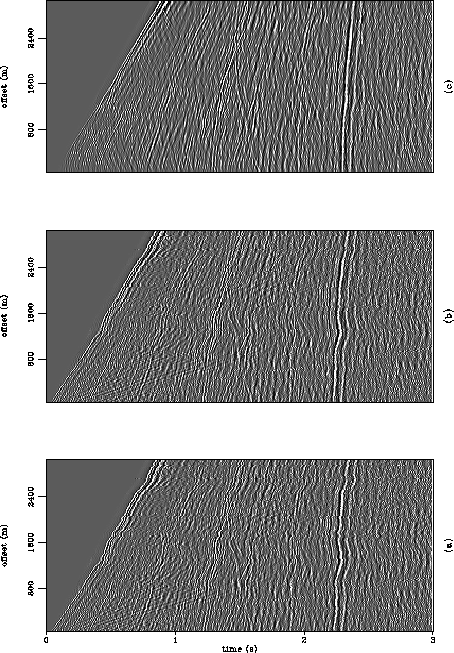
Figure a shows the first shot gather from the
overthrust data set.
The residual statics correction has
been applied in Figure b. The data now look much more
continuous, but the long wavelength distortion is still pronounced.
Figure c is the result of applying wave-equation
datuming to the static-corrected gather. The receivers are now at
the final output datum elevation of 1700 m.
 |


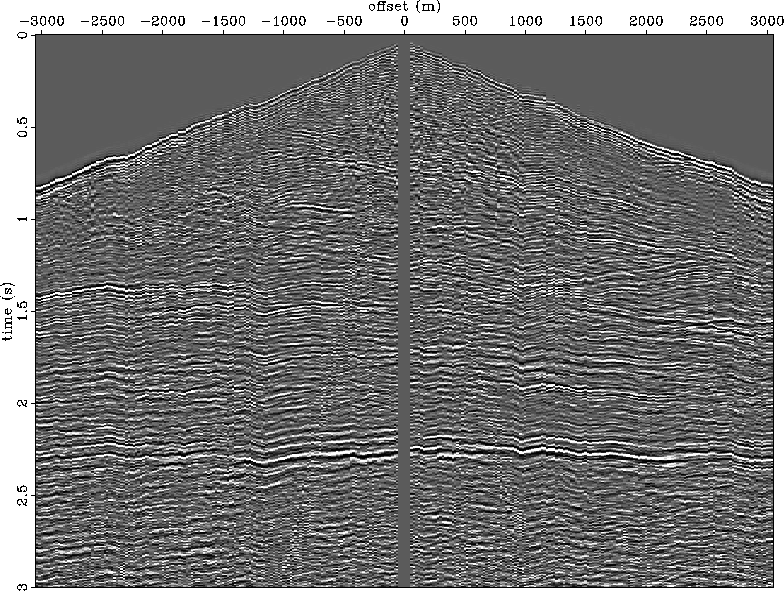
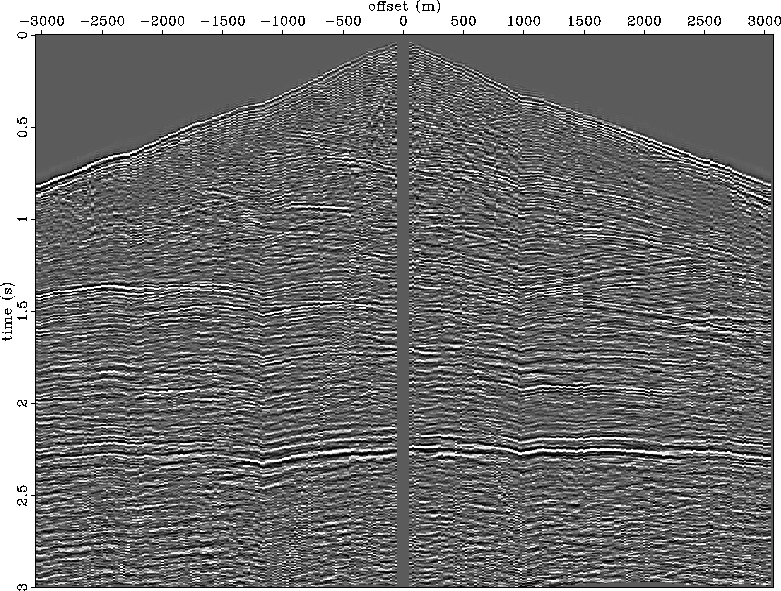
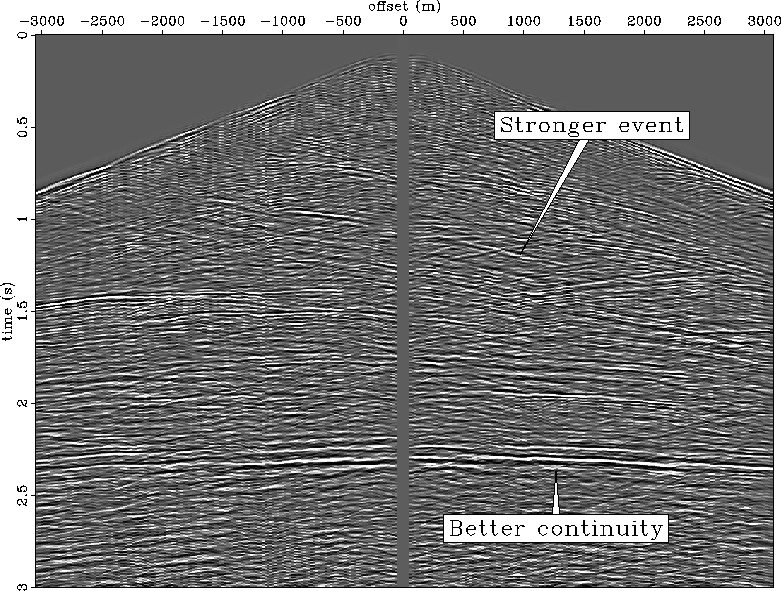
Figures and show shot number 53
before and after residual statics application.
This shot spans an area approximately between CMP
500 and CMP 800, so it has significant topography
along offset.
Receiver elevation statics have been applied in
Figure to shift the data to the 1700 m datum.
Most of the topographic distortion has now been removed from the events.
However, as shown in Figure , the events have better
lateral continuity after wave-equation datuming.
Wave-equation datuming also brings out events which were not
visible, or not readily detectable before.
Another benefit of wave-equation datuming is seen in this example. There are some steep-dip noise events on the inner offsets of the original and static corrected gathers. Evidently, the array design of this survey was adequate to suppress most of this noise, but on some land data sets it can be a significant problem. After wave-equation datuming, the steep-dip noise events have been eliminated because wave-equation datuming implicitly removes events that have dip angles which exceed those that can be reconstructed with a given extrapolation velocity.
So far, I have only applied elevation statics and datuming to the
receivers alone. Application of the shot elevation static will not change
the overall appearance of Figure , since it
only involves a bulk shift of all the traces within the gather.
To complete the redatuming task, I upward continue
the data in common receiver gathers as outlined in Chapter .
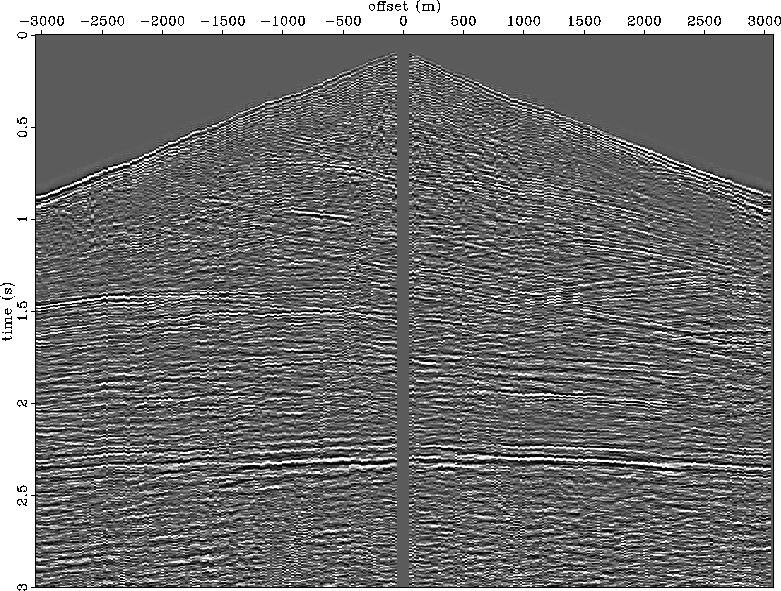
Figure shows shot gather 53 after both common
shot and receiver gathers have been upward continued to a regularly
grided output datum at elevation 1700 m.
The shot gap has been filled in by the extrapolation operator.
There is an area of weak reconstruction around offset -1500 m,
where the original acquisition geometry has a substantial gap.
The wave-equation datumed gather shows numerous strong reflection
events with good lateral continuity. There are many events present
after datuming that were not identifiable before. The steep-dip
and high frequency noise has also been removed by the datuming operation.
The best wave-equation datuming results are usually obtained when both sources and receivers are closely spaced at equal intervals. In this case, shots are spaced, on average, at five times the receiver interval. Nonetheless, wave-equation datuming works well for this example. This is due to the fact that the propagation velocities are so fast that the data are not severely aliased, if at all. The issue of under-sampled shot spacing becomes detrimental to wave-equation datuming when propagation velocities are slow and when there is substantial moveout.
I will demonstrate in the next section that working with the wave-equation datumed gathers offers a distinct advantage for subsequent wave-based operations such as stacking and migration.
 |
 |
![[*]](http://sepwww.stanford.edu/latex2html/movie.gif)
 |
 |
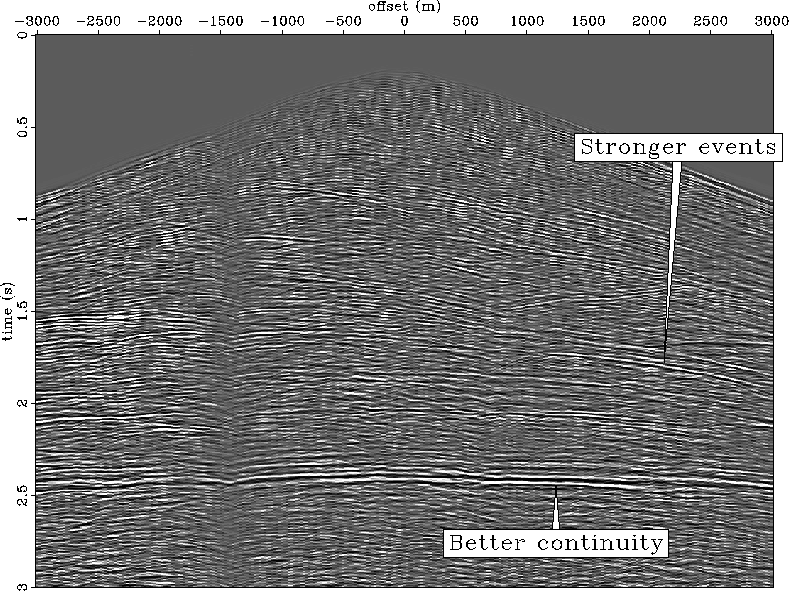 |
Figure is a plot of the gathers from
after wave-equation datuming to a datum elevation of 1700 m.
In all cases, the application of wave-equation
datuming results in well-behaved moveout trajectories. Most
of the departure from hyperbolic moveout is now due to the
complex velocity structure rather than to topographic and near-surface
effects.
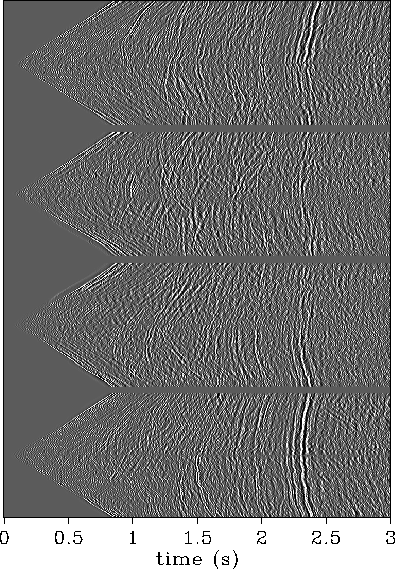 |
after
residual statics and wave-equation datuming. The topographic
distortions have been removed. Movie.