


In this section I compare my layer-stripping migration algorithm to shot-profile migration, and Kirchhoff migration using both maximum-amplitude traveltimes and band-limited Green's functions.
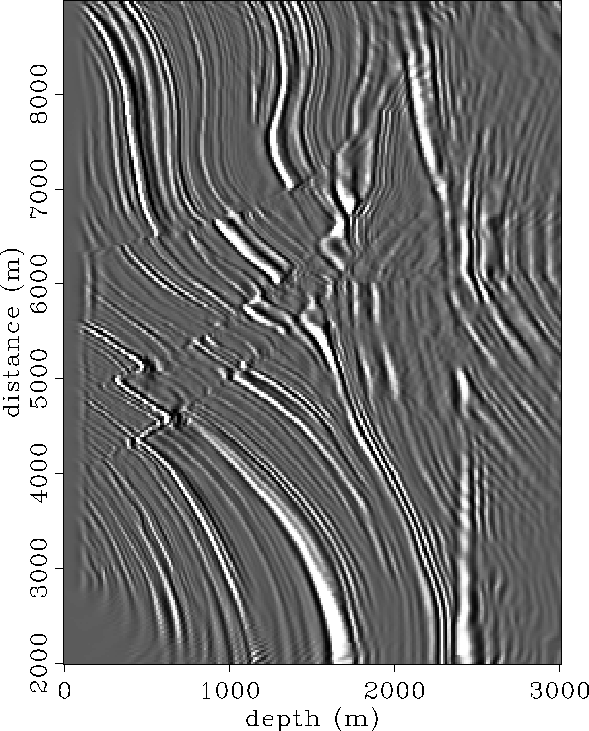
The shot-profile migration generated with
Advance Geophysical Co.'s commercial algorithm
is displayed in Figure ![[*]](http://sepwww.stanford.edu/latex2html/cross_ref_motif.gif) .
It produces a good structural image by recursively downward
continuing source and receiver wavefields for all frequencies using
explicit finite-difference extrapolators.
The problem with the method is that it is expensive and it requires
regular fine sampling of the recording surface. This makes it impractical
for 3-D data and irregularly-sampled land data.
.
It produces a good structural image by recursively downward
continuing source and receiver wavefields for all frequencies using
explicit finite-difference extrapolators.
The problem with the method is that it is expensive and it requires
regular fine sampling of the recording surface. This makes it impractical
for 3-D data and irregularly-sampled land data.
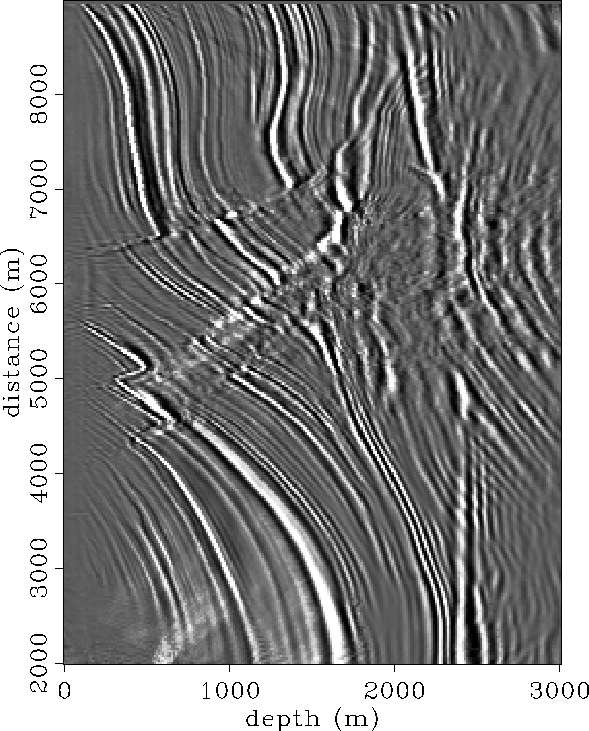
Figure is the result of Kirchhoff migration using
maximum-amplitude traveltime and phase calculated with a paraxial
ray-tracing program.
Thorbjorn Rekdal did the ray tracing and Dave Nichols
did the migration to produce this image (Nichols, 1994).
This results in a much better image than
the standard first-arrival traveltime migration of Figure ,
but it is not as good as my layer-stripping Kirchhoff migration.
It shows that there is an advantage to maximum-amplitude ray tracing,
but that the complexity of the wavefield cannot be adequately accounted
for at late times. This method is generally pretty expensive and requires
extensive smoothing of the slowness model to ensure stability of
ray tracing.
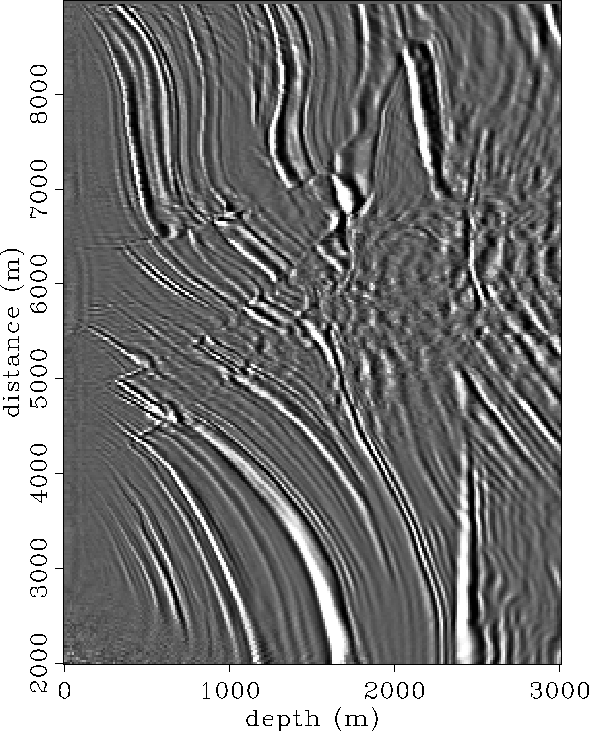
Figure is the result of using Nichols' (1994) band-limited
Green's function method to calculate traveltimes for Kirchhoff migration.
The image is much better than the
standard first-arrival traveltime migration of Figure ,
but, once again, it is not as good as my layer-stripping Kirchhoff migration.
The figure shows that using traveltimes which are calculated in the seismic
frequency band has a distinct advantage over first-arrival traveltimes
and that the band-limited traveltimes
track the high energy portions of the wavefield better, but they are still
not able to capture all the events which should be summed coherently to
form the best image. Nichols' method is considerably less expensive
than shot-profile migration because only eight frequency components are
propagated to estimate band-limited traveltimes; however, it is more
expensive than finite-difference first-arrival traveltime calculation.
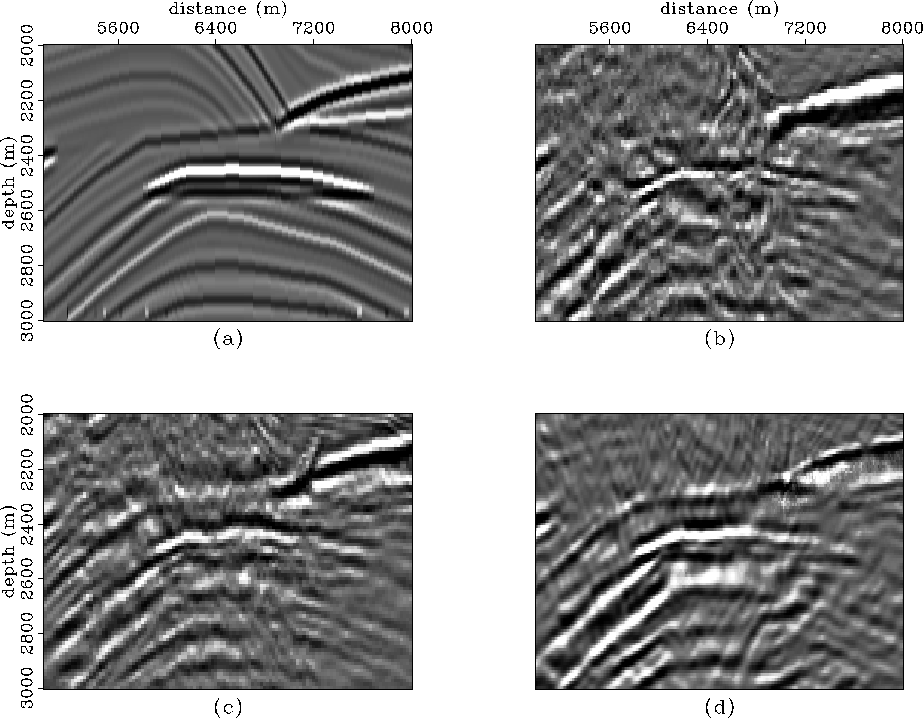
The target zone images of the Kirchhoff migration results are compared
in Figure . The layer-stripping migration
produces the best image. It is the best match to the idealized reflectivity,
and it has the best overall image quality in terms of lateral
continuity and structural definition.
 |
![[*]](http://sepwww.stanford.edu/latex2html/movie.gif)


 |
. Movie.
 |
. Movie.
 |