


The simplest type of aliasing related to imaging operator is image-space aliasing . It occurs when the spatial sampling of the image is too coarse to represent adequately the steeply dipping reflectors that the imaging operator attempts to build during the imaging process. In other words, image-space aliasing is caused by too coarse sampling of the image space, and consequent aliasing of the migration ellipsoid. A simple way of avoiding image aliasing is to make the spatial sampling of the image denser. But for a given spatial sampling of the image, to avoid image aliasing we need to limit, during the migration process, the frequency content of the image as a function of reflectors' dips. This goal can be accomplished by performing a dip-dependent temporal lowpass filtering of the input data during the summation process. An efficient method to lowpass time-domain data with variable frequency is the triangle-filters method described in Basic Earth Imaging Claerbout (1995). An alternative method is to precompute lowpassed versions of the input traces, and select the appropriate input data during summation Gray (1992). This second method is potentially more accurate than the triangle filtering, and it is more computationally efficient when each input trace is summed into many output traces, as happens for 3-D migrations Abma (1998). However, it may require storing many versions of the input data. To reduce the storage requirements, without affecting the accuracy, I linearly interpolate the lowpassed traces along the frequency axis during the summation.
The anti-aliasing constraints to avoid image aliasing
can be easily derived from basic sampling theory.
For the case of time migration,
when the coordinates of the
image space are  ,the pseudo-depth frequency
  must
fulfill the following inequalities:
must
fulfill the following inequalities:
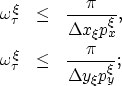 |
||
| (1) |
 and
and  are respectively the image sampling rate of the
  and
and  axes,
and
axes,
and  and
and  ,
are the reflector dip components.
,
are the reflector dip components.
As discussed above, it is convenient to apply
an anti-aliasing filter as a band-pass filter of the input traces,
before summing
their contributions to the image
into the output.
Therefore, we need to recast the constraints
on the pseudo-depth frequency
of equations (1) into constraints
on the input data frequency  .This distinction is important because
the frequency content of the seismic wavelet changes during
the imaging process because of stretching, or compression,
of the time axis.
In particular, during migration the wavelet is always
stretched; neglecting this stretch would lead
to anti-aliasing constraints that are too stringent.
Notice, that the seismic wavelet may get compressed,
instead of stretched, by other imaging operators, such as
inverse DMO and AMO Biondi et al. (1998).
The pseudo-depth frequency of the image and the temporal frequency
of the data are thus linked by the wavelet-stretch factor
.This distinction is important because
the frequency content of the seismic wavelet changes during
the imaging process because of stretching, or compression,
of the time axis.
In particular, during migration the wavelet is always
stretched; neglecting this stretch would lead
to anti-aliasing constraints that are too stringent.
Notice, that the seismic wavelet may get compressed,
instead of stretched, by other imaging operators, such as
inverse DMO and AMO Biondi et al. (1998).
The pseudo-depth frequency of the image and the temporal frequency
of the data are thus linked by the wavelet-stretch factor
 , as
, as
 .Taking into account the wavelet-stretch factor,
we can write the constraints on the data frequency
that control image aliasing, as a function of the
image sampling rates and ,the image dips and ,and the wavelet-stretch factor ,
.Taking into account the wavelet-stretch factor,
we can write the constraints on the data frequency
that control image aliasing, as a function of the
image sampling rates and ,the image dips and ,and the wavelet-stretch factor ,
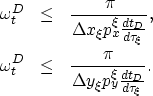 |
||
| (2) |