


 and
and  ,
and the wavelet-stretch factor
,
and the wavelet-stretch factor  ,can be analytically derived
as functions of the input and output trace geometry
and the input time.
Appendix A presents the derivation
of the analytical relationships that I apply for the following examples.
,can be analytically derived
as functions of the input and output trace geometry
and the input time.
Appendix A presents the derivation
of the analytical relationships that I apply for the following examples.
|
Imp-noantialias
Figure 5 Image obtained by applying Kirchhoff migration without anti-aliasing. | 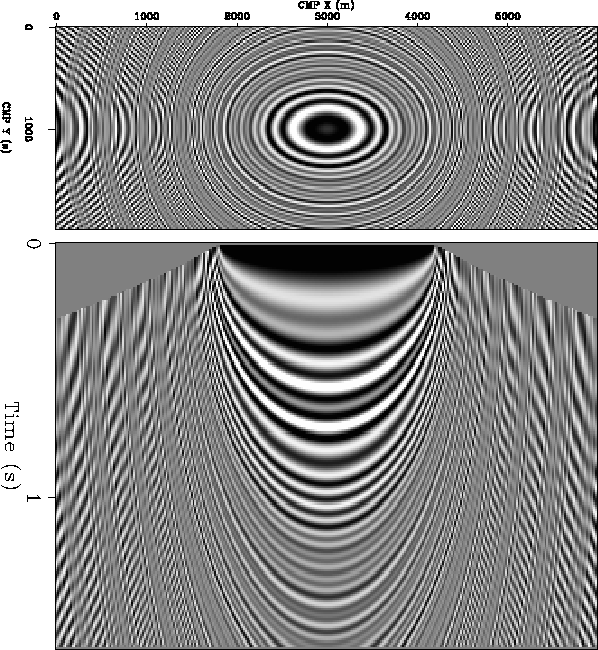 |


|
Imp-antialias-equal
Figure 6 Image obtained by applying Kirchhoff migration with image-space anti-aliasing. | 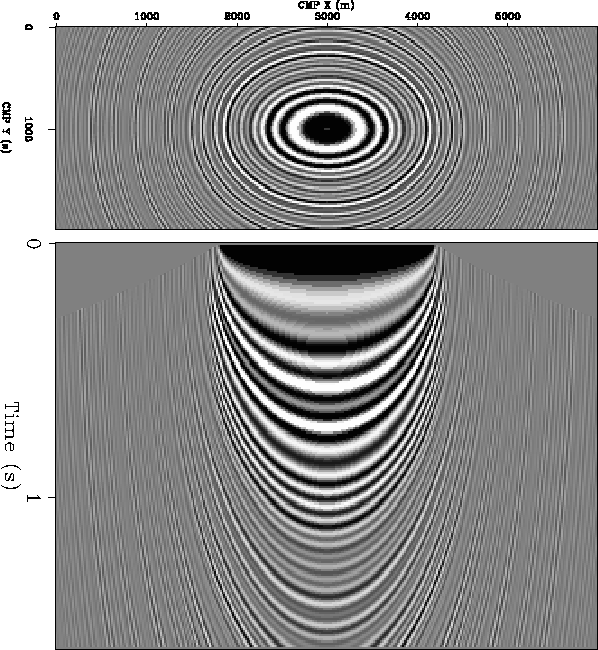 |
|
Imp-nostretch
Figure 7 Image obtained by applying too strong of anti-aliasing by ignoring the effects of the wavelet stretch on the frequency content of the image. | 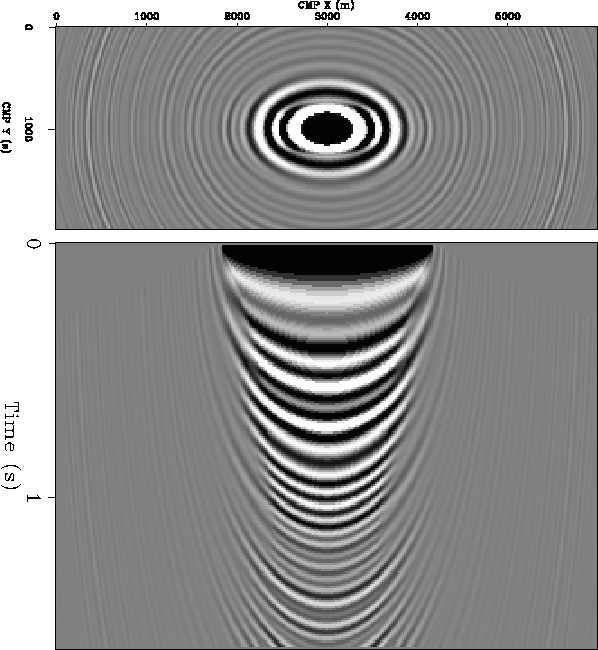 |
To gain intuition about the effects of incorporating
an anti-aliasing filter in migration operator,
it is instructive to analyze the
images generated by migrating one single input trace
into a cube.
Figure 5 shows the result
of migrating one trace
without the application of any anti-aliasing filter.
The input trace was recorded at an offset of 2.4 km.
The image sampling was 20 m in each direction
 .Strong aliasing artifacts are visible in both the time slices
and the vertical section.
.Strong aliasing artifacts are visible in both the time slices
and the vertical section.
Figure 6 shows the result
of migrating the same data trace with an appropriate
anti-aliased operator.
Notice that the aliasing artifacts disappear
as the frequency content of the imaged reflectors
progressively decreases as the dips increase.
Figure 7 shows the result
of migrating the same data trace when the effects
of the wavelet stretch are not taken into account;
that is, by setting
 .In this case the anti-aliasing filter over-compensates
for the image dip and valuable resolution is lost
at steep dips.
Examining the time slice shown on the top
of Figure 7,
we notice that the loss of resolution is larger
for regions of the migration ellipses
with a steep dip along the cross-line direction.
.In this case the anti-aliasing filter over-compensates
for the image dip and valuable resolution is lost
at steep dips.
Examining the time slice shown on the top
of Figure 7,
we notice that the loss of resolution is larger
for regions of the migration ellipses
with a steep dip along the cross-line direction.
Figure 8 shows the effects
of image-space aliasing on the migrated results
from the salt-dome data set
shown in Figure 1.
Figure 8a shows
the non-antialiased migration results
with  ;that is the original sampling of the zero-offset data.
Shallow dipping reflectors
and the steep high-frequency event at about 2.2 seconds
are badly aliased.
The quality of the image improves
by halving the image spatial sampling to
;that is the original sampling of the zero-offset data.
Shallow dipping reflectors
and the steep high-frequency event at about 2.2 seconds
are badly aliased.
The quality of the image improves
by halving the image spatial sampling to
 (Figure 8b).
It is useful to notice that
the traces in
Figure 8a
are exactly the same as the odd traces
in Figure 8b.
Therefore, image aliasing does not
add noise to the image,
it just makes the image more difficult and ambiguous to interpret.
The application of the image-space anti-aliasing constraints,
expressed in equation (2),
further improves the image quality,
in particular for the shallower events
(Figure 8c).
Although the image in
Figure 8c
is less noisy
than the images in
Figure 8a and
Figure 8b,
it is still contaminated by aliasing artifacts.
These artifacts are caused by
operator aliasing ,
or data-space aliasing.
Next section analyzes the causes of operator aliasing,
and presents anti-aliasing constraints to eliminate it.
(Figure 8b).
It is useful to notice that
the traces in
Figure 8a
are exactly the same as the odd traces
in Figure 8b.
Therefore, image aliasing does not
add noise to the image,
it just makes the image more difficult and ambiguous to interpret.
The application of the image-space anti-aliasing constraints,
expressed in equation (2),
further improves the image quality,
in particular for the shallower events
(Figure 8c).
Although the image in
Figure 8c
is less noisy
than the images in
Figure 8a and
Figure 8b,
it is still contaminated by aliasing artifacts.
These artifacts are caused by
operator aliasing ,
or data-space aliasing.
Next section analyzes the causes of operator aliasing,
and presents anti-aliasing constraints to eliminate it.
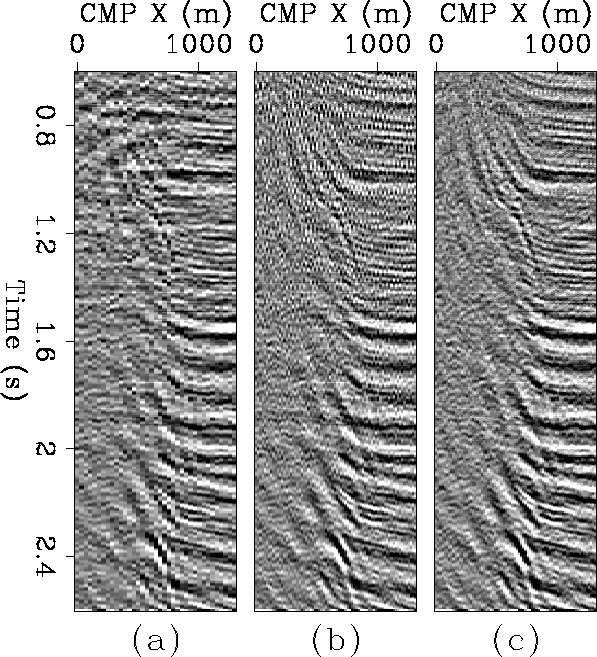 |
and no anti-aliasing,
(b) and no anti-aliasing,
(c) and image-space anti-aliasing.