


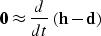
All Galilee imaging formulations until now have produced images with survey-vessel tracks in them. We do not want those tracks. Allow me a hypothetical explanation for the tracks. Perhaps the level of the lake went up or down because of rain or drought during the months of the survey. Perhaps some days the vessel was more heavily loaded and the sensor was deeper in the water. We would not have this difficulty if instead of measuring depth, we measured water bottom slope, say by subtracting two successive depth measurements. This gives a new problem, that of finding the map of the topography of the water bottom from measurements of its slopes along ships' tracks. We can express this as the fitting goal
 |
(20) |
|
To eliminate vessel tracks in the map, we apply along the track a derivative to both the model and the data. |
A beginner might believe that if the ship changes speed
or stops while the depth sounder continues running,
that we should divide the depth differences by the distance traveled.
We could try that,
but it might be neither necessary nor appropriate
because the (1,-1) operator is simply a weighting function for a statistical
estimation problem,
and weighting functions do not need to be known to great accuracy.
Perhaps the best weighting function is the prediction-error filter
determined from the residual itself.
Without further ado, we write the noise-weighting operator
as  and consider it to be either d/dt or a PEF.
Notice that we encounter PEFs in both data space and model space.
We have been using
and consider it to be either d/dt or a PEF.
Notice that we encounter PEFs in both data space and model space.
We have been using
 and
and  to denote PEFs on the final map,
and now in the data space we have the PEF on the residual.
to denote PEFs on the final map,
and now in the data space we have the PEF on the residual.