


 |
(23) |
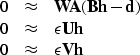
I omit the display of my subroutine for the goals (23) because the code is so similar to potato(). (Its name is pear() and it is in the library.)
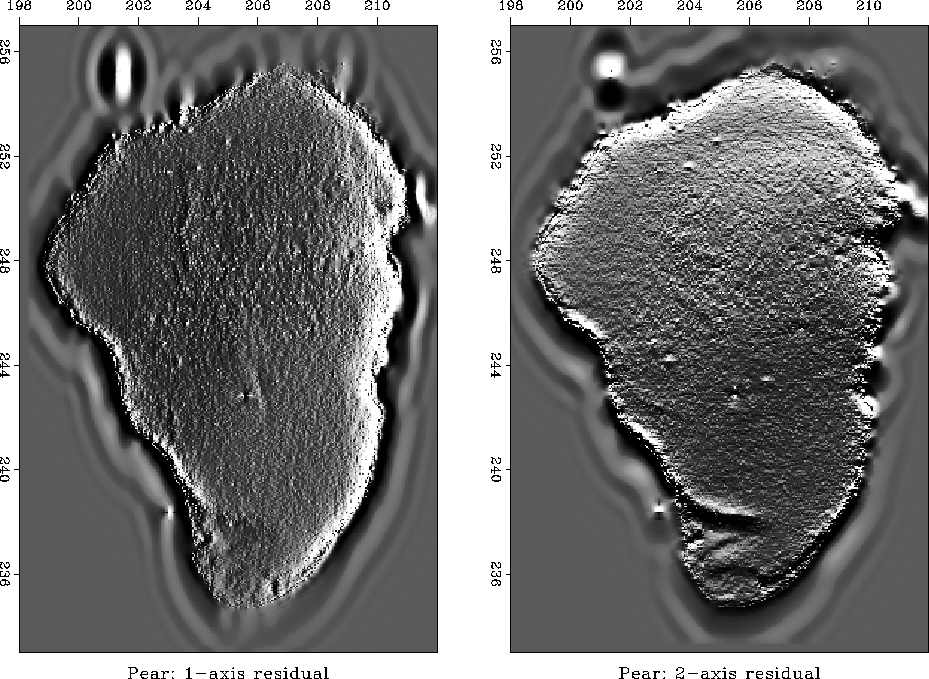
A disadvantage of the previous result in Figure 10 is that for the horizontal gradient, the figure is dark on one side and light on the other, and likewise for the vertical gradient. Looking at the result in Figure 11 we see that this is no longer true. Thus although the topographic PEFs look similar to a gradient, the difference is substantial.
 |
![[*]](http://sepwww.stanford.edu/latex2html/movie.gif)


Subjectively comparing Figures 10 and 11 our preference depends partly on what we are looking at and partly on whether we view the maps on paper or a computer screen. Having worked on this so long, I am disappointed that most of my 1997 readers are limited to the paper. Another small irritation is that we have two images for each process when we might prefer one. We could have a single image if we go to a single model roughener.
I have wondered whether any significant improvements
might result from using linear interpolation  instead of simple binning
  .The initialization arguments are identical in operator
lint2
.The initialization arguments are identical in operator
lint2 ![[*]](http://sepwww.stanford.edu/latex2html/cross_ref_motif.gif) and operator bin2 ,
so they are ``plug compatible''
and we could easily experiment.
and operator bin2 ,
so they are ``plug compatible''
and we could easily experiment.