Next: PEFs on both model
Up: ELIMINATING SHIP TRACKS IN
Previous: ELIMINATING SHIP TRACKS IN
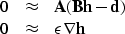
For simplicity,
we begin with a simple gradient for the PEF of the map.
We have
|  |
(21) |
This is our first fitting system that involves all the raw data.
Previous ones have involved the data only after binning.
Dealing with all the raw data,
we can expect even more difficulty
with impulsive and erratic noises.
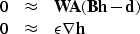
The way to handle such noise
is via weighting functions.
Including such a weighting function gives us the map-fitting goals,
|  |
(22) |
Involving as it does so many aspects of this book,
the solver potato() is quite a clutter.
Sorry about that.
Maybe it will look cleaner after I learn more about all the features
in Fortran 90.
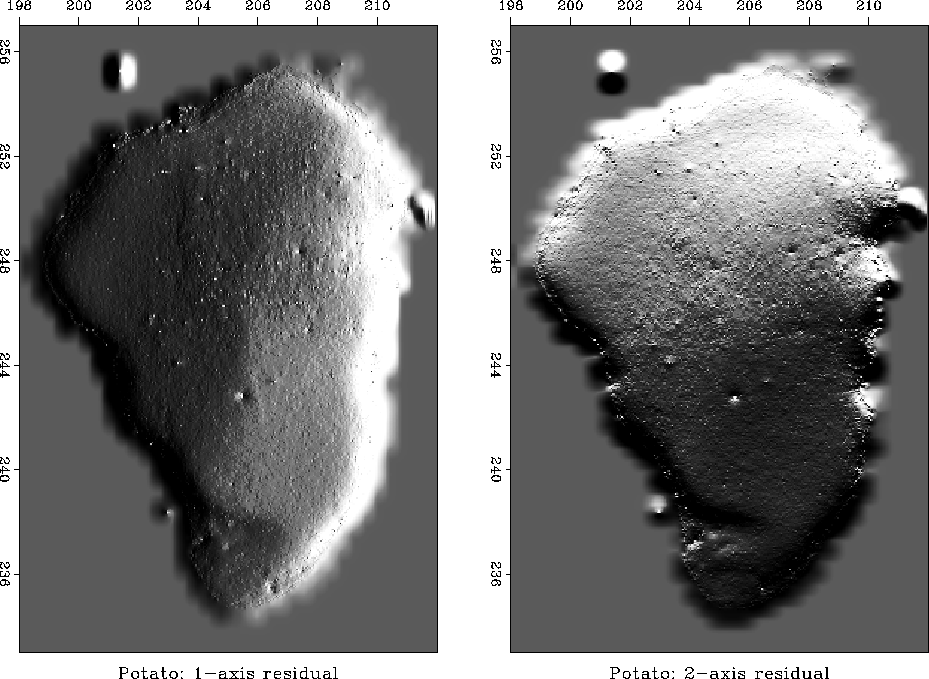
Results are in Figure 10.
potato
Figure 10
Gradient of the Galilee map from (22).
![[*]](http://sepwww.stanford.edu/latex2html/movie.gif)


It is pleasing to see the ship's tracks gone at last.
Next: PEFs on both model
Up: ELIMINATING SHIP TRACKS IN
Previous: ELIMINATING SHIP TRACKS IN
Stanford Exploration Project
12/15/2000