


Next: Spline regularization
Up: Fomel: Inverse interpolation
Previous: Seismic applications of forward
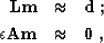
In the notation of Claerbout (1999), inverse interpolation amounts to a
least-squares solution of the system
|  |
(15) |
| (16) |
where  is a vector of known data f(xi) at irregular
locations xi,
is a vector of known data f(xi) at irregular
locations xi,  is a vector of unknown function values
f(n) at a regular grid n,
is a vector of unknown function values
f(n) at a regular grid n,  is a linear interpolation
operator of the general form (1),
is a linear interpolation
operator of the general form (1),  is an
appropriate regularization (model styling) operator, and
is an
appropriate regularization (model styling) operator, and  is
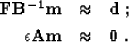
a scaling parameter. In the case of B-spline interpolation, the
forward interpolation operator becomes a cascade of two
operators: recursive deconvolution
is
a scaling parameter. In the case of B-spline interpolation, the
forward interpolation operator becomes a cascade of two
operators: recursive deconvolution  , which converts the
model vector to the vector of spline coefficients
, which converts the
model vector to the vector of spline coefficients
 , and a spline basis construction operator
  .System (15-16) transforms to
|  |
(17) |
| (18) |
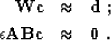
We can rewrite (17-18) in the form that
involves only spline coefficients:
|  |
(19) |
| (20) |
After we find a solution of system (19-20),
the model will be reconstructed by the simple convolution
|  |
(21) |
This approach resembles a more general method of model preconditioning
Fomel (1997a).
The inconvenient part of system (19-20) is the
complex regularization operator  . Is it possible to avoid
the cascade of
. Is it possible to avoid
the cascade of  and and to construct a
regularization operator directly applicable to the spline coefficients
? In the following subsection, I develop a method for
constructing spline regularization operators from differential
equations.
and and to construct a
regularization operator directly applicable to the spline coefficients
? In the following subsection, I develop a method for
constructing spline regularization operators from differential
equations.
Next: Spline regularization
Up: Fomel: Inverse interpolation
Previous: Seismic applications of forward
Stanford Exploration Project
11/9/2000