


As the variable
 is replaced with in the integral
![\begin{displaymath}
\int d\omega p(\omega,k_y,k_h)=
\int d\omega_0 {\left[{{d \omega} \over {d \omega_0}}\right]}
p^*(\omega_0,k_y,k_h),\end{displaymath}](img25.gif)
in the integral
needs to be associated with the appropriate value of the field
 which is
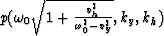 .The new field
  represents
a remapping of the original field .Each value in the new field with
coordinates
represents
a remapping of the original field .Each value in the new field with
coordinates  corresponds to the value
in the field with coordinates
corresponds to the value
in the field with coordinates
 .
.
The  remapping can be understood easier
if one takes the particular case ky=0.
The change of variable in (5) becomes
remapping can be understood easier
if one takes the particular case ky=0.
The change of variable in (5) becomes

![\begin{displaymath}
{\left[ {{d \omega} \over {d \omega_0}} \right]}=
{{\mid {{2...
...over v} \mid} \over
{\sqrt{{{4\omega_0^2} \over v^2}+k_h^2}}},\end{displaymath}](img33.gif)
 |
(10) |
 |
(11) |
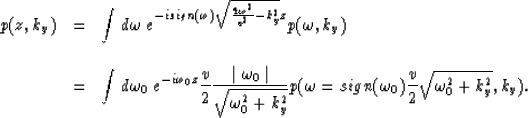
 . This similitude suggests the equivalent
formulation:
. This similitude suggests the equivalent
formulation:
 |
(12) |
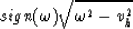
to get back the inverse Fourier transform
of the initial expression.
The integration in kh represents the inverse Fourier transform at zero offset (h=0). However because equation (12) actually performs summation along hyperbolas in the spatial coordinate h, replacing the integral in kh by the inverse Fourier transform will not return the constant-offset sections.
Applying the same technique to the case  I obtain
![\begin{displaymath}
p_0(t_0,k_y)=
\int dk_h \int d\omega \;
e^{-isign(\omega)
{\...
...h^2)^2-4\omega^2v_y^2})\right]}^{1\over2}t_0}
p(\omega,k_y,k_h)\end{displaymath}](img40.gif) |
(13) |
 with a new variable defined as
![\begin{displaymath}
\omega_0^2 = {1 \over 2}
\left [ {\omega^2+v_y^2-v_h^2 +
{\sqrt {(\omega^2+v_y^2-v_h^2)^2-4 \omega^2 v_y^2}}} \right ].\end{displaymath}](img42.gif) |
(14) |