


In this section we demonstrate the sensitivity of the AVO coefficient
derived from the vertical and radial particle motion
to variations in P-wave and S-wave velocity. As before, one of the
velocities was varied by  100 m/s, while the other was kept
constant. A similar study has
been performed by Amundsen and Reitan Amundsen and Reitan (1994).
100 m/s, while the other was kept
constant. A similar study has
been performed by Amundsen and Reitan Amundsen and Reitan (1994).
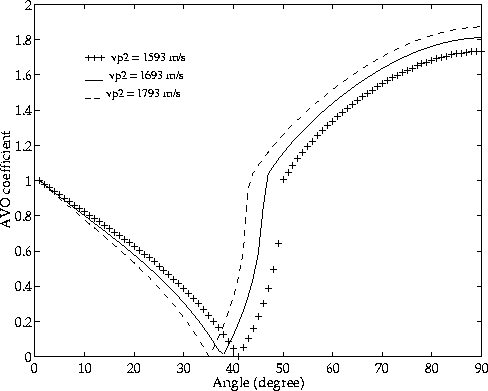
Figure 4 shows the sensitivity of the AVO coefficient to variations in the P-wave velocity. There is a significant sensitivity to changes in vp at all angles of incidence. The higher the P-wave velocity, the smaller the angle at which the AVO coefficient reaches its minimum value of zero and the smaller the critical angle (R=1).
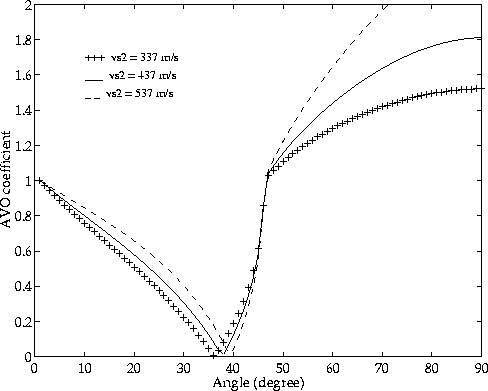
In Figure 5 we show the sensitivity of the AVO coefficient to variations in the S-wave velocity. At post-critical angles of incidence, there is a significant sensitivity to changes in vs. The higher the S-wave velocity the smaller the AVO coefficient. There is also a considerable dependence on the S-wave velocity at pre-critical angles of incidence. Close to the critical angle, however, the AVO coefficient barely changes with variations in the S-wave velocity. This is due to the fact that R is independent to vs2 at the critical angle.
|
ref2p
Figure 4 AVO coefficient for P velocity variations of 100 m/s.
|  |

|
ref2s
Figure 5 AVO coefficient for S velocity variations of 100 m/s.
|  |
Since the AVO coefficient is significantly sensitive to both P- and S-wave velocity before the critical angle, both parameters can be estimated for relatively small angles of incidence. However, it has to be taken into account that the radial velocity component will vanish at very small angles of incidence. Thus, the angular coverage should not be too small.