


 are only functions of the image point coordinates
  and of the midpoint coordinates of the data trace
  .
.
The first condition for linking
image aliasing to operator aliasing
is that the data are not spatially aliased,
and thus the operator anti-aliasing constraints
are the ones expressed in equation (3),
and not
the constraints expressed in equation (5).
Comparing the constraints for operator anti-aliasing
[equation (3)]
with the constraints for image anti-aliasing
[equation (2)]
we can easily notice that a necessary condition
for them being uniformly equivalent
is that the data sampling rates
 and
and  must be equal to the image sampling rates
 and
and  .The other necessary conditions are that
 and
and
 .These conditions are fulfilled in the
important case of spatially invariant imaging operators,
as it can be shown by
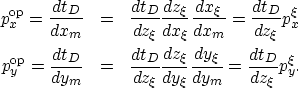
applying the chain rule to the derivative
of the summation surfaces tD
with respect to the midpoint coordinates of the data trace
:
.These conditions are fulfilled in the
important case of spatially invariant imaging operators,
as it can be shown by
applying the chain rule to the derivative
of the summation surfaces tD
with respect to the midpoint coordinates of the data trace
:
 |
||
| (6) |
The distinction between operator aliasing and image aliasing can thus be safely ignored when time migrating well sampled zero-offset data Bevc and Claerbout (1992); Claerbout (1995); Lumley et al. (1994), but it ought be respected when depth migrating irregularly sampled prestack data. This distinction is also important when a priori assumptions on the dips in the data permit setting less stringent operator anti-aliasing constraints, and thus the reflectors can be imaged with high-resolution and without operator-aliasing artifacts.
An open, and more subtle, question remains regarding the operator aliasing of prestack data, that in general do not constitute a minimal data set Padhi and Holley (1997). However, also in this case the constraints to avoid image aliasing [equation (2)] must be respected to produce high-quality and interpretable images.